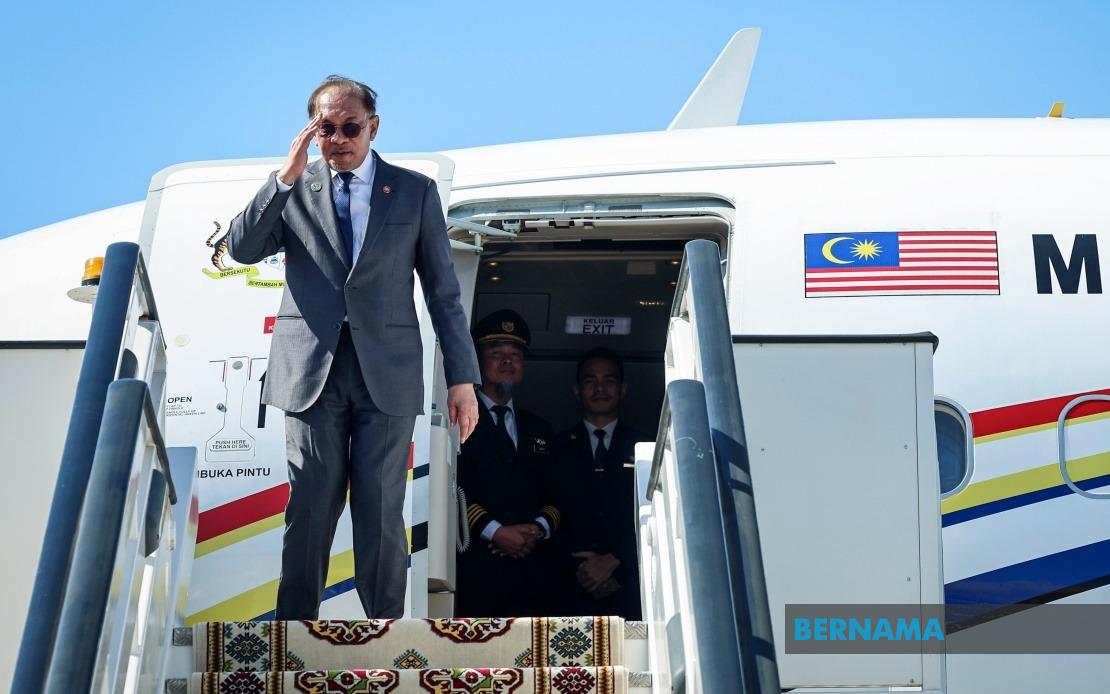
Prime Minister Datuk Seri Anwar Ibrahim touched down in Penang on June 20 after completing his official visit to Turkmenistan, launching into an intensive one-day schedule featuring major economic announcements and celebrations honouring Malaysia's media sector. The compressed itinerary underscores the government's focus on balancing diplomatic engagement abroad with domestic economic development and recognition of professional achievement at home.
The Prime Minister's aircraft departed Ashgabat International Airport at 4.45 pm local time, arriving in Penang to commence a series of high-profile engagements. His stop in the northern state forms part of a broader regional tour that included the 35th ASEAN-Russia Commemorative Summit in Kazan, Russia, held earlier in the week alongside Investment, Trade and Industry Minister Datuk Seri Johari Abdul Ghani and Economy Minister Akmal Nasrullah Mohd Nasir.
The Turkmenistan leg of Anwar's journey represented historic ground, marking his debut visit to the Central Asian nation since assuming office as Malaysia's 10th Prime Minister in November 2022. The two-day official visit, which commenced on June 18, came at the invitation of President Serdar Berdimuhamedov and signals Malaysia's intention to deepen ties with energy-rich nations beyond traditional trading partners. For Malaysia's burgeoning interests in Central Asian markets and resources, such high-level engagements carry symbolic and substantive weight in establishing channels for future cooperation.
Back on domestic soil, Anwar's immediate priority was the official opening of MKS Instruments Malaysia Sdn Bhd at Bandar Cassia Technology Park in Batu Kawan at 11 am. The facility represents the kind of high-technology manufacturing investment that the government seeks to attract to Malaysia's industrial corridors, particularly in the northern region where competition from Thailand and Vietnam remains intense. MKS Instruments, a precision technology manufacturer, brings advanced capabilities to Malaysia's semiconductor and industrial equipment ecosystem.
Following the factory inauguration, the Prime Minister moved to Bandar Setia Fontaines for the groundbreaking ceremony of the Setia Fontaines Industrial Park, scheduled for 1 pm at the Setia Experience Centre in Kepala Batas. This development project carries particular significance for the Northern Corridor economic initiative, a long-standing government priority aimed at spurring balanced regional growth. The industrial park framework allows property developer Setia to contribute meaningfully to Penang's manufacturing base while driving residential and commercial integration—a model increasingly adopted across Malaysian states seeking to diversify beyond single-industry reliance.
During the Setia Fontaines groundbreaking, the developer announced two additional strategic collaborations within the township, though specific details were not disclosed in initial announcements. Such partnerships typically involve logistics providers, utility operators, or complementary industrial service companies designed to create an ecosystem supporting anchor tenants and smaller manufacturers. The approach reflects contemporary thinking about industrial parks as integrated communities rather than simple landlord-tenant arrangements.
The centrepiece of Anwar's Penang schedule was attendance at the National Journalists' Day (HAWANA) 2026 Grand Finale at PICCA Convention Centre @ Butterworth Arena at 3 pm. The event drew approximately 1,000 media practitioners from Malaysia and international locations, transforming Penang into a gathering point for the nation's journalism sector. HAWANA, organised by the Communications Ministry with Bernama as implementing agency, functions as the premier annual recognition platform for media professionals, celebrating their contributions to public discourse and democratic accountability.
At the HAWANA ceremony, Anwar presented both the HAWANA Award and Special HAWANA Award to individuals and organisations deemed to have advanced journalism and shaped public understanding through dedicated reporting and editorial leadership. Beyond individual recognition, the Prime Minister distributed contributions from Tabung Kasih@HAWANA, a support mechanism assisting media practitioners facing financial hardship. This dual recognition—celebrating excellence while providing welfare support—reflects government acknowledgement that journalism's economic sustainability remains fragile across traditional and digital platforms.
The HAWANA platform carries particular relevance in contemporary Malaysia, where questions about media freedom, editorial independence, and the industry's financial viability intersect with broader conversations about democratic health. Government participation, symbolised by the Prime Minister's attendance and award-giving role, signals institutional validation of journalism's social contribution at a time when media organisations navigate economic pressures and evolving audience consumption patterns. The presence of international delegates suggests deliberate efforts to position Malaysian journalism within regional and global professional networks.
Anwar's packed Penang schedule reflects a governing pattern emphasising simultaneous attention to economic development initiatives and civil society engagement. The progression from factory opening through industrial park groundbreaking to journalists' recognition demonstrates an attempt to address multiple constituencies—manufacturing investors, development companies, workers, and knowledge professionals—within compressed timeframes and geographic proximity. Such intensity also underscores the demanding physical and political schedules that senior government figures maintain across Malaysia's distributed economic centres.
Following completion of his Penang engagements, the Prime Minister was scheduled to proceed to Negeri Sembilan for the Himpunan Pertubuhan Lima Generasi (PLG) Malaysia dinner that evening, extending his multi-day circuit across regional diplomatic, economic, and civic engagements. The cumulative effect of these movements—from Central Asia through northern Malaysia and onward to central regions—illustrates the sprawling nature of contemporary governance, where prime ministerial time becomes stretched across competing domestic and international priorities.

