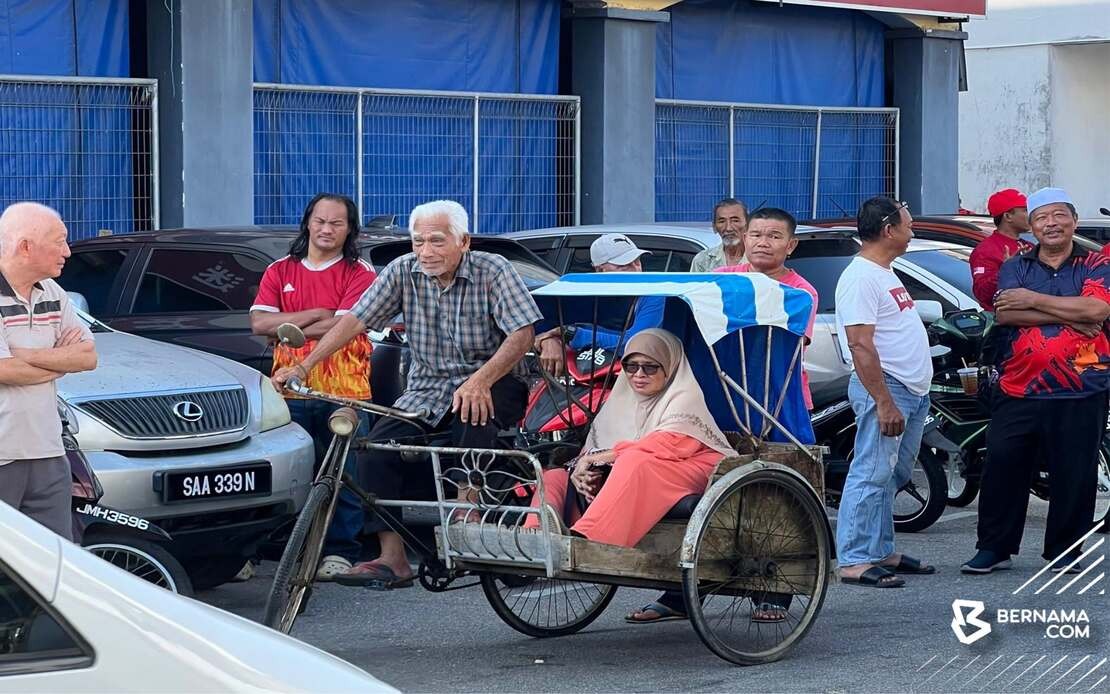
Prime Minister Datuk Seri Anwar Ibrahim has publicly acknowledged the heartfelt gesture of an elderly couple from Kampung Parit Bugis in Johor, after the husband made an extraordinary effort to fulfill his wife's wish of glimpsing the nation's leader. The incident, which took place during Anwar's campaign visit to the Senggarang constituency in Batu Pahat, has resonated as a touching moment that reflects the deep connections between ordinary Malaysians and their political leaders.
Abdul Razak Pelangga, aged 86, made the decision to transport his 64-year-old wife, Jamilah Samsudin, by trishaw across nearly a kilometre from their residential area to Kedai Kopi Hailam Sri Medan in the town centre. Having learned the previous day that Anwar would be stopping for breakfast at this particular eatery as part of his Johor State Election campaign activities, the elderly man seized the opportunity to grant his wife's desire to see the Prime Minister in person. Despite having access to motorised transport options—including both a car and motorcycle—Abdul Razak deliberately chose the trishaw, calculating that such a vehicle would be easier to manoeuvre and park in the small town's congested streets.
The decision to use the trishaw was particularly significant given Abdul Razak's age and the physical exertion required to pedal the traditional three-wheeled vehicle. As an imam at Masjid Raudhatul Jannah Parit Bugis, he is a respected figure within his community, and his willingness to undertake this personal journey underscores the value he placed on honouring his wife's wishes. The couple's actions exemplify a form of grassroots connection to national leadership that transcends formal political structures and speaks to the human dimensions of democratic participation in Malaysia.
However, the couple's careful planning and journey proved bittersweet. When Anwar arrived at the eatery for his scheduled breakfast meeting and community engagement programme, he did not encounter Abdul Razak and Jamilah among the residents he met. The couple thus missed the direct interaction they had travelled to secure, a disappointment that Anwar himself recognised and addressed in his subsequent public response.
Recognising the effort involved, Anwar took to Facebook to express his sincere appreciation for the couple's gesture and their dedication, even though the hoped-for face-to-face meeting did not materialise. In his message, the Prime Minister apologised for the missed opportunity and assured the couple that such an encounter would eventually occur. His response conveyed genuine warmth and acknowledgment of the sacrifice the elderly couple had made, suggesting that missed moments during campaign schedules do not diminish his awareness of individual supporters' commitment.
Anwar's public statement carried both personal warmth and spiritual sentiment. He extended wishes for the couple's health and wellbeing, invoking Islamic blessings upon them for their encouragement and support. This approach resonates strongly within Malaysia's Muslim-majority context and demonstrates how political figures can acknowledge constituent devotion in culturally appropriate ways. The use of Islamic phraseology also reflects Anwar's position as a senior Muslim politician whose words carry weight within religious and communal contexts.
The incident offers a window into Malaysian political culture during election periods, when national leaders embark on extensive campaign tours across constituencies to build momentum and connect with voters. The Johor State Election, which prompted Anwar's visit to Senggarang, represents a significant political contest, and such ground-level interactions—whether successful meetings or near-misses like the one involving Abdul Razak and Jamilah—form part of the campaign narrative.
For ordinary Malaysians, particularly in smaller towns like Batu Pahat, such visits represent rare opportunities for direct exposure to national leadership. The willingness of an 86-year-old man to pedal a trishaw for such an encounter speaks to how much such moments matter to citizens, especially those in less-urbanised areas who may feel geographically distant from the corridors of power. The trishaw itself carries symbolic weight as a traditional mode of transport increasingly rare in modern Malaysia, suggesting a connection between heritage, community, and civic engagement.
Anwar's prompt and gracious response to the situation, rather than simply proceeding with his schedule, demonstrates political awareness of how constituent stories gain traction and shape public perception. By publicly acknowledging the couple and their effort, he transforms a missed encounter into a meaningful political moment that circulates through social media and news cycles, ultimately reaching audiences far beyond Batu Pahat.
The broader significance of this incident extends to how Malaysian political leaders balance formal campaign schedules with the spontaneous human connections that voters seek. In an era of increasingly managed political communication, the genuine emotion and effort evident in Abdul Razak and Jamilah's journey stands out as an authentic expression of democratic participation. Their story reinforces that for many Malaysians, engaging with national politics remains a personal and emotional endeavour rather than a purely transactional one.
Looking forward, Anwar's promise that the couple will meet another time carries weight both as a personal commitment and as a political signal. Whether such a meeting materialises, the incident has already cemented the couple's place in a particular narrative about Malaysian political life—one where an octogenarian's determination to honour his wife's wish becomes a moment worthy of a Prime Minister's public gratitude and blessing.

