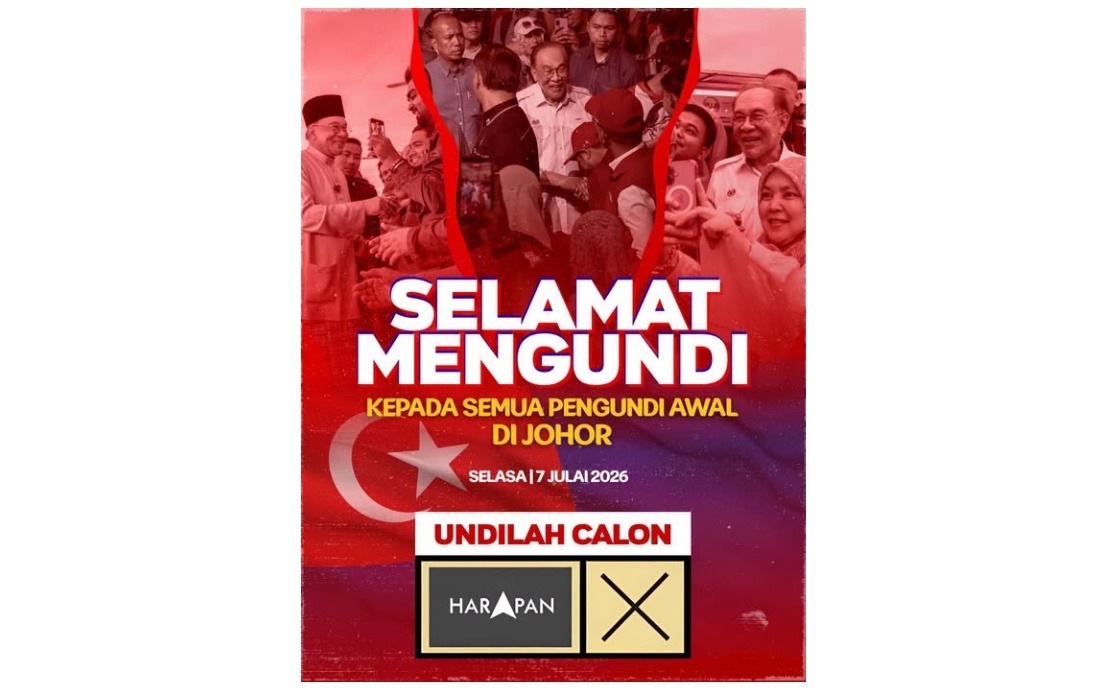
Prime Minister Datuk Seri Anwar Ibrahim has made a direct appeal to early voters in the 16th Johor state election, urging them to back Pakatan Harapan candidates in pursuit of a brighter future for the southern state. In a Facebook message on July 7, Anwar, who also chairs the ruling coalition, extended his wishes to all eligible voters participating in the early polling phase, framing the election as a critical opportunity for Johorians to shape their state's trajectory.
The early voting round saw 24,751 eligible voters head to the polls across 64 designated centres throughout Johor on that day. This preliminary voting phase is specifically designed to accommodate those whose official duties or military service prevent them from voting on the main election day scheduled for Saturday. The arrangement reflects Malaysia's electoral system's recognition that uniformed personnel, including military and police officers, often face deployment or duty constraints that would otherwise disenfranchise them during standard voting periods.
The composition of early voters reveals the significant proportion of security personnel participating in the exercise. Among the 24,751 early voters, 12,041 comprised Malaysian Armed Forces personnel and their spouses, while the remaining 12,710 consisted of Royal Malaysia Police and General Operations Force members along with their family members. This breakdown underscores how Malaysia's electoral framework prioritises ensuring that those in uniform and their immediate families can exercise their democratic rights despite their professional commitments to the nation.
Polling logistics for the early voting phase were carefully coordinated across the state. The 53 polling centres designated for police and civil security forces opened simultaneously at 8 am, while 11 additional centres served military voters. Closing times were staggered between noon and 6 pm depending on each location's specific circumstances and the number of registered voters present, allowing flexibility in the voting process while maintaining operational integrity.
Pakatan Harapan is contesting all 56 available state seats in Johor, fielding a balanced slate of candidates drawn from its three component parties. The coalition nominated 20 candidates from the People's Justice Party (PKR), 19 from the National Mandate Party (Amanah), and 17 from the Democratic Action Party (DAP). This distribution reflects an established formula within the coalition that balances representation and reflects each partner's organisational strength and electoral viability across different constituencies.
The broader election environment encompasses significantly greater participation than early voting alone. The 16th Johor state election has attracted 172 candidates competing across all seats, reflecting intense competition among various political coalitions vying for control of the state assembly. With approximately 2.7 million registered voters preparing to cast their ballots during the main polling day, the election represents one of Malaysia's most substantial electoral exercises in recent years and carries major implications for the political landscape in one of the country's most economically significant states.
Anwar's public appeal to early voters carries symbolic weight within Malaysia's political context. As both Prime Minister and Pakatan Harapan chairman, his intervention in the Johor campaign underscores the coalition's investment in retaining control of the state government. Johor holds substantial strategic importance within Malaysian politics, serving as a crucial economic hub and home to a large electorate whose voting patterns often influence national political dynamics. The state's government determines resource allocation, development priorities, and governance approach affecting over 4 million residents.
The Prime Minister's messaging emphasised continuity and progress, framing a Pakatan Harapan victory as essential for Johor's development. His call for voters to "choose Harapan candidates for a better future" connects the election directly to broader narratives about economic management, social policy, and governance quality that the coalition has championed. For early voters in particular—predominantly composed of security personnel whose responsibilities include national stability—the appeal to vote for improved state governance carries additional resonance around institutional effectiveness and public administration standards.
The timing of early voting in the election cycle serves practical and democratic functions simultaneously. By allowing military and police personnel to vote several days before the general election, Malaysian electoral authorities acknowledge that these groups' professional duties sometimes necessitate special arrangements. This approach has become standard practice in Malaysian elections, reflecting a compromise between security establishment needs and democratic participation principles. Early voting data also provides initial indicators of voting patterns, though results remain sealed until the main polling period concludes.
For Pakatan Harapan specifically, the Johor election represents a significant test of its ability to maintain state-level support and deliver on governance promises. The coalition has controlled Johor since 2018, and losing the state would represent a meaningful political setback. Conversely, retaining or expanding the coalition's representation would validate its approach to state administration and suggest continued voter confidence in its leadership direction across different regions of Malaysia.
The broader implications of the Johor election extend beyond the state itself. As one of Malaysia's most substantial states by economy and population, Johor's political direction influences national-level calculations about coalition viability and electoral momentum. Results will likely shape perceptions about the strength of Pakatan Harapan's brand and its resilience in defending territory against opposition parties, particularly the Perikatan Nasional coalition and United Malays National Organisation, which have mounted serious challenges in recent state elections across Malaysia.

