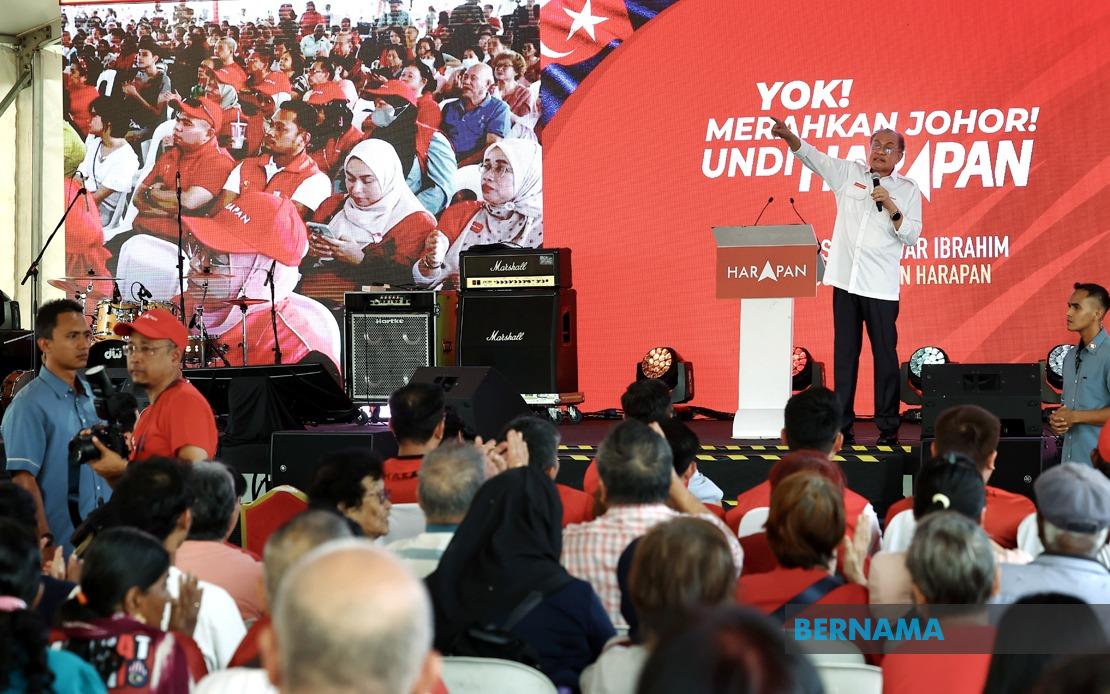
Prime Minister Datuk Seri Anwar Ibrahim has called on all political parties competing in the Johor state election to refrain from weaponising the issue of Datuk Seri Najib Razak's prison sentence for electoral advantage, arguing that such tactics distract from pressing governance priorities. Speaking at a campaign event in Kulai, the PM stressed that with Najib currently incarcerated, the focus should shift toward meaningful policy discussions centred on protecting citizens' economic wellbeing and stabilising the nation's finances.
Anwar's plea reflects growing frustration within the government coalition about the persistent politicisation of the 1MDB scandal, which continues to dominate opposition rhetoric nearly five years after Najib's initial conviction in July 2020. The former prime minister's case remains emblematic of Malaysia's grappling with high-level corruption, yet Anwar contends that perpetual campaign invocations of his detention serve no constructive purpose when substantive fiscal challenges demand immediate attention.
The RM51 billion 1MDB debt inherited by successive administrations represents a tangible constraint on public investment that extends far beyond symbolic political scoring. Anwar articulated this reality bluntly, noting that funds currently diverted toward servicing this colossal liability could otherwise enhance educational infrastructure, healthcare systems, transportation networks, and social safety nets for vulnerable populations. The opportunity cost of misappropriated wealth becomes starker when measured against unmet needs in schools, clinics, and communities across Malaysia.
This intervention during the Johor campaign period underscores divisions within the nation's political landscape regarding how historical wrongs should be addressed versus transcended. Opposition parties have traditionally leveraged Najib's conviction as evidence of systemic rot under previous Barisan Nasional governance, positioning their candidates as agents of renewal and accountability. Conversely, Anwar's messaging suggests that dwelling excessively on the former premier's predicament risks exhausting voter patience and obscuring genuine policy differences between contenders.
The timing of Anwar's remarks carries additional significance given that Johor has historically served as the Barisan Nasional's electoral stronghold. By encouraging candidates from all sides to elevate discourse beyond personalised attacks, the PM may be attempting to consolidate support for Pakatan Harapan by demonstrating maturity and forward-thinking governance. The presence of Youth and Sports Minister Mohammed Taufiq Johari, Deputy Investment, Trade and Industry Minister Sim Tze Tzin, and Pakatan Harapan's Bukit Batu candidate Arthur Chiong Sen Sern at the Yok! Merahkan Johor! Undi Harapan event reinforced the coalition's determination to compete substantively on developmental records.
For Malaysian voters, particularly those fatigued by corruption narratives that feel perpetually recycled without resolution, Anwar's intervention signals a deliberate repositioning of the political conversation. Rather than rehashing Najib's legal battles, this approach implicitly acknowledges that public expectations have evolved toward tangible improvements in service delivery, job creation, inflation management, and sectoral competitiveness. The 1MDB debt burden, while historical in origin, remains acutely present in budgetary constraints that affect current and future generations.
Regionally, Malaysia's experience mirrors broader Southeast Asian struggles with legacy corruption cases intersecting contemporary governance challenges. Countries throughout the region have grappled with how to balance accountability mechanisms against the imperative to move forward economically. Anwar's framing suggests recognition that repeated references to past malfeasance, while necessary for establishing institutional integrity, cannot substitute for demonstrable progress in managing present-day economic headwinds, currency volatility, and sectoral disruptions affecting ordinary Malaysians.
The challenge facing opposition parties responding to Anwar's directive lies in distinguishing between legitimate historical accountability and electoral opportunism. Critics might argue that abandoning discussion of systemic corruption enables normalisation of wrongdoing, yet the PM's counterargument—that resources spent pursuing symbolic political victories over imprisonment discussions represent opportunity costs to actual governance—carries weight for pragmatically minded constituents. This tension will likely define campaign rhetoric throughout the Johor contest.
Moving forward, the success of Anwar's appeal depends substantially on whether other political actors embrace his invitation to elevate campaign substance. Should candidates across the spectrum accept this implicit truce on Najib-centric messaging, Johor voters may encounter elections genuinely focused on comparative development visions, economic management philosophies, and social spending priorities. Conversely, if opposition figures continue deploying imprisonment references as shorthand for Barisan Nasional culpability, the PM's intervention may prove merely symbolic, revealing persistent reluctance among some quarters to compartmentalise historical grievances from present political competition.

