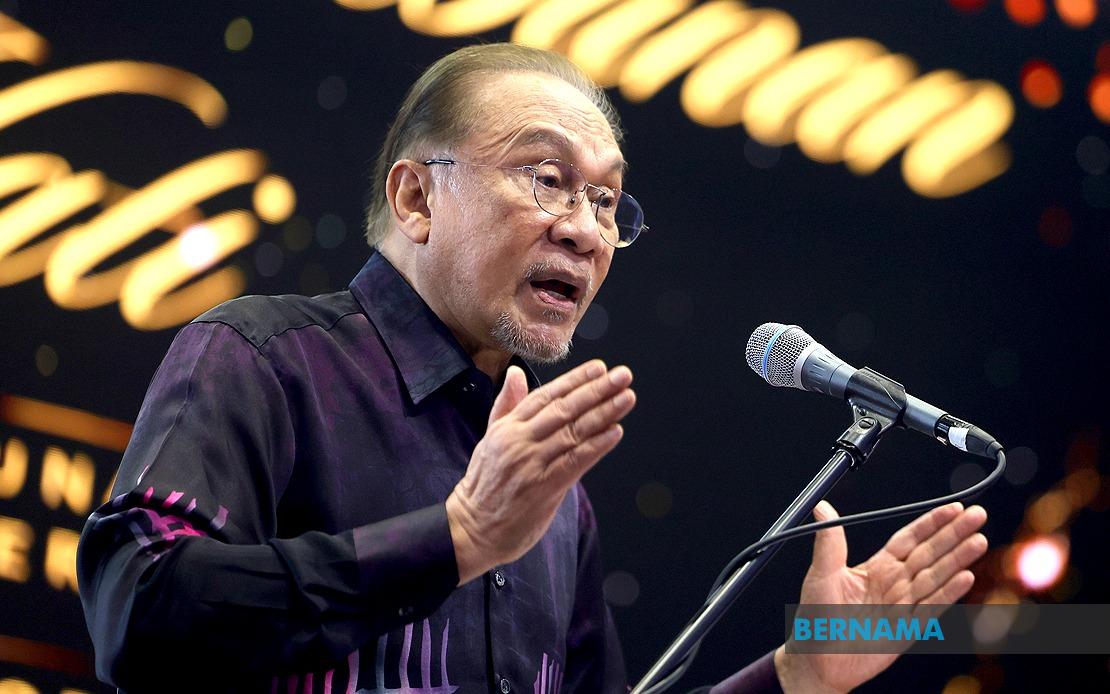
Prime Minister Datuk Seri Anwar Ibrahim has issued a forthright call for Malaysians to stand united against the spread of racial animosity, warning that some political actors deliberately seek to sow discord among the nation's diverse ethnic communities. Speaking at a dinner event organised by Pertubuhan Lima Generasi (PLG) Malaysia in Seremban on June 20, Anwar emphasised that divisive messaging threatens to undermine Malaysia's fundamental strength as a multiethnic nation.
The prime minister articulated a vision of national cohesion grounded in the recognition that Malaysia's ethnic diversity represents a considerable asset rather than a liability. He stressed that this advantage can only be sustained when underpinned by genuine mutual respect and substantive cooperation across community lines. His remarks directly addressed what he characterised as a troubling pattern of deliberate divisiveness, where certain leaders deliberately weaponise ethnicity as a tool to generate enmity among Malaysians.
Anwar singled out the inflammatory nature of some political rhetoric, which frames interethnic relations as zero-sum competition. He rejected the narrative that seeks to position Malays against Chinese, Chinese against Indians, and Indians against Malays, framing such divisive framing as fundamentally antithetical to Malaysia's interests. The prime minister called on Malaysians to transcend such narrow tribal thinking and recognise the collective interest in maintaining social peace and institutional stability.
In constructing his argument for unity, Anwar invoked the contemporary reality of Malaysian multiethnic cooperation. He highlighted that across the country, Malays, Chinese, Indians, Kadazans and members of other communities currently function as a unified force working towards common national objectives. This characterisation challenges the premise underlying divisive rhetoric, demonstrating through existing evidence that meaningful interethnic collaboration represents the practical baseline of Malaysian society rather than an aspirational ideal.
The event itself reflected the collaborative spirit Anwar advocated. More than 1,000 PLG members attended the gathering, which also included Negeri Sembilan Menteri Besar Datuk Seri Aminuddin Harun, underlining the participation of representatives across different levels of government and civil society in affirming the message of national unity. The presence of state-level leadership alongside the prime minister signalled institutional reinforcement of the unity agenda from multiple governance levels.
For Malaysian readers, Anwar's remarks carry particular significance given the country's history of periodic communal tensions and the recurring emergence of political actors seeking short-term electoral advantage through identity-based mobilisation. The prime minister's explicit identification of divisive rhetoric as a deliberate strategy employed by certain leaders suggests an administrative commitment to countering such narratives through positive messaging about interethnic cooperation and shared national purpose.
The timing of these comments reflects ongoing concerns about political discourse in the lead-up to potential electoral contests and governance transitions. By publicly and forcefully rejecting racial divisiveness at a high-profile community gathering, Anwar positioned the government as the custodian of national unity against forces he characterised as intent on fragmentation. This framing carries implications for how political competition unfolds and the normative boundaries within which electoral campaigns are conducted.
The speech also illuminates the philosophical framework underpinning Anwar's approach to governance. Rather than viewing ethnic diversity as a problem requiring management through segregation or hierarchical arrangements, he articulates a vision where diversity strengthens the nation through enhanced social capital and broader talent pools. This conception stands in contrast to identity-based political strategies that emphasise communal separation and zero-sum resource allocation.
For Southeast Asian observers, Malaysia's experience with managing multiethnic societies offers instructive lessons. The region contains numerous nations confronting similar challenges of sustaining social cohesion amid ethnic, religious, and cultural diversity. Anwar's insistence that unity requires active reinforcement through positive interethnic engagement and rejection of divisive narratives reflects broader regional imperatives around conflict prevention and the construction of inclusive national identities.
The explicit condemnation of leaders who exploit racial divisions also raises questions about the mechanisms available to democratic governments for countering such rhetoric without breaching principles of free expression. Anwar's approach emphasises positive advocacy for unity and the articulation of alternative narratives rather than punitive measures, suggesting confidence in persuasive messaging to counter divisive discourse among the Malaysian electorate.
Looking forward, the government's emphasis on unity through interethnic cooperation may influence how subsequent policy initiatives are framed and justified. Development programmes, economic opportunities, and social initiatives may increasingly be presented as vehicles for collaborative advancement rather than as mechanisms favouring particular communities. This rhetorical strategy reflects recognition that governance legitimacy increasingly rests on demonstrated ability to deliver public goods and manage diversity equitably.

