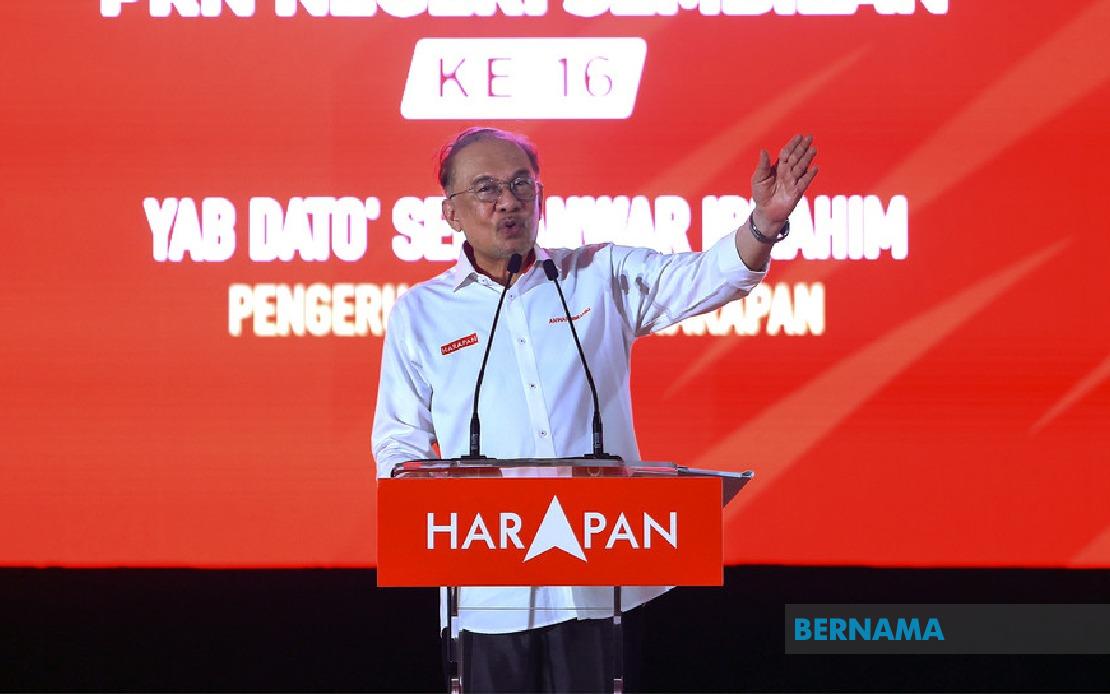
Prime Minister Datuk Seri Anwar Ibrahim has made a direct appeal to Negeri Sembilan voters to maintain their support for Pakatan Harapan (PH) in the state election scheduled for 1 August, framing the vote as essential to preserving the development trajectory achieved over the past six years. Through a social media address released in Seremban, the PH chairman stressed that political continuity remains vital for delivering the infrastructure and service improvements that residents expect, cautioning against disrupting programmes already underway.
The timing of Anwar's intervention reflects the strategic importance of Negeri Sembilan to the ruling coalition's broader political standing. As PH chairman coordinating federal and state-level governance, Anwar has positioned the state election as a referendum on the coalition's administrative competence and commitment to fulfilling electoral promises. His emphasis on partnership between the state government under Menteri Besar Datuk Seri Aminuddin Harun and federal authorities underscores how modern Malaysian governance often depends on alignment across multiple tiers of administration to execute complex policy agendas.
Aminuddin Harun, commonly known as Tok Min, has led Negeri Sembilan since 2018 when PH first came to power federally. Anwar's characterisation of his tenure as marked by "integrity, humility and a strong sense of responsibility" represents an attempt to humanise political leadership and differentiate PH candidates from potential opposition challengers. The invocation of these qualities suggests PH intends to contest the election partly on grounds of personal credibility and ethical governance rather than policy platforms alone.
The substance of Anwar's message centres on accumulated development gains that PH claims would be jeopardised if voters opted for change. The Prime Minister references "numerous development projects" implemented through cooperation between state and federal machinery, though he does not enumerate specific initiatives. For Malaysian voters, particularly in smaller states like Negeri Sembilan where development priorities might include infrastructure connectivity, healthcare access, and educational facilities, the appeal to maintain momentum carries weight if projects visibly affect daily life. However, the lack of concrete detail may leave some constituencies uncertain about tangible benefits received.
The electoral timeline shapes the urgency of Anwar's appeal. Nominations occur on the Saturday following his statement, with early voting scheduled for 28 July and the main polling day on 1 August, providing opposition parties and independent candidates less than two weeks to mount organised campaigns once nominations close. This compressed schedule arguably favours the incumbent administration, which benefits from established machinery, media familiarity, and the ability to point to projects already completed or nearing completion.
For Southeast Asian observers tracking Malaysian political dynamics, Anwar's intervention illustrates how federal prime ministers increasingly engage in state-level elections despite the constitutional separation between state and federal politics. This blurring of boundaries reflects both the interconnected nature of policy implementation across governance tiers and the electoral mathematics that national coalitions employ to consolidate parliamentary majorities. A loss in Negeri Sembilan could weaken PH's legislative strength and embolden critics questioning the coalition's effectiveness.
The religious language employed by Anwar—phrases like "Alhamdulillah" and "Insya-Allah"—reflects cultural conventions in Malaysian political communication and may resonate particularly with voters for whom Islamic values inform political preferences. By framing development and governance within an explicitly faith-conscious narrative, the PM appeals to constituencies that prioritise moral and ethical dimensions of leadership alongside material progress.
Negeri Sembilan's economy relies substantially on manufacturing, palm oil-related industries, and small and medium-sized enterprises, sectors that have experienced volatility in recent years due to global commodity price fluctuations and supply chain disruptions. Voters in these communities likely prioritise policies addressing employment stability, business support, and cost-of-living pressures. Anwar's appeal emphasises stability and continuity rather than proposing transformative economic policies, suggesting PH's campaign strategy aims to consolidate existing support rather than pursue major ideological repositioning.
The outcome in Negeri Sembilan will carry symbolic weight beyond the state's borders. As a bellwether for national sentiment, the election results could influence how Malaysian politicians assess voter appetite for the current federal administration heading toward the next general election, anticipated within the next two years. Significant gains or losses by PH could either affirm the coalition's resilience or signal softening public confidence, with implications for coalition stability and policy direction across the region's largest economy.
Anwar's call for voters to prevent development "coming to a halt halfway" reflects an implicit acknowledgment that completed projects alone may not guarantee political support; citizens increasingly evaluate governments on prospective benefits and economic opportunities rather than past achievements. The challenge facing PH in Negeri Sembilan thus extends beyond defending its record to convincing voters of a compelling vision for future development that addresses emerging challenges in a post-pandemic economic landscape where traditional growth drivers face transformation.

