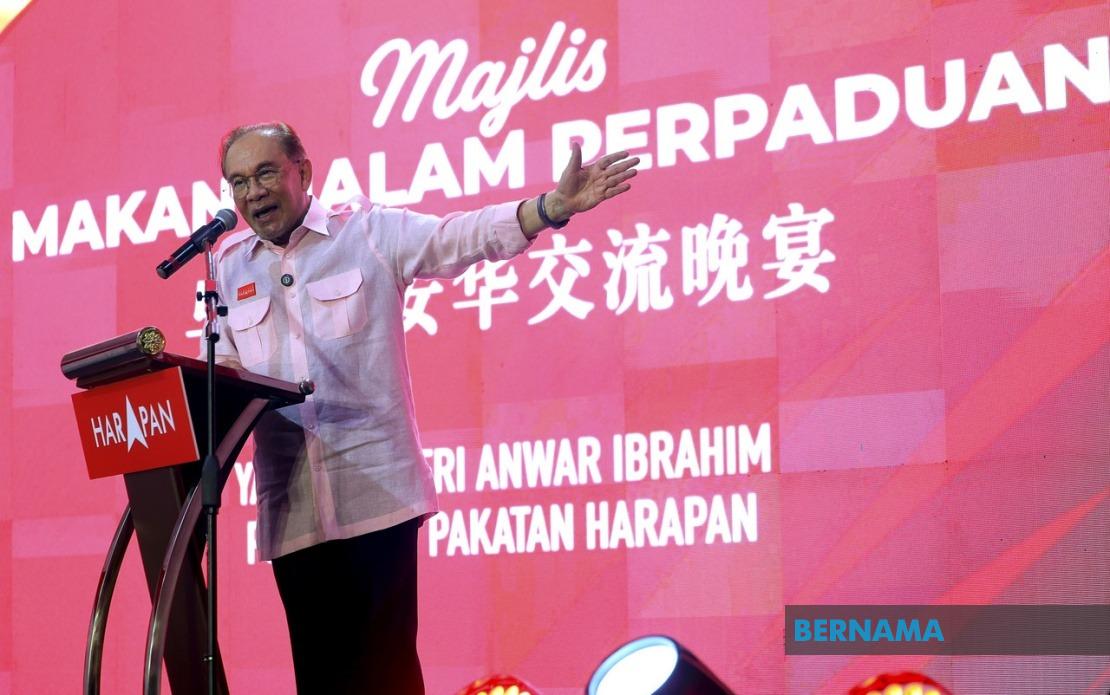
Prime Minister Datuk Seri Anwar Ibrahim has sought to capitalise on what he characterises as internal discord within the opposition ahead of the Negeri Sembilan state election, questioning the eagerness of rival parties to jostle for the menteri besar's post. Speaking at a 'Perpaduan' dinner in Sikamat on July 22, the Pakatan Harapan chairman drew a pointed contrast between what he depicted as the opposition's preoccupation with leadership positions and his coalition's purported commitment to governance centred on public service.
The prime minister's remarks appear designed to shift electoral focus away from policy differences and towards questions of political legitimacy and internal stability. By highlighting the scramble for chief ministerial office within opposition ranks, Anwar attempted to construct a narrative in which PH represents institutional cohesion and responsible leadership, whilst opposition parties are consumed by factional competition. This rhetorical strategy reflects a broader campaign approach aimed at persuading voters that capable administration should supersede partisan allegiances.
Anwar explicitly urged Negeri Sembilan voters to retain Datuk Seri Aminuddin Harun as menteri besar, framing the incumbent's tenure as evidence of effective state governance. The prime minister pointed to Aminuddin's administration as demonstrating integrity and freedom from corruption, presenting continuity as preferable to the uncertainties of transition. Aminuddin is contesting as the PH candidate for the Linggi seat, positioning him as both state leader and district representative.
The Pakatan Harapan coalition is mounting a comprehensive challenge in the August 1 election, fielding candidates across all 36 state seats. The distribution reflects established internal arrangements: PKR will contest 16 seats, DAP eleven, and Amanah nine. This allocation demonstrates the coalition's confidence in contesting comprehensively across the state, suggesting no uncontested seats or strategic concessions to rivals. Early voting is scheduled for July 28, with the main polling day four days later.
Beyond questions of internal opposition fragmentation, Anwar also addressed what he characterised as divisive racial narratives deployed by certain quarters during the campaign. The prime minister argued that such appeals to communal sentiment undermine the inclusive governance model that the Unity Government purports to champion. This criticism reflects ongoing tensions within Malaysian politics regarding the balance between community-specific advocacy and ostensibly colour-blind administration.
In response to such divisive rhetoric, Anwar reaffirmed the government's commitment to equitable resource distribution across all communities. He highlighted initiatives spanning socio-economic development, housing provision, and salary adjustments for civil servants as evidence of this inclusive approach. These programmatic commitments are presented not merely as welfare measures but as fundamental to a governance philosophy that explicitly rejects what the government frames as the racial tribalism of previous administrations.
The gathering in Taman Sri Penaga included other prominent PH figures contesting the election, amongst them Nor Azman Mohamad, the coalition's Sikamat candidate, and Datuk Muhammad Nazri Kassim, the Ampangan representative. The presence of such candidates alongside Anwar underscores the symbolic importance PH attaches to unified messaging in Negeri Sembilan, a state where the coalition has previously demonstrated electoral viability.
Negeri Sembilan presents a significant test for the Unity Government's electoral durability. As a state where PH has governed relatively successfully in recent years, a strong performance would reinforce narratives of governance competence. Conversely, any significant losses would invite questions about the coalition's capacity to sustain electoral support across Malaysia's diverse constituencies. The timing of the election, occurring as the federal government navigates economic challenges and ongoing debates about institutional reform, adds weight to the outcome.
The campaign dynamic evident in Anwar's remarks reveals how Malaysian electoral politics continues to operate at multiple registers simultaneously. Whilst policy differences exist between coalition and opposition parties, campaign messaging frequently pivots to questions of personality, institutional stability, and communal identity. Anwar's emphasis on opposition internal conflict rather than substantive policy critique suggests a campaign strategy that prioritises narrative advantage over detailed governance proposals, a pattern not unfamiliar in Malaysian politics but one that shapes how voters make electoral choices.
For Southeast Asian observers, the Negeri Sembilan election offers insights into how Malaysia's political system negotiates stability and change. The state election provides a relatively lower-stakes environment in which broader national political trends can be tested and adjusted before higher-stakes contests. The outcome may influence calculations within both government and opposition regarding their respective electoral viability heading towards the next federal general election.

