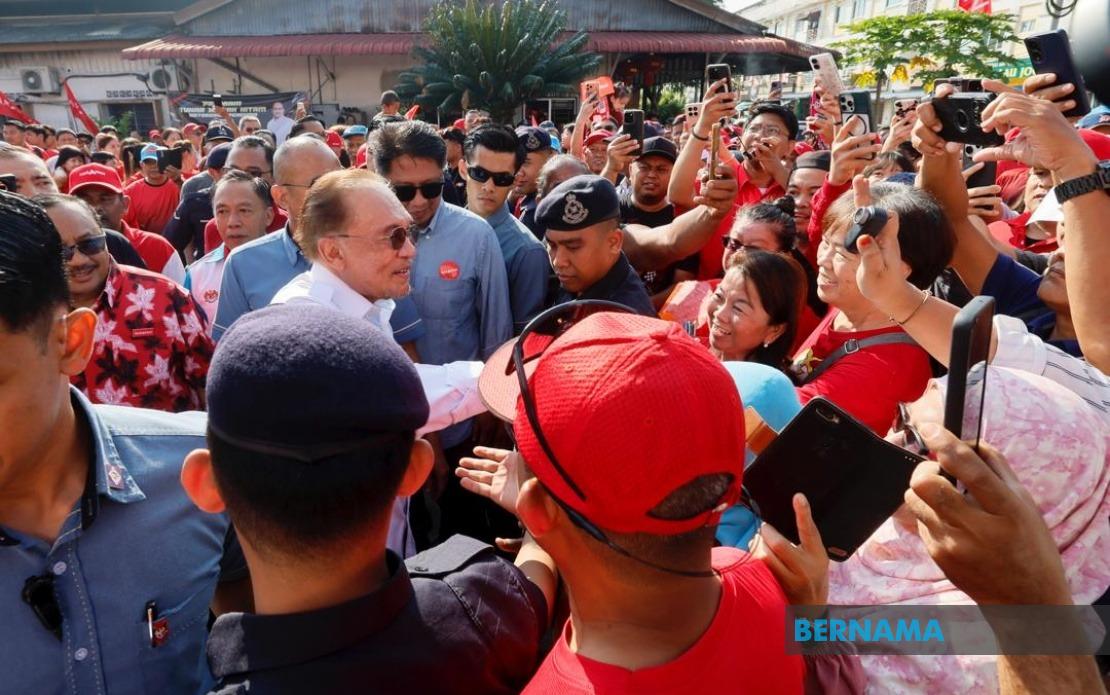
Prime Minister Datuk Seri Anwar Ibrahim's campaign appearance on the ninth day of hustings for the Johor state election has delivered a significant lift to the morale of Pakatan Harapan's campaign operations across the Machap and Layang-Layang state constituencies. The timing of his visit to the region comes as the alliance intensifies its push towards polling day on July 11, with a ground presence that the candidates believe underscores the gravity with which the coalition views the contest.
Nur Hafiz Roslan, Pakatan Harapan's contender for the Machap seat, highlighted how the Prime Minister's engagement transcended symbolic value. According to Nur Hafiz, Anwar's presence functioned as a rallying point for both campaign personnel and party volunteers, while simultaneously articulating the coalition's foundational message that all campaign activities must be anchored in genuine public service. The candidate emphasised that this framing represents a deliberate strategic choice in how Pakatan Harapan wishes to present itself to Johor voters during this election cycle.
During his interactions with the campaign teams, Anwar, who concurrently serves as PKR president, pressed home the importance of disciplined, conscientious effort. His emphasis on performing acts of righteous service reflected a particular rhetorical approach—one that seeks to elevate the campaign narrative beyond transactional politics and position the coalition's candidacies as motivated by ethical commitment to community welfare. This messaging, according to Nur Hafiz, resonated particularly strongly with those managing voter outreach in the Simpang Renggam parliamentary constituency and the adjacent state seats.
The Prime Minister's central argument to campaign workers centred on a distinction he sought to establish: that the coalition's presence in these constituencies is fundamentally constructive rather than divisive. By framing the campaign as an exercise in service provision without bias, Anwar attempted to position Pakatan Harapan as transcending the adversarial tone that sometimes characterises Malaysian electoral contests. For Nur Hafiz, this messaging shaped his own approach to community engagement, with the candidate pledging that any services his administration might deliver would remain impartial and comprehensive across all population segments.
Guna Balakrishnan, the Pakatan Harapan nominee for Layang-Layang, similarly attributed a strengthening of his ground efforts to the Prime Minister's visit. He noted that whilst community reception to his candidacy had already proven receptive, the Prime Minister's personal engagement provided additional impetus to deepen connections with residents. The intensity of voter contact, from Guna's perspective, cannot be assumed or merely maintained at existing levels but rather requires continuous escalation as election day approaches. This understanding reflects awareness within the campaign that enthusiasm must be translated into actual voting behaviour.
Guna also revealed that Anwar had impressed upon him the responsibilities incumbent upon a victorious candidate, framing electoral success as the beginning of an obligation to local development and community support rather than its conclusion. This framing serves a dual purpose within campaign strategy: it signals to voters that victory carries tangible developmental consequences, whilst simultaneously binding candidates to accountable performance metrics that could shape subsequent electoral cycles. For constituents evaluating their voting choices, such commitments carry weight in assessing whether candidates represent genuine commitments to local prosperity.
The campaign event itself, styled as 'PMX Santai Sarapan Bersama Masyarakat' (a casual breakfast gathering with the community), drew participation from more than one thousand Simpang Renggam residents. The format appears deliberately designed to project accessibility and informality—a strategic choice in how the Prime Minister presents himself to voters. By adopting a relaxed public demeanour during campaign engagement, Anwar sought to create an atmosphere of approachability rather than distance, a calculated element of campaign theatre that research suggests influences voter perception in Malaysian electoral contexts.
For Chuan Chee Mei, a 48-year-old resident of Simpang Renggam, the Prime Minister's personal attendance at community programming significantly influenced her voting intentions. Her observation that Anwar's wholehearted support for the nominated candidates created visible confidence in the campaign infrastructure suggests that high-level political engagement functions as a signal to voters about a candidate's viability and backing. In Malaysian electoral psychology, the presence of senior leadership often correlates with increased voter confidence in local candidates, as voters interpret such attention as an indicator of electoral competitiveness and candidate credibility.
Noor Takiyudin Salleh, aged 38, similarly credited the accessibility demonstrated during Anwar's campaign visit with reinforcing his intention to support Pakatan Harapan candidates. His characterisation of the Prime Minister's approach as notably relaxed and his impression of the large attendance figures suggest that the scale and atmosphere of campaign events communicates important information to voters about the coalition's momentum and community resonance. The reported presence of over one thousand participants created a visible manifestation of political support that attendees themselves absorbed and reinforced through their own social networks.
The Johor state election itself encompasses a competitive field, with 172 candidates contesting for 56 state assembly seats across the state. This level of candidate density reflects the stakes that multiple political factions perceive in the Johor contest. Early voting is scheduled for July 7, providing an opportunity for certain voters to cast ballots before the main polling day on July 11. The calendar structure creates an extended election period during which campaign momentum remains crucial, as early voting results can psychologically influence subsequent voters' behaviour.
For Pakatan Harapan, the Johor election represents a significant test of the coalition's capacity to consolidate electoral gains and extend its influence beyond the federal level into state governance. The Prime Minister's personal campaign engagement in constituencies like Machap and Layang-Layang underscores the coalition's assessment that these seats represent genuinely competitive contests warranting high-level political attention. Such visits communicate to voters that the coalition views their constituencies as valuable and within realistic reach, rather than marginal or surrendered territories.
The campaign dynamics in Johor also carry implications for broader Malaysian politics, as state-level electoral outcomes frequently shape perceptions about national political momentum. A strong showing would reinforce Pakatan Harapan's narrative of broad-based electoral support, whilst conversely, disappointing results could invite scrutiny regarding the coalition's governance performance and electoral viability. For political analysts observing Malaysian electoral trends, the Johor contest provides empirical evidence about voter sentiment and the effectiveness of different campaign strategies in contemporary Malaysian political competition.

