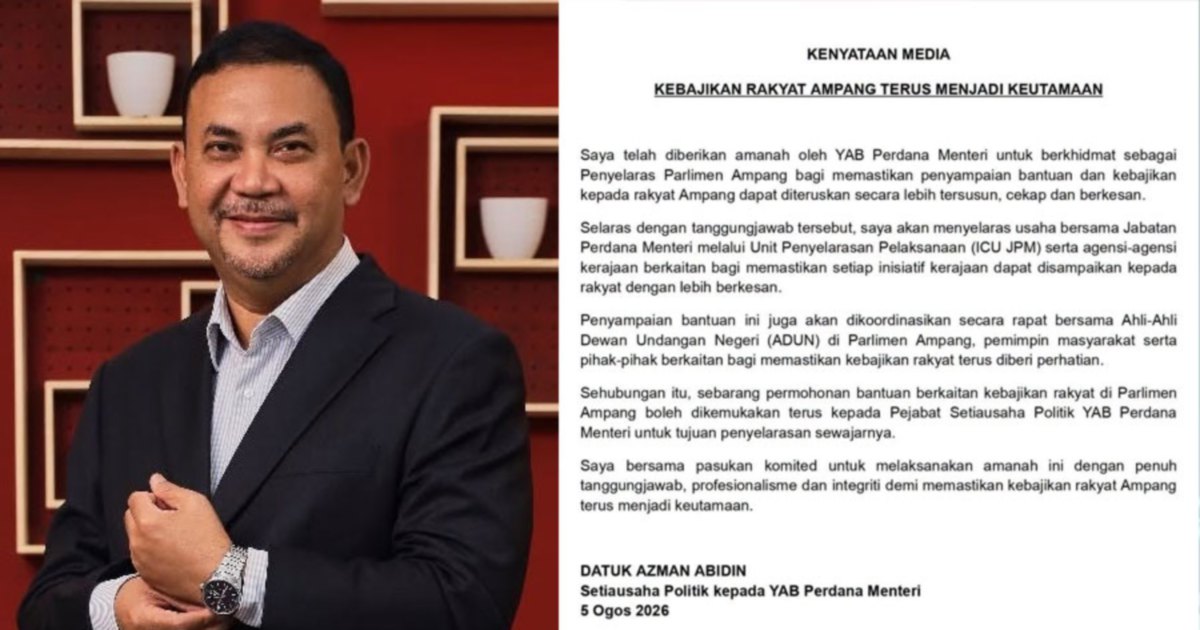
A political secretary working directly under Prime Minister Datuk Seri Anwar Ibrahim has taken on the role of parliamentary coordinator for Ampang, marking a significant development in the administration of the constituency following recent moves to restrict fund distribution authority. This appointment comes in the wake of a decision to suspend Ampang MP Rodziah Ismail's access to the MyKhas constituency allocation system, a computerised platform that manages the disbursement of development and welfare funds to parliamentary representatives.
The move reflects broader governance adjustments within Anwar's administration and raises questions about internal party dynamics within PKR, the primary component of the ruling coalition. The timing of these administrative changes suggests a deliberate restructuring of how parliamentary resources are managed and allocated at the constituency level, with the Prime Minister's office now exercising closer oversight of Ampang's operations through a direct representative positioned within his own secretariat.
Rodziah Ismail, the MP for Ampang and a member of Anwar's People's Justice Party, has faced the suspension of her access to the MyKhas system, which constitutes a significant functional limitation for a sitting lawmaker. This platform represents the primary mechanism through which elected representatives can recommend and approve development projects, poverty alleviation schemes, and constituency services funded through federal allocations. Suspension from this system effectively restricts her ability to initiate new projects or mobilise resources for her constituents, a critical function that MPs routinely perform.
The appointment of a Prime Minister's aide to the coordinator position introduces an unprecedented layer of oversight into Ampang's parliamentary administration. Typically, such coordination roles are handled by individuals directly accountable to the MP or the local party leadership. By positioning one of his own political secretaries in this role, Anwar appears to be establishing direct administrative control over resource distribution in a constituency that falls under his party's representation but may have experienced governance or accountability concerns.
For Malaysian constituents and observers of PKR's internal machinations, this development carries implications beyond simple administrative reshuffling. It signals that the Prime Minister's office is willing to intervene directly in constituency-level matters when concerns arise, and it suggests potential friction between different power centres within the party regarding how funds and resources should be managed. The suspension of Rodziah Ismail's system access indicates that underlying issues—whether related to fund management practices, accountability procedures, or party discipline—triggered this intervention.
The MyKhas system itself represents one of the government's efforts to bring transparency and oversight to the distribution of parliamentary constituency funds. By maintaining centralised control through this platform rather than allowing MPs unfettered authority, the government theoretically enhances accountability and prevents misuse of public resources. However, the suspension of an MP's access also raises governance questions about due process, appeal mechanisms, and how disputes over fund management are resolved within the system.
Within the broader Southeast Asian context, this situation reflects tensions common to many developing democracies where executive authority and parliamentary prerogatives occasionally clash over resource control. Malaysia's devolved system of parliamentary representation means MPs wield considerable influence over local development priorities, and the MyKhas platform represents an attempt to systematise this influence while maintaining ministerial oversight. When conflicts emerge, as appears to be the case with Rodziah Ismail, they often become tests of internal party discipline and the extent to which party leadership can exercise control over elected representatives.
The appointment of Anwar's political secretary also reflects the practical realities of Malaysian governance, where proximity to the Prime Minister frequently translates into political efficacy and resource access. By placing one of his staff members in a coordinating role for Ampang, Anwar ensures that resource allocation decisions flow through channels he can monitor directly. This approach mirrors practices seen elsewhere in Malaysian politics, where chief executives and senior political figures maintain parallel administrative structures to oversee key functions.
For Ampang residents and businesses seeking constituency support or development initiatives, the structural change creates uncertainty about approval processes and timelines. Projects that previously required only Rodziah Ismail's endorsement now likely require clearance through the Prime Minister's office via the newly appointed coordinator. This could lead to delays or require constituents to navigate additional layers of bureaucracy to access support services.
The situation also underscores ongoing discussions within Malaysian political circles about the relationship between parliamentary accountability and executive power. As governments worldwide grapple with balancing representative authority with institutional oversight, Malaysia continues to experience these tensions play out through administrative mechanisms like the MyKhas system and personnel appointments.
Looking forward, this development may influence how other MPs approach resource management and parliamentary obligations, knowing that the Prime Minister's office maintains capacity to intervene in constituency operations if it perceives governance shortcomings. Whether this represents a temporary measure to address specific concerns regarding Ampang's administration or signals a broader shift toward tighter executive control over parliamentary functions remains to be seen. The resolution of Rodziah Ismail's situation and the eventual transition of the Ampang coordinator role will provide clearer signals about the direction of these administrative practices.

