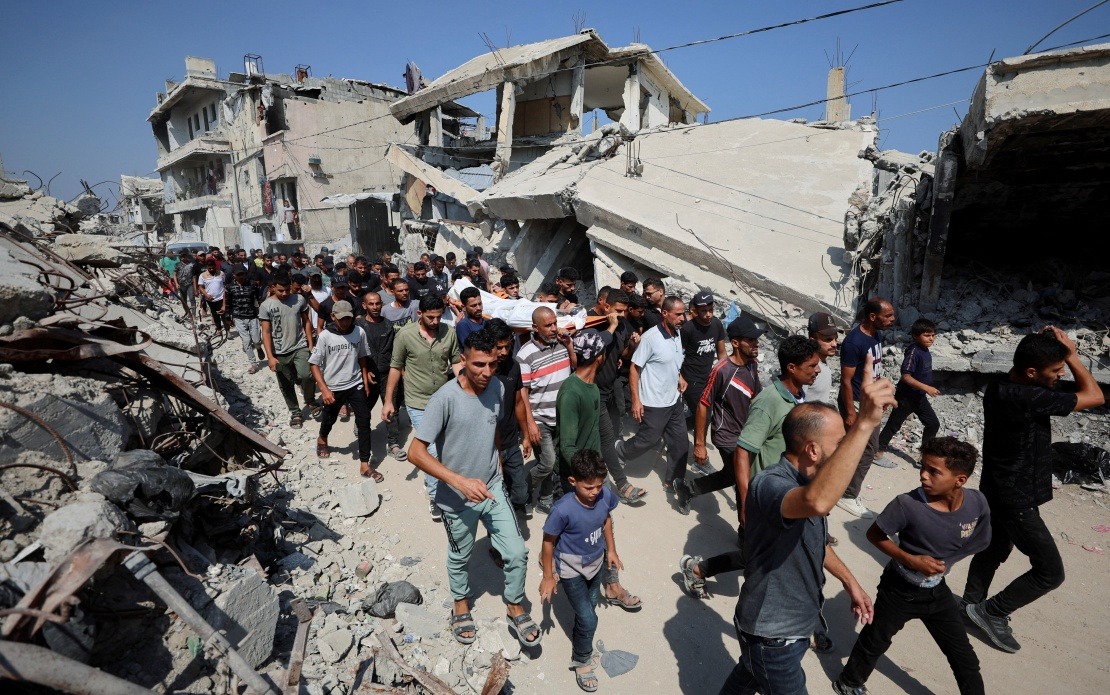
The Arab League's top diplomat has sounded alarm bells over deteriorating conditions in the Middle East, directly appealing to US President Donald Trump to intervene in Israeli government conduct towards Palestinians. Speaking ahead of an imminent Washington meeting between Trump and Israeli Prime Minister Benjamin Netanyahu, Secretary-General Nabil Fahmy articulated deep concern that regional tensions are spiralling towards what he characterised as a critical "moment of explosion" across multiple fronts.
Fahmy's statement reflects intensifying pressure within Arab capitals over the humanitarian and political fallout from ongoing Israeli military operations. Since October 2023, Gaza has endured an offensive that official tallies attribute to Israeli forces, resulting in more than 73,000 deaths and over 174,000 injuries. Simultaneously, the occupied West Bank has witnessed a significant escalation in Israeli military actions, with nearly 1,200 Palestinian casualties recorded across the same timeframe. These figures underscore the scale of human suffering that has animated Arab diplomatic responses in recent months.
Beyond the Israeli-Palestinian dimension, Fahmy identified the stalled Palestinian peace process and what he termed "reckless escalation and brinkmanship" connected to broader Gulf tensions as contributing factors to regional instability. The situation has been further inflamed by military exchanges between Israel, the United States, and Iran, including joint February strikes on Iranian targets and subsequent Iranian retaliatory actions against facilities in Gulf states hosting American personnel. These tit-for-tat escalations have created a climate of unpredictability that concerns Middle Eastern players and their international partners alike.
The Arab League chief's appeal targets what many regional analysts view as Washington's unique leverage over Israeli decision-making. Fahmy explicitly called upon Trump to "rein in the extremist ambitions of the Israeli government," framing this as essential to preventing derailment of peace initiatives. He referenced Trump's own 20-point proposal for Gaza, unveiled in September 2025, which envisions a phased ceasefire arrangement, prisoner exchanges, incremental Israeli military withdrawal, establishment of an interim Palestinian administrative structure, and reconstruction efforts across the devastated territory. The plan represents one of the most detailed recent American frameworks for resolving the conflict, yet its implementation faces formidable obstacles.
Fahmy's criticism extended to what Arab League officials characterise as systematic efforts to eliminate Palestinian presence through territorial expansion. The Arab League chief accused the Israeli government of actively pursuing displacement strategies whilst simultaneously expanding settlements in occupied territories—actions that international legal opinion generally views as violations of international law. He called for an end to what he described as "repeated Israeli violations in East Jerusalem," signalling particular concern over actions in the contested capital's eastern sector, where Palestinian population concentrations and disputed sovereignty create flashpoints for confrontation.
For Malaysian policymakers and observers, Fahmy's intervention carries implications beyond bilateral Israeli-Palestinian dynamics. Southeast Asia maintains significant economic relationships with Gulf states and shares strategic interests in maintaining freedom of navigation through contested waterways. The Arab League chief specifically highlighted concerns about safe passage through the Bab el-Mandeb Strait connecting the Red Sea to the Gulf of Aden—a chokepoint through which substantial global commerce flows and where regional instability directly affects shipping routes vital to Asian economies. Disruptions in this corridor reverberate through supply chains and insurance costs affecting Malaysian traders and manufacturers.
Fahmy also advocated for renewed engagement between Washington and Tehran, urging what he termed "a swift return" to understandings between the two powers. This reflects Arab League anxiety that prolonged US-Iran antagonism creates vacuums exploited by rival regional actors, further destabilising the environment. His call for resuming negotiations aimed at conflict de-escalation, respect for national sovereignty, and restoration of waterway security suggests the Arab League views comprehensive regional dialogue as preferable to the current trajectory of fragmented crises.
The timing of Fahmy's statement carries particular weight given the planned Trump-Netanyahu meeting, indicating Arab League determination to inject its perspective into what many view as a consequential conversation. The Arab League represents twenty-two nations spanning North Africa and the Middle East, granting its secretary-general significant diplomatic standing. Fahmy's characterisation of the situation as approaching an explosive moment represents a senior Arab voice warning that current trajectories prove unsustainable and require urgent American diplomatic intervention.
For regional stability and Malaysia's strategic interests, the Arab League's concerns highlight the interconnection between Israeli-Palestinian dynamics and broader Gulf security architecture. Unresolved Palestinian grievances fuel broader anti-American sentiment in parts of the Arab world, whilst perceived American partiality towards Israel complicates Washington's diplomatic relationships throughout the region. The accumulation of grievances—compounded by casualties, displacement, and stalled peace processes—creates conditions for unexpected escalations that can suddenly embroil major powers and disrupt international commerce. Fahmy's appeal to Trump essentially argues that addressing the underlying Palestinian issue represents not merely a humanitarian imperative but a strategic necessity for maintaining regional equilibrium that benefits all parties, including American interests and the broader international community dependent on Middle Eastern stability.

