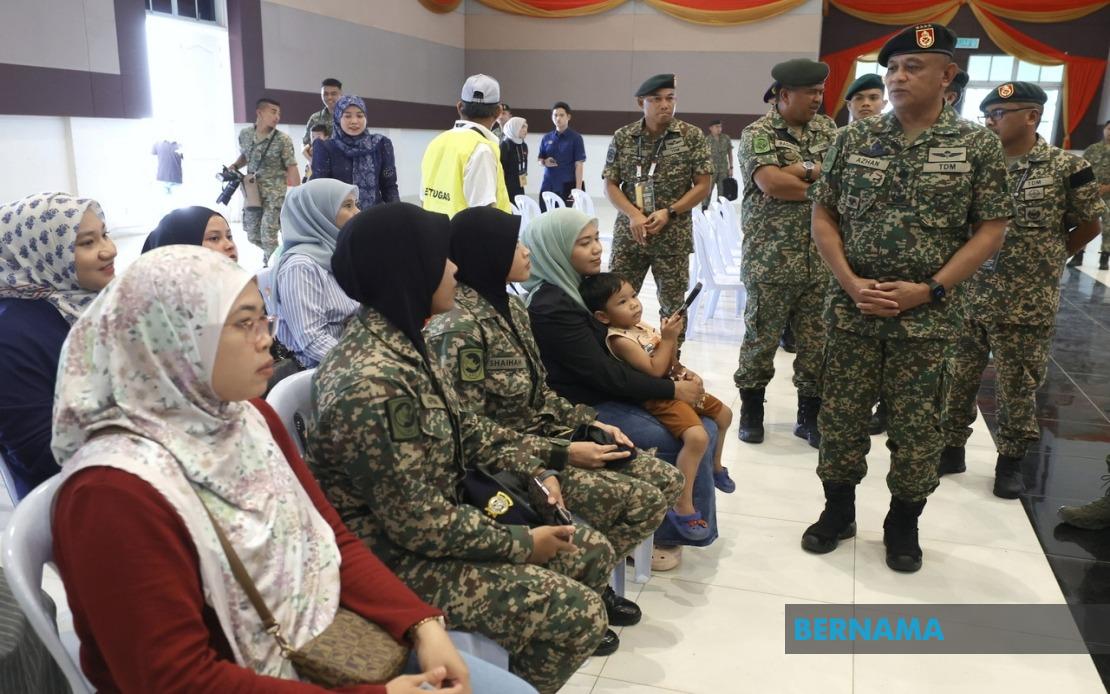
The advance polling exercise for military and police personnel in the 16th Negeri Sembilan state election has demonstrated efficient execution and robust participation, with security force voters displaying a strong commitment to the electoral process. As of midday on polling day, more than 60 per cent of eligible military voters and their families had already cast their ballots at designated military installations, signalling a trajectory toward exceeding the Election Commission's ambitious 90 per cent turnout benchmark by the time voting closes at 5 pm.
General Tan Sri Azhan Md Othman, the chief of the Malaysian armed forces, personally visited multiple voting stations to monitor the process and assess operational readiness. His inspection tour included stops at the Rasah Camp in Seremban and the Army Basic Training Centre (PUSASDA) in Port Dickson, where the bulk of military voting was concentrated. During his observations, the Army chief found no logistical bottlenecks or administrative irregularities that might have impeded the voting experience for service members and their dependents.
The scale of early voting coordination was substantial, involving 16,884 registered military voters alongside their eligible spouses. By mid-afternoon, approximately 63 per cent of this cohort had successfully completed their civic duty, placing the projected final turnout well within the expected range. This performance reflected not only effective electoral administration by the Election Commission but also the disciplined approach military institutions brought to their polling operations and personnel management.
Beyond the military contingent, the early voting framework encompassed a broader security sector participation. The overall early voting pool reached 22,339 registered voters, with 16,467 individuals casting votes in person across designated facilities. This physical turnout comprised 11,293 military personnel and their spouses alongside 5,174 police officers and family members. The remaining eligible early voters exercised the postal voting option, demonstrating the flexibility built into the system for those unable to attend in-person sessions.
The Negeri Sembilan state election represents a significant political exercise, with 36 state assembly seats contested by 103 candidates across various constituencies. The electoral competition would culminate with the main voting day scheduled for the Saturday immediately following the early voting period, when 867,151 registered voters across the state would participate in determining the composition of the state legislative assembly. The advance voting arrangement for uniformed personnel reflects established practice within Malaysia's electoral framework, recognizing the operational demands placed on security force personnel and their families during election periods.
General Azhan's public assessment of the early voting process carried particular weight given his position as head of the armed forces and his direct observation of polling conditions at multiple locations. His confidence in the efficiency and integrity of the voting operation provided assurance to the broader public about electoral management standards. The absence of reported complications or security concerns at military polling stations underscored the institutional coordination between the Election Commission and defence establishments.
The projected 90 per cent turnout among military voters would align with historical patterns of strong electoral participation within the armed forces, where voting is often viewed as both a civic responsibility and a reflection of institutional discipline. The early voting mechanism has become integral to ensuring that service members, who may face deployment constraints or operational obligations, can participate meaningfully in democratic processes without compromising their professional duties.
For Negeri Sembilan specifically, the military and police vote carries measurable weight given the substantial presence of defence installations and personnel within the state. The state houses several significant military bases and training facilities, making the security sector workforce a demographic factor in local electoral calculations. The successful management of their voting arrangements therefore possesses implications extending beyond purely procedural concerns, touching on questions of institutional effectiveness and democratic participation among key public sector groups.
The Election Commission's targeting of a 90 per cent turnout among early voters reflected ambitions to maximize participation while maintaining operational discipline. Achieving or exceeding this benchmark in the security force contingent would demonstrate the viability of advance voting as a mechanism for expanding democratic participation. The smooth execution observed during the day suggested that the institutional arrangements put in place have matured into a reliable component of Malaysia's electoral infrastructure.

