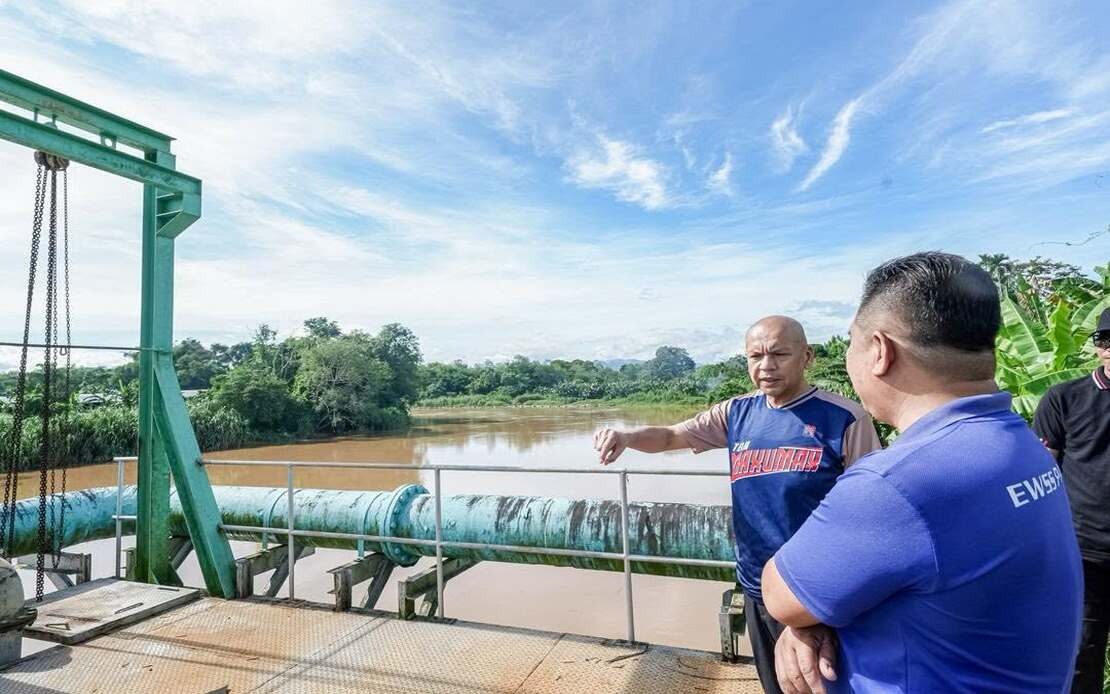
Datuk Armizan Mohd Ali, the Domestic Trade and Cost of Living Minister and Member of Parliament for Papar, conducted a comprehensive site inspection of water supply stabilization initiatives in the district this week. The visit followed a coordinated meeting held on June 15 to assess progress on multiple projects designed to resolve persistent water supply deficiencies affecting residents. Armizan's hands-on approach reflects growing concern over infrastructure reliability in a district where demand pressures continue to mount.
Two major undertakings are anchoring the stabilization effort. The Kogopon Water Treatment Plant is undergoing significant expansion, with capacity slated to increase from 40 million litres per day to 80 million litres per day. Simultaneously, authorities are upgrading the Kampung Kabang intake infrastructure. Together, these initiatives represent a substantial investment in bolstering the district's water handling capabilities and addressing the structural bottlenecks that have constrained supply during peak demand periods.
Papar's water challenges reflect broader challenges facing Malaysian urban and semi-urban districts where population growth and economic activity have outpaced infrastructure expansion. The district's position as a growing commercial hub, coupled with residential development, has created urgent capacity constraints. By doubling the Kogopon facility's output, planners aim to provide a buffer against future disruptions and accommodate continued economic expansion without sacrificing service quality.
During his inspection, Armizan also assessed operational difficulties at the EWSS Plant and the JETAMA Limbahau Plant, both of which experienced forced shutdowns in recent days. These facilities faced persistent problems related to raw water quality, specifically elevated nephelometric turbidity unit (NTU) values at intake points. Water turbidity—a measure of suspended particles and cloudiness—directly affects treatment efficiency. High turbidity forces treatment plants to either operate at reduced capacity or cease operations entirely until source water conditions improve, creating cascading supply disruptions for downstream consumers.
The turbidity incidents underscore vulnerabilities in Papar's water sourcing strategy. Raw water quality depends on conditions far upstream, where deforestation, agricultural runoff, construction activity, and monsoon weather patterns can all degrade water quality rapidly. When NTU values spike beyond treatable thresholds, treatment plants must either wait for conditions to stabilize or implement emergency protocols that reduce output. For residents and businesses relying on uninterrupted supply, such disruptions represent significant hardship and economic loss.
Armizan emphasized the necessity of direct field monitoring to understand operational constraints comprehensively. By visiting treatment facilities personally rather than relying solely on written reports, the minister gained insight into specific technical challenges, staff capacity, and coordination gaps that might escape notice in formal briefings. This approach aligns with growing recognition across Southeast Asian water utilities that effective crisis management requires senior leadership engagement with frontline operations.
The minister's inspection itinerary included both plants experiencing current difficulties and those undergoing expansion. This dual focus—simultaneously addressing immediate crises and implementing long-term solutions—reflects the complex balancing act required in utility management. Papar's water authority must maintain existing service levels while constructing new capacity, all while responding to quality issues that emerge without warning.
For Malaysian consumers and policymakers, the Papar situation illustrates wider regional water security concerns. Southeast Asian countries increasingly face pressure from competing demands for fresh water resources, from agriculture to industry to domestic consumption. Climate variability threatens traditional water supply patterns, while aging infrastructure in many districts struggles to meet modern service standards. Sabah, as a resource-rich but infrastructure-challenged state, epitomizes these tensions.
The emphasis on ensuring solutions could be "implemented more effectively" suggests that Armizan and his team recognize implementation capacity as a critical constraint. In Malaysia, as across the region, identifying necessary projects is often simpler than executing them reliably. Delays, cost overruns, and technical difficulties are common. The minister's monitoring approach appears designed to keep implementation momentum focused and to rapidly resolve obstacles.
Papar's water infrastructure challenges carry political significance as well. The district elects its own Member of Parliament, and constituent satisfaction with essential services directly influences electoral outcomes. By demonstrating active ministerial engagement with local infrastructure concerns, Armizan signals responsiveness to voter priorities. His dual role as minister and MP creates accountability mechanisms that may accelerate problem-solving compared to districts where political representation remains distant from service delivery.
The Kogopon and Kampung Kabang projects, once completed, should substantially improve system resilience. Doubled treatment capacity provides redundancy; if one facility faces disruption, the second can partially compensate. Enhanced intake infrastructure may also improve raw water quality consistency by allowing selection from multiple sources or better pre-treatment before water reaches main treatment plants. These investments represent recognition that Papar's current infrastructure has fundamentally reached capacity limits.
Looking ahead, continued vigilance will be essential. Treatment plant expansions must be completed on schedule and within budget—outcomes that have challenged other Malaysian utilities. Raw water source management requires coordination with state environmental authorities and upstream stakeholders, adding layers of complexity. Armizan's sustained monitoring commitment suggests awareness that post-project handover remains critical; many infrastructure investments fail to deliver intended benefits due to inadequate operational support after inauguration.
The minister's engagement with Papar's water challenges reflects evolving governance approaches in Malaysia, where senior officials increasingly conduct field visits to verify on-the-ground conditions rather than accepting intermediaries' assessments. This transparency and accountability focus, while demanding of ministerial time, builds public confidence in institutional commitment to service delivery. For residents enduring repeated supply interruptions, such visible leadership attention provides reassurance that their concerns are reaching the highest policy levels.

