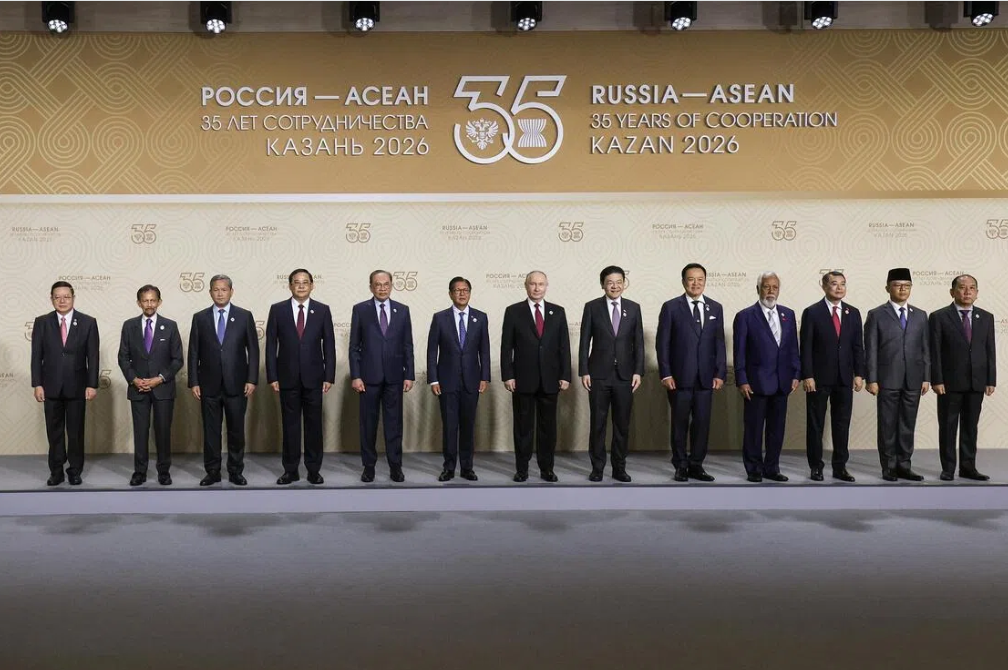
Asean and Russia have moved to strengthen their bilateral engagement through an ambitious five-year cooperation blueprint, cementing ties at a high-level summit held in Russia's southwestern city of Kazan. The Asean-Russia Commemorative Summit, convened on June 17-18 by Russian President Vladimir Putin, served as a milestone gathering recognizing three and a half decades of formal relations alongside thirty years of structured dialogue partnership between the two sides.
The summit produced a substantial package of collaborative instruments designed to guide practical cooperation across multiple domains. The Kazan Declaration, the summit's principal outcome document, conducted a comprehensive review of progress achieved over the partnership's 35-year history while establishing strategic direction for future engagement. This declaration specifically identifies maritime cooperation, trade and investment flows, energy development, infrastructure connectivity, security cooperation, educational advancement, and cultural exchange as priority areas warranting intensified collaboration.
Supplementing the main declaration, participating nations adopted a Joint Statement on Cultural Cooperation that emphasizes deepening connections at the grassroots level through expanded cultural programming and people-to-people interactions. A more detailed roadmap for the next lustrum emerged in the form of the Asean-Russia Comprehensive Plan of Action spanning 2026 to 2030, providing concrete guidance for bilateral initiatives across these identified sectors. The plan represents an attempt to operationalize broader commitments through specific, measurable projects during the coming half-decade.
Singapore's Prime Minister Lawrence Wong, speaking at the summit's concluding session, articulated the strategic rationale for renewed partnership emphasis. He advocated for concentrated effort on areas where Asean and Russian interests naturally align rather than attempting to resolve deeper disagreements, an approach reflecting pragmatic understanding of geopolitical constraints. Wong particularly highlighted Russian support for Asean Centrality, the regional grouping's longstanding principle that Southeast Asia should remain the driving force in shaping its own architecture and external relationships, as a significant area of convergence.
The Prime Minister underscored Russia's historical engagement with Asean-led institutional frameworks, specifically noting Moscow's participation in the ASEAN Regional Forum and the East Asia Summit. He outlined Singapore's expectations for continued Russian involvement in these mechanisms during the Philippines' hosting of such meetings later in 2024, while looking ahead to Russia's collaboration when Singapore assumes the rotating Asean chairmanship in 2027. This institutional dimension proves particularly relevant as Southeast Asia navigates an increasingly complex international environment requiring predictable partnerships.
Practical areas of cooperation identified by Wong extended beyond traditional diplomatic engagement to include disaster management capacity-building and counter-narcotics initiatives, reflecting shared vulnerability to transnational challenges. Educational and cultural exchanges received particular emphasis, with Wong noting that Russian civil service officials regularly participate in professional development programs across Asean member states, including Singapore. These people-to-people connections provide important counterbalance to high-level political dialogue and help sustain relationships amid inevitable policy disagreements.
Wong's remarks positioned the Asean-Russia partnership within the context of regional integration and external engagement, noting that deepening internal cohesion while simultaneously expanding international partnerships represents a dual priority for Southeast Asian nations. He explicitly connected this strategic approach to what he characterized as an increasingly unpredictable and volatile global geopolitical environment, implying that stable external relationships become more valuable when uncertainty prevails internationally.
The Prime Minister devoted considerable attention to principles governing international conduct, underscoring Singapore and Asean's consistent advocacy for peaceful dispute resolution through dialogue and adherence to international law and the rules-based order. His remarks reflected the region's long-standing concern with upholding freedom of navigation through critical international waterways, particularly in Southeast Asian waters, as guaranteed under the United Nations Convention on the Law of the Sea. This emphasis takes on heightened significance given regional maritime security concerns and great power competition in waters traversing the Indo-Pacific.
Wong also addressed two major international conflicts receiving regional attention. He welcomed a recently concluded peace agreement between the United States and Iran, expressing hope that this breakthrough could open pathways toward permanent conflict resolution and restoration of normal maritime passage through the strategically vital Strait of Hormuz. Regarding the Ukraine conflict, Wong articulated Singapore's principled stance, emphasizing that the nation's position derives from consistent commitment to universal principles of state sovereignty and territorial integrity rather than alignment with particular great powers. He noted Singapore's support for diplomatic efforts aimed at achieving an enduring peace settlement consistent with international law and the United Nations Charter.
The Prime Minister's carefully calibrated language reflected the delicate balance Singapore and other Asean members maintain in international relations. Despite Singapore's previous condemnation of Russia's invasion of Ukraine and its 2022 decision to impose sanctions and restrictions on Moscow that remain in effect, Wong signaled openness to compartmentalized cooperation where mutual interests exist. This approach acknowledges that complete isolation proves neither feasible nor strategically advantageous for regional nations seeking to maintain diverse partnerships while upholding core principles.
On the bilateral level, Wong and Putin conducted substantive discussions encompassing both bilateral relations and broader regional and international developments during a bilateral meeting scheduled at the Russian president's request. Wong subsequently emphasized through social media that dialogue and engagement retain value even between countries experiencing disagreements on particular issues. He reiterated Singapore's valuation of longstanding ties with Russia and its people, while confirming intentions to pursue cooperation opportunities concentrated on mutual interest areas.
Beyond the prime ministerial engagement, Wong also met with Rustam Minnikhanov, the Rais or president of the Republic of Tatarstan, a substantial regional subdivision of the Russian Federation. Singapore and Tatarstan maintain historical bilateral connections traceable to former Minister Mentor Lee Kuan Yew's visit to the region in 2007. The Wong-Minnikhanov discussion extended across cultural, educational, and people-to-people cooperation domains, reflecting the broader framework established at the summit level while demonstrating Singapore's interest in developing relationships at subnational governmental levels.
The Kazan summit outcomes reflect both the resilience of Asean-Russia ties despite recent geopolitical tensions and the region's pragmatic approach to international engagement. Rather than allowing disagreements on major conflicts to foreclose all cooperation, Southeast Asian nations have demonstrated willingness to maintain dialogue and develop collaborative projects in areas of genuine convergence. This stance, while sometimes criticized by Western partners, represents an essential feature of how middle-power nations like Singapore navigate a multipolar international system where complete alignment with any single major power remains neither possible nor desirable.

