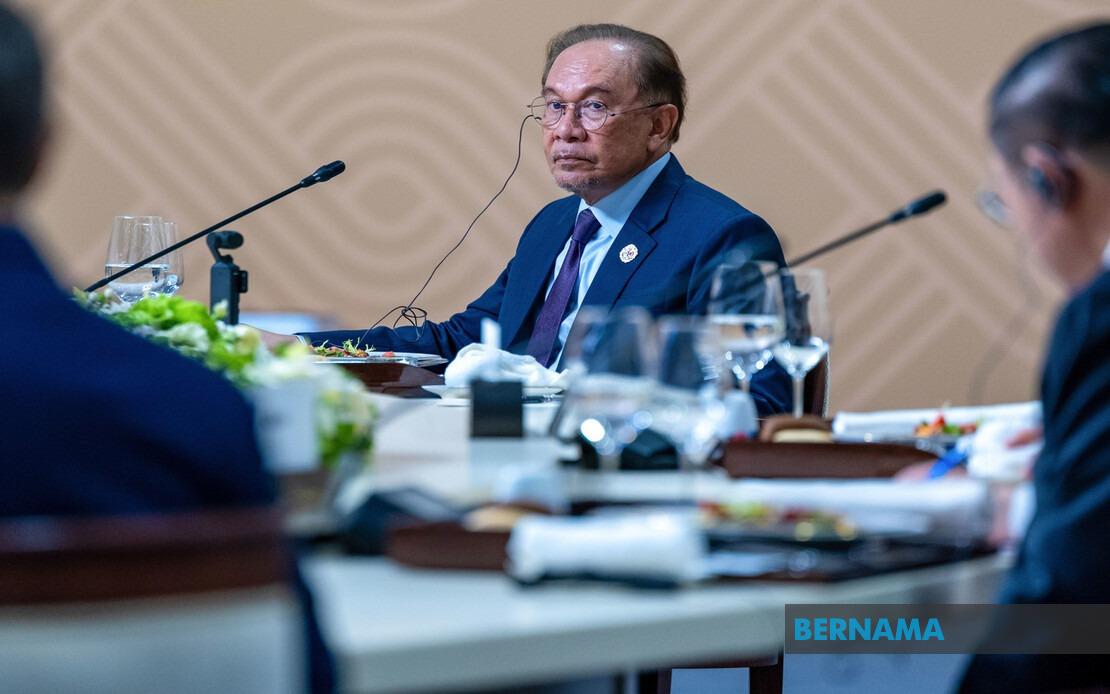
Prime Minister Datuk Seri Anwar Ibrahim has called for the Association of Southeast Asian Nations and the Shanghai Cooperation Organisation to combine their resources and expertise in addressing transnational crime and fortifying regional energy cooperation. Speaking during an ASEAN-Russia working lunch in Kazan on June 18, Anwar emphasised that both regional bodies possess the foundational agreements necessary to escalate their collaborative efforts, building on cooperation frameworks already established through their 2005 memorandum of understanding.
The existing institutional architecture between these two major regional organisations encompasses cooperation across several critical domains including counter-terrorism operations, illicit drug and narcotic control, anti-money laundering initiatives, and frameworks for economic and financial collaboration. Energy cooperation, particularly in hydroelectric power generation and biofuel development, has likewise been incorporated into these agreements. However, Anwar argued that these arrangements require deeper activation and resource mobilisation to achieve tangible outcomes that benefit member nations and their citizens.
The Prime Minister identified the pace of modern criminal activity as a central challenge demanding immediate collective action. Online fraud networks, organised financial crime, and human trafficking operations increasingly transcend national borders with alarming speed, outpacing the capacity of individual nations to detect, investigate, and prosecute offenders operating across jurisdictions. Anwar contended that this asymmetry between criminal mobility and law enforcement response necessitates robust intelligence-sharing mechanisms and coordinated capacity-building programmes. Strengthened partnerships would enable rapid information exchange and harmonised operational responses that individual countries cannot achieve independently.
On energy matters, Anwar emphasised the particular strategic advantage of drawing together the Shanghai Cooperation Organisation's major resource producers and accumulated technological expertise. The organisation brings together nations with substantial energy reserves and sophisticated infrastructure management capabilities. This concentration of expertise and productive capacity creates opportunities for practical initiatives that advance both energy security and the regional transition toward sustainable energy sources. For Malaysia, whose geographical position and economic interests align with broader regional energy dynamics, such cooperation holds particular relevance.
Anwar outlined a comprehensive energy cooperation agenda extending beyond conventional hydrocarbon management. The proposed framework encompasses efficiency improvements in energy systems, strengthening grid reliability across interconnected networks, liquefied natural gas and conventional gas supply chains, accelerated renewable energy integration, and knowledge exchange regarding operational safety and system resilience. This multi-faceted approach reflects recognition that modern energy security requires addressing supply reliability, environmental sustainability, technological modernisation, and risk management simultaneously rather than pursuing isolated policy objectives.
Beyond the Shanghai Cooperation Organisation, Anwar extended similar reasoning to ASEAN's relationship with the Eurasian Economic Union, another significant regional bloc comprising Russia and Central Asian nations. He argued that existing institutional frameworks between ASEAN and the EAEU similarly require activation through deliberate commercial and investment initiatives. The Prime Minister identified three interconnected priorities for strengthening business-to-business relationships within this partnership architecture. First, private sector actors from both regions should participate more frequently and substantially in each other's major commercial events, including dedicated business dialogues held alongside the Eastern Economic Forum and St Petersburg International Economic Forum.
Second, Anwar highlighted the particular vulnerability of smaller and medium-sized enterprises attempting to compete across both regions. These firms require targeted support mechanisms including improved market access arrangements, technology transfer opportunities, and skill development programmes enabling them to utilise advanced technologies effectively. Without such support, smaller enterprises face structural barriers that prevent meaningful participation in cross-regional trade and investment flows, perpetuating economic concentration among large multinational actors and limiting the inclusive development benefits that regional integration theoretically enables.
Third, Anwar identified emerging areas of convergent interest between ASEAN and the EAEU that warrant collaborative development. The digital economy, artificial intelligence applications, cybersecurity infrastructure and governance, and food security represent domains where both regional groupings confront similar challenges and possess complementary capabilities. Digital transformation increasingly shapes economic competitiveness and social progress across both regions, yet individual nations lack the capacity to address cybersecurity threats or establish artificial intelligence governance frameworks independently. Similarly, food security transcends regional boundaries in an era of complex global supply chains and climate variability.
The Prime Minister's remarks reflect a broader strategic vision positioning Malaysia and ASEAN within interconnected regional partnerships spanning Asia. Rather than viewing regional blocs as competing entities, Anwar portrayed them as complementary structures offering distinct advantages that can be mobilised for collective benefit. The Shanghai Cooperation Organisation's energy resources and counter-terrorism expertise, combined with ASEAN's economic dynamism and geographic centrality, create synergies that neither grouping could fully exploit in isolation. Similarly, EAEU membership and capabilities complement ASEAN's existing strengths in distinct ways.
Anwar's emphasis on focusing collaborative efforts on specific areas with defined timeframes reflects pragmatic recognition that regional partnerships often falter when ambitions exceed implementation capacity. Rather than pursuing sweeping integration across all policy domains, the Prime Minister advocated for concentrated effort producing measurable progress in carefully selected sectors. This approach increases the likelihood of successfully demonstrating partnership value, building political momentum for deeper cooperation, and establishing institutional precedents and working relationships that facilitate subsequent expansion into additional domains.
The Shanghai Cooperation Organisation, established in 2001, currently comprises ten full member states including China, India, Russia, Iran, and Kazakhstan, alongside two observer states. Its evolution from a regional security mechanism to a comprehensive political, economic and security organisation reflects broader trends in Asian regionalism toward multifaceted partnerships addressing diverse policy challenges. ASEAN's engagement with the SCO positions Southeast Asia within these broader Asian integration processes while maintaining the grouping's traditional emphasis on flexible, consensus-based cooperation without supranational institutional structures.
Anwar was in Kazan, the capital of Russia's Tatarstan region, for a two-day working visit attending the ASEAN-Russia Commemorative Summit. His remarks crystallised key themes emerging from ASEAN-Russia engagement, emphasising practical cooperation addressing transnational challenges rather than geopolitical competition. For Malaysian observers and policymakers, Anwar's intervention suggests an administration seeking to position the country as an active bridge between major Asian regional organisations, leveraging its ASEAN membership and growing engagement with broader Asian structures to advance specific national and regional interests.

