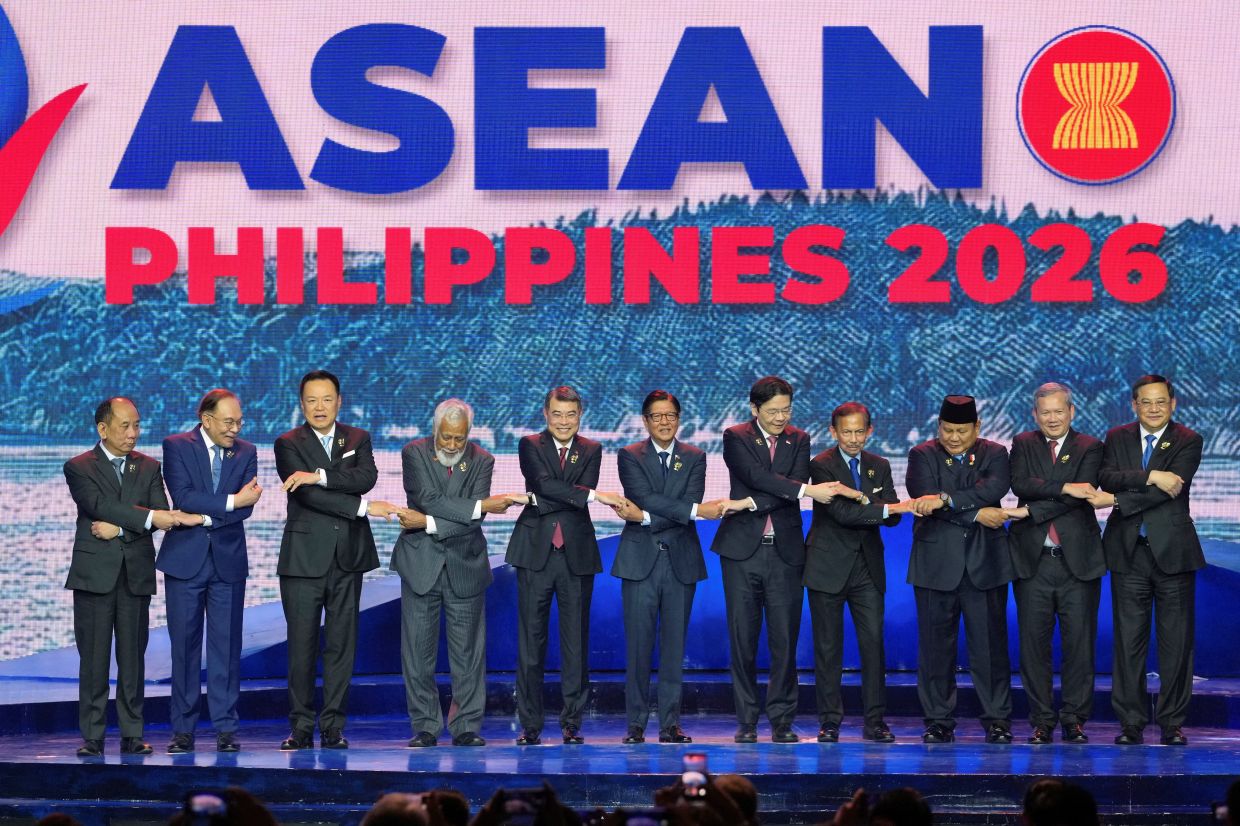
Southeast Asia's diplomatic machinery will shift into high gear this week as foreign ministers from across the region converge on Manila for a critical gathering that reflects the mounting pressures bearing down on the Association of Southeast Asian Nations from multiple directions. The three-day ministerial talks, hosted by the Philippines under its current ASEAN chairmanship, represent an attempt to coordinate regional responses to three interconnected crises: the deteriorating security situation in the Middle East, the unresolved conflict consuming Myanmar, and the festering territorial disputes in the South China Sea. The assembly will draw heavyweight representation from beyond the region, including U.S. Secretary of State Marco Rubio, Chinese Foreign Minister Wang Yi, and Russian Foreign Minister Sergey Lavrov, underscoring how deeply external powers have become invested in Asean's deliberations and stability.
The renewed hostilities between the United States and Iran have thrust Middle Eastern affairs onto Asean's agenda with unusual urgency, reflecting the region's profound dependence on energy supplies transiting through volatile corridors. Southeast Asia, home to over 680 million people, sources substantially more of its oil and gas from the Middle East than most other regions globally, making it acutely vulnerable to the supply disruptions and price volatility that accompany regional conflicts. The Strait of Hormuz, through which roughly one-fifth of the world's oil supplies normally passes, has become a focal point of concern; any escalation threatening freedom of navigation through these waters directly imperils Southeast Asia's economic lifeline. The Filipino government's decision to declare a national energy emergency in March provides vivid evidence of how deeply the region has already felt the tremors of Middle Eastern instability.
Asean's foreign ministers are expected to issue a coordinated statement expressing serious concerns about the Middle East trajectory and to call publicly for the protagonists to return to diplomatic channels. This measured but pointed intervention reflects the bloc's delicate balancing act: Asean must demonstrate that it takes global flashpoints seriously without appearing to take sides between the United States and Iran, neither of which are members but both of which exercise significant influence over regional affairs. The diplomatic language will carefully preserve Asean's tradition of non-alignment while signalling to both Washington and Tehran that further escalation carries costs for regional stability that extend far beyond the Middle East itself.
Secretary Rubio's participation in the Manila meetings carries particular significance given American strategic concerns about China's assertiveness in the Indo-Pacific. The Trump administration's focus on containing Iran has inevitably diverted considerable American military resources and diplomatic attention away from Asia-Pacific concerns, raising anxieties among regional partners about whether Washington remains genuinely committed to maintaining stability in their waters. Rubio's presence and his expected emphasis on a "free and open Indo-Pacific" represent an effort to reassure nervous capitals that the United States has not abandoned its regional priorities despite preoccupations elsewhere. His planned meetings with fellow Quad members—Japan, India and Australia—will further signal Washington's determination to maintain its architecture for long-term strategic competition with China through the region.
The prospective engagement between Rubio and Wang carries its own diplomatic complexity. While both sides have indicated openness to discussions, no formal meeting has been confirmed, reflecting the current fragility of U.S.-China relations. Rubio's recent comments acknowledging the inevitability of irritants between major powers while emphasizing the importance of maintaining dialogue suggest a modestly pragmatic approach, though whether this extends to substantive negotiating breakthroughs remains uncertain. Any genuine meeting of minds on South China Sea conduct or Taiwan assurances would represent significant diplomatic movement, yet the structural tensions between the two powers show no signs of fundamental resolution.
Myanmar's spiralling civil conflict stands as perhaps the most intractable item on Asean's agenda, and the bloc's handling of this crisis increasingly exposes the limitations of regional solidarity and consensus-based diplomacy. Since the military coup of 2021, more than eight thousand people have been killed in fighting, while nearly twenty-three thousand others languish in detention according to rights monitoring organizations. Asean's five-point peace plan, formulated in 2021 and representing the bloc's primary diplomatic instrument for addressing the Myanmar catastrophe, has effectively stalled, overwhelmed by the military junta's refusal to comply with its provisions and the absence of meaningful enforcement mechanisms. The bloc's decision to exclude Myanmar's leaders from top-level meetings, including this week's Manila sessions, represents a rare moment of collective discipline but has failed to produce tangible changes on the ground.
In a controversial development that has drawn criticism from human rights advocates, Asean foreign ministers including Philippine Foreign Secretary Theresa Lazaro recently broke the silence by meeting directly with Myanmar's Foreign Minister Tin Maung Swe in Bangkok, marking their first engagement in five years. Supporters of this diplomatic opening argue that maintaining communication channels remains essential for eventual conflict resolution, while critics contend that the move represents a capitulation to the military junta that yields diplomatic legitimacy without securing any concrete concessions. The subsequent consultations with ethnic armed groups conducted in Thailand's coastal Pattaya resort demonstrate Asean's attempt to maintain inclusive dialogue, yet the effectiveness of such talks remains questionable given the fundamental military imbalance and the junta's apparent intransigence. Lazaro's insistence that these meetings do not constitute abandonment of the five-point consensus suggests that Asean intends to pursue what it characterizes as "resolute diplomacy with all parties," though the distinction between negotiation and capitulation grows increasingly blurred.
The South China Sea disputes represent another arena where Asean has struggled to translate numerical solidarity into diplomatic leverage. Territorial standoffs involving China, Taiwan, and four Asean members—Brunei, Malaysia, the Philippines and Vietnam—have become progressively more militarized and economically consequential. Recent years have witnessed particularly acute friction between Chinese and Philippine maritime forces, a dynamic reflecting both Manila's more assertive stance and Beijing's expanding capabilities for projecting power far from its shores. The proposed "code of conduct" that Asean has been negotiating with China for years remains perpetually in process, seemingly designed more to manage conflict than to resolve underlying claims. Foreign ministers will meet with Wang to discuss the current state of these negotiations, though meaningful breakthroughs appear unlikely given the fundamental incompatibility between Asean's desire for limitations on Chinese activities and Beijing's evident strategy of consolidating de facto control through incremental actions that accumulate over time.
The gathering in Manila thus encapsulates the broader challenge confronting Asean as an institution: the bloc possesses limited coercive capacity to enforce its preferences on either internal conflicts or disputes involving major external powers. Its utility lies primarily in convening dialogue, establishing principled positions, and maintaining communication networks that might prevent localized disputes from spiraling into broader confrontations. Yet this measured approach increasingly frustrates countries inside the organization—particularly the Philippines and Vietnam—that face direct security pressures and seek stronger collective action. The attendance of Rubio, Wang, Lavrov and others suggests that Asean retains relevance as a venue for great power diplomacy, but this same presence also underscores how the region's destiny remains heavily shaped by forces and decisions emanating from beyond Southeast Asia's borders.

