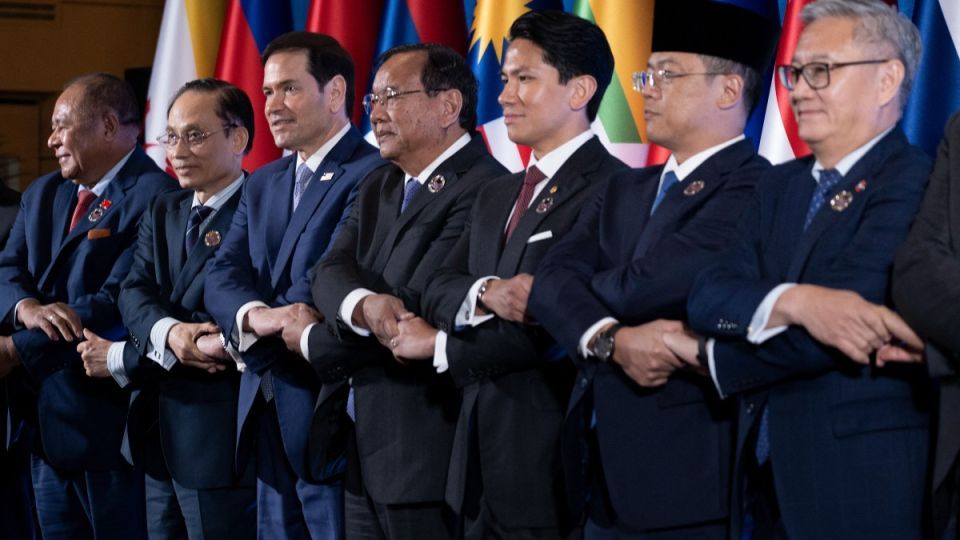
The Association of Southeast Asian Nations has formally urged the restoration of unobstructed maritime and aviation transit through the Strait of Hormuz, signalling growing alarm among member states over the cascading economic damage inflicted by ongoing Middle East hostilities. The appeal emerged from the 59th Asean Foreign Ministers' Meeting in Manila, where energy security and trade disruption dominated discussions across multiple security forums convened throughout the week. The bloc's intervention underscores how geopolitical upheaval thousands of kilometres away is reshaping the region's economic calculations and forcing Southeast Asian capitals to grapple with forces largely beyond their control.
The joint communiqué released Thursday specifically referenced the 1982 United Nations Convention on the Law of the Sea, grounding Asean's position in established international maritime governance. Foreign ministers called upon all actors to ensure continuous passage of commercial vessels and aircraft whilst guaranteeing the safety of crews and shipping, language reflecting the assembly's determination to invoke existing legal frameworks rather than establish new ones. This measured approach reflects Asean's broader diplomatic strategy of anchoring contentious issues within recognised international law, a tactic that has defined the bloc's engagement with major powers for decades.
The Middle East conflict has inflicted tangible economic consequences across Southeast Asia that extend far beyond oil market volatility. Elevated energy prices have cascaded through agricultural sectors, where fertiliser costs have spiked, whilst global supply chain disruptions have reverberated across manufacturing hubs throughout the region. During the week's ministerial sessions, delegates repeatedly referenced these interconnected vulnerabilities, recognising that a distant conflict zone poses immediate threats to food security, industrial competitiveness and employment. The breadth of concern suggests that Asean governments are increasingly viewing energy and maritime security not as peripheral issues but as central to their development trajectories and domestic stability.
Indonesia emerged as a leading voice pushing for substantive reform within Asean's security mechanisms, arguing that decades-old dialogue frameworks require modernisation to address 21st-century challenges. Foreign Minister Sugiono contended that confidence-building exercises, whilst valuable, have become insufficient in an era of rapid geopolitical transformation. He advocated for enhanced early-warning systems, joint capacity-building initiatives and coordinated exercises that would enable Asean to move beyond symbolic gatherings toward practical problem-solving. This position reflects Jakarta's broader conviction that Asean-led forums risk obsolescence if they cannot demonstrate concrete utility in managing regional disputes and transnational threats.
The Asean Regional Forum, established in 1994 as an innovation in regional confidence-building, has long attracted criticism for producing dialogue without commensurate behavioural change among participating states. Observers have noted that whilst the forum excels at convening rivals—including Washington, Beijing, Moscow and Tokyo—it has struggled to influence outcomes or prevent escalation when tensions rise. Sugiono's comments implicitly acknowledge this limitation, proposing what amounts to a reorientation toward conflict prevention rather than merely crisis communication. The critique carries particular weight given that the forum now encompasses eighteen participating countries spanning democracies, authoritarian states and major military powers with fundamentally divergent interests.
The South China Sea tensions provided a concrete backdrop to discussions about Asean's ability to manage regional security challenges. Philippine Foreign Minister Theresa P. Lazaro reported that recent confrontations around Second Thomas Shoal—where Philippine and Chinese vessels have engaged in dangerous manoeuvres—featured prominently in bilateral negotiations concerning the long-pending Code of Conduct. With completion of the Code targeted for this year, these practical disputes underscore the urgency of establishing binding mechanisms to prevent maritime incidents from escalating into broader conflicts. The recurring flare-ups suggest that dialogue mechanisms, whilst necessary, have proven insufficient to prevent dangerous encounters or establish clear protocols for managing them.
Indonesia's intervention at the East Asia Summit extended beyond structural reform to substantive foreign policy positions, particularly regarding the Middle East. Sugiono reiterated Indonesia's support for a two-state solution in Palestine whilst emphasising that selective application of international law ultimately undermines the rules-based order that smaller states depend upon for security. This framing represents a deliberate attempt to link disparate crises—Middle Eastern conflicts and South China Sea disputes—under a common principle: that international law must apply uniformly or lose legitimacy. For Southeast Asian nations, this principle holds particular resonance given their vulnerability to great power behaviour unconstrained by legal or diplomatic norms.
Philippine Foreign Minister Lazaro's appeal for regional unity despite unprecedented challenges carried implicit acknowledgment of the pressures fragmenting Asean consensus. Recent years have witnessed Myanmar's descent into civil conflict, Myanmar's suspension from Asean meetings, divisions over how to respond to Chinese assertiveness in the South China Sea, and now the spillover effects of Middle Eastern instability. Lazaro's call for cohesion despite rather than because of challenges suggests recognition that centrifugal forces are testing the bloc's capacity to maintain unified positions on contentious matters. The statement reflects anxiety that without sustained commitment to collective problem-solving, individual member states might pursue bilateral arrangements with external powers at the expense of bloc solidarity.
The timing of these discussions—occurring before November's Leaders' Summit where Asean is expected to chart strategic direction for coming years—invested the ministerial meetings with particular significance. The gathering represented opportunity to shape the agenda that leaders would subsequently address, allowing foreign ministries to establish parameters and identify consensus where possible. The prominence accorded to Middle Eastern fallout, South China Sea management and institutional reform suggests that the bloc's November gathering will grapple with immediate economic vulnerabilities whilst simultaneously wrestling with the bloc's long-term viability as a meaningful security actor.
Indonesia's specific advocacy for practical improvements to Asean forums reflects Jakarta's positioning as a conceptual leader within the association. Having chaired Asean in 2023, Indonesia continues to champion institutional evolution, pushing against assumptions that dialogue mechanisms developed for a unipolar world remain adequate for multipolar competition. This intellectual leadership carries weight because Indonesia, as Asean's largest economy and most powerful military, can realistically champion reforms without appearing to challenge the principles of non-interference and consensus that underpin bloc cohesion. Other member states, particularly smaller ones, often lack the authority to propose systemic changes without triggering concerns about agenda manipulation.
The convergence of Middle Eastern economic spillover, South China Sea security challenges and calls for institutional reform reflects a bloc grappling with accelerating change. Asean's traditional strength—its ability to maintain dialogue platforms amid great power competition—now confronts the reality that dialogue divorced from implementable outcomes offers diminishing returns. Sugiono's invocation of moving beyond 1994-era confidence-building resonates precisely because it acknowledges that thirty years of incremental diplomacy have failed to prevent the very incidents and crises that forums were established to manage. Whether Asean can translate this recognition into operational changes remains unclear, but the ministerial discussions demonstrate that the bloc's leadership comprehends the stakes.
For Malaysia and other Southeast Asian economies, these discussions carry particular significance given the region's dependence on energy imports and maritime trade. The Strait of Hormuz disruptions and energy price inflation directly threaten manufacturing competitiveness, export prospects and government revenues dependent on hydrocarbon sales. Moreover, the discussions underscore that regional security arrangements cannot insulate Southeast Asia from distant conflicts, particularly those involving major powers that underpin global trade and investment flows. This reality constrains Asean's options, limiting it largely to diplomatic advocacy for adherence to international law—the approach outlined in Thursday's communiqué—rather than tangible influence over Middle Eastern actors' behaviour.

