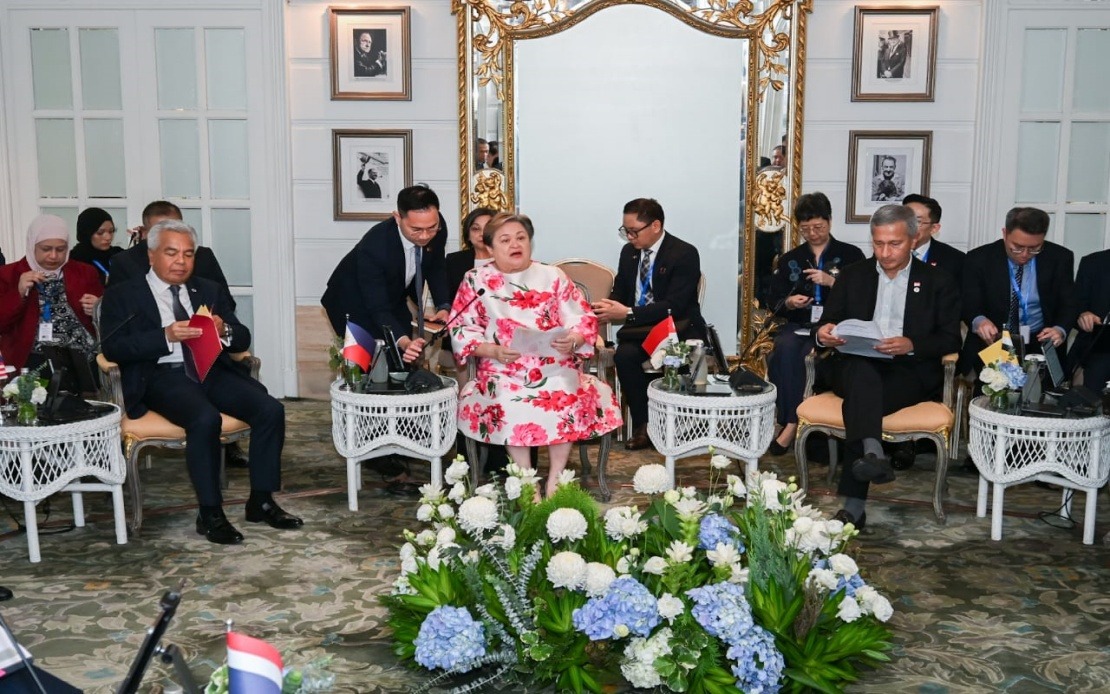
ASEAN has demonstrated unwavering commitment to the Five-Point Consensus as its cornerstone approach to the Myanmar crisis, even as the ruling junta continues to resist the regional bloc's efforts to broker peace in the troubled nation. At meetings convened in Bangkok on Sunday, ASEAN foreign ministers reaffirmed that the 2021 accord remains the legitimate basis for engagement with all parties in Myanmar, signalling the regional organisation's determination to maintain a unified diplomatic stance despite mounting frustration over stalled progress.
Philippine Foreign Secretary Maria Theresa Lazaro, operating in her capacity as the ASEAN Chair's Special Envoy on Myanmar, emphasised that the Five-Point Consensus serves as the foundational document guiding all discussions with Myanmar's government and other stakeholders. Her remarks came after the Myanmar junta's parliament passed a motion last week explicitly rejecting the peace framework, a move that underscores the deepening diplomatic impasse between the military regime and the Southeast Asian bloc. Nevertheless, Lazaro made clear that ASEAN would not abandon its approach, stating unequivocally that the regional organisation stands behind the consensus regardless of the junta's position.
The Five-Point Consensus, adopted in April 2021 following the military coup that toppled Myanmar's democratically elected government, comprises five interconnected pillars designed to guide Myanmar toward stability and reconciliation. These elements include an immediate cessation of violence, establishment of inclusive dialogue involving all political factions, provision of humanitarian assistance to affected populations, mediation through an ASEAN Special Envoy, and engagement with all relevant stakeholders. The framework represents a carefully calibrated approach that attempts to balance ASEAN's foundational principle of non-interference with its growing concern over the humanitarian catastrophe unfolding in Myanmar.
During the meetings, ASEAN conveyed three critical expectations to Myanmar's delegation, setting a roadmap for the coming months that reflects the bloc's pragmatic priorities. First, member states are committed to substantially expanding humanitarian assistance to Myanmar's suffering civilian population, with the Philippine chair planning a dedicated humanitarian mission to explore mechanisms for increasing aid delivery and accessibility. This initiative acknowledges that millions of ordinary Burmese citizens face acute food insecurity, limited healthcare access, and displacement as a direct consequence of the junta's violent suppression of opposition and ongoing internal conflicts.
Second, ASEAN has explicitly called for a reduction in violence, particularly targeting civilians caught in the escalating conflict between military forces and armed resistance movements. The emphasis on civilian protection reflects growing international concern over atrocities and indiscriminate attacks that have claimed thousands of lives and displaced hundreds of thousands from their homes. This demand represents perhaps the most immediate and measurable expectation, as daily violence reports from Myanmar continue to horrify the international community and strain ASEAN's credibility as a regional peacemaker.
Third, ASEAN is pushing for more inclusive political dialogue that can genuinely advance national reconciliation and political transition away from military rule. This component specifically includes efforts to foster a political environment conducive to democratic processes and the release of political prisoners held by the junta, many of whom include elected leaders from the National League for Democracy and civil society activists. The emphasis on political prisoners reflects international human rights concerns and the view that their continued detention represents an insurmountable obstacle to any meaningful dialogue about Myanmar's political future.
Lazaro characterised the Sunday meetings as a significant diplomatic milestone, noting they represented the first in-person gathering between ASEAN foreign ministers and Myanmar's foreign minister since the political crisis erupted in February 2021. This breakthrough in engagement logistics, while symbolically important, masks the underlying reality that substantive progress remains elusive. The fact that such a meeting qualified as noteworthy indicates how thoroughly the junta has isolated itself diplomatically within Southeast Asia, even within a regional forum traditionally characterised by consensus-building and restrained criticism.
Thailand's Foreign Minister Sihasak Phuangketkeow, whose government hosted the diplomatic gathering, articulated ASEAN's broader strategic approach as one of calibrated engagement, a terminology that attempts to thread a needle between maintaining relationships and applying pressure. He argued that this calibrated engagement operates as a two-way street, implying that Myanmar's government bears responsibility for reciprocating ASEAN's diplomatic overtures and addressing regional concerns. This framing suggests growing exasperation within ASEAN over what member states perceive as the junta's intransigence and unwillingness to accommodate legitimate regional anxieties about Myanmar's trajectory.
When pressed on whether ASEAN had established specific timelines for Myanmar to address these concerns, Sihasak indicated that the regional bloc would undertake a comprehensive assessment of progress during the broader ASEAN Summit scheduled later in the year. This approach defers accountability measures, suggesting ASEAN remains reluctant to impose concrete consequences or sanctions on Myanmar. The absence of firm deadlines reflects both ASEAN's traditional diplomatic culture and the practical reality that meaningful leverage over Myanmar's junta remains limited, particularly as China and Russia continue providing military and diplomatic support to the regime.
The meetings were chaired by the Philippines, the current ASEAN Chair, and included representatives from all member states with the notable exception of Cambodia, whose absence at such a significant consultation raises questions about internal ASEAN unity on Myanmar policy. Malaysia's participation through Foreign Ministry Secretary-General Tan Sri Amran Mohamed Zin underscores the importance Malaysian leadership places on Myanmar issues, given the cross-border implications for Malaysian security and the substantial numbers of Myanmar refugees and migrants present in Malaysian territory.
For Malaysian observers, the ASEAN consensus on Myanmar carries particular significance given Malaysia's substantial migrant worker population from Myanmar and its experience managing refugee flows across its eastern borders. The emphasis on humanitarian assistance resonates with Malaysian concerns about the destabilisation effects of Myanmar's ongoing crisis, while the focus on violence reduction directly impacts regional security and stability. Malaysia's continued participation in these diplomatic efforts, despite the limited tangible progress, reflects the country's commitment to finding regional solutions that prevent further deterioration and potential spillover effects affecting Southeast Asian security architecture.
The ASEAN consensus approach, while maintained in principle, faces mounting credibility challenges given the junta's explicit rejection and the absence of measurable progress on any of the Five-Point Consensus elements. The military regime shows no signs of halting violence against civilians, appears unmotivated to engage in genuine political dialogue, and maintains strict control over humanitarian access. This disconnect between ASEAN's stated expectations and the junta's evident behaviour raises fundamental questions about the framework's viability as an instrument for change, even as ASEAN member states insist on maintaining their united front and continued diplomatic engagement with Naypyidaw.

