The resurgence of tensions in the Middle East rippled through Asian financial markets on Monday, triggering a broad retreat in regional currencies and sparking fresh anxieties about inflationary pressures. The U.S. dollar strengthened noticeably across the basket of major currencies as investors sought the relative safety of the world's reserve currency, capitalising on the geopolitical uncertainty. The renewed conflict between Gulf states drove crude oil prices up by 4%, reviving dormant concerns about cost-push inflation and prompting traders to reassess the likelihood of additional interest rate increases from central banks across the globe. For emerging economies like Malaysia, already grappling with imported inflation, the combination of higher oil prices and currency weakness created a challenging backdrop for policymakers and investors alike.
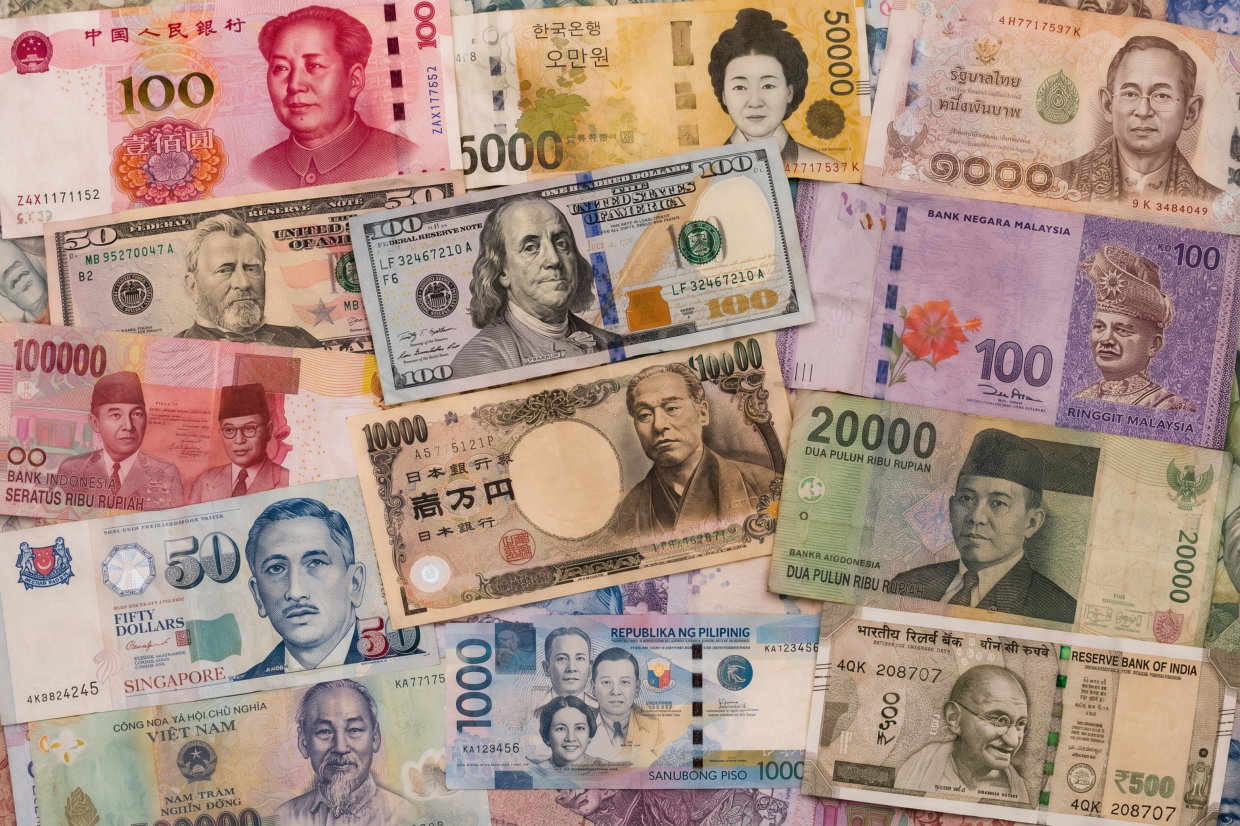
The depreciation extended across the entire spectrum of emerging Asian currencies, with particularly acute pressure visible in the Indonesian rupiah, which fell to 18,140 against the dollar—a level not seen in over a month. South Korea's won deteriorated to 1,507.9 per dollar, reflecting both the broader regional sell-off and specific domestic concerns about the health of the nation's export-dependent economy. The currency movements underscore how quickly geopolitical shocks can overwhelm local economic narratives, forcing investors to recalibrate risk assessments across the region. For Malaysian readers accustomed to tracking the ringgit's movements, the weakness of regional currencies signals a challenging period for export-oriented businesses and importers navigating volatile exchange rates.
The performance of South Korea's equity market proved most dramatic, with the KOSPI benchmark sliding 7.96% to reach its lowest point in ten weeks and triggering automatic circuit breaker halts. The index's collapse was driven primarily by a spectacular 13% nosedive in SK Hynix, the world's pre-eminent manufacturer of artificial intelligence memory chips. The sell-off appeared to reflect profit-taking by investors who had ridden a powerful rally following the company's blockbuster debut in the United States on Friday. The sharp reversal exposed the vulnerability of momentum-driven gains and highlighted how quickly sentiment can shift in technology-dominated markets, particularly when large institutional investors determine that valuations have become stretched.
Underlying the renewed caution around semiconductor stocks lie deeper structural concerns about the sustainability of earnings growth in the sector. The prodigious demand for high-bandwidth memory chips that power large language models and artificial intelligence systems has been the primary engine of profitability for companies like SK Hynix, but investors increasingly question whether this demand trajectory can be maintained. There is growing scepticism about whether hyperscaler companies—the technology giants deploying AI infrastructure at enormous scale—will continue their aggressive capital expenditure, or whether spending will become more disciplined as competition intensifies and unit economics tighten. These fundamental doubts have begun to weigh on sentiment, transforming what seemed like a structural tailwind into a potential headwind.
The volatility afflicting South Korean semiconductor stocks has been amplified by the role of highly leveraged exchange-traded funds that track individual shares. These products, which allow retail investors to magnify their exposure to single stocks, have exacerbated both upside rallies and downside reversals. The combination of profit-taking by large institutions and forced liquidations in leveraged vehicles created a vicious cycle that dragged prices down sharply. This dynamic carries important implications for Malaysian and regional investors, many of whom hold exposure to Asian technology stocks through regional funds or direct holdings. The episode serves as a cautionary reminder of how leverage can distort price discovery and create outsized movements disconnected from fundamental value.
Despite the severity of Monday's decline, the KOSPI retains substantial longer-term gains, down roughly 25% from its record closing level of June 22 but still boasting a remarkable 63% increase year-to-date. This perspective matters for investors evaluating whether Monday's rout represents a fundamental repricing or merely a correction within a broader bull market. South Korea's equity market remains among the world's best performers in 2024, a testament to the powerful structural tailwinds from artificial intelligence adoption and the global shift toward semiconductors as critical infrastructure.
In Malaysia, the ringgit weakened to 4.0780 per dollar, mirroring the depreciation affecting other regional currencies. Yet the Malaysian equity market demonstrated relative resilience, climbing to its highest level in three weeks despite the political turbulence that gripped the nation. A decisive defeat suffered by Prime Minister Anwar Ibrahim's governing coalition in a Johor state election on Saturday has seeded genuine uncertainty about the cohesion of the federal government's ruling bloc. Political analysts have begun openly discussing the possibility of an early general election, potentially upending the careful coalition management that has underpinned economic policymaking since the government's formation.
The divergence between Malaysia's currency weakness and stock market strength reflects the complex calculus investors apply when weighing political risk against economic fundamentals. Goldman Sachs observed in a recent analysis that continued uncertainty about federal coalition stability and the government's economic agenda could erode what the investment bank termed the "policy-stability premium" that has supported Malaysian assets. The firm highlighted that investors have rewarded Malaysia for its consistent approach to economic reform and fiscal discipline, but that this goodwill could dissipate if political fragmentation threatens the continuity of those policies. However, Goldman analysts noted that measures implemented by Bank Negara Malaysia in June to encourage foreign exchange inflows should help mitigate excessive depreciation and volatility in the ringgit, providing some stabilising support even amid ongoing political uncertainty.
Across the broader region, the pattern of market movements revealed the divergent impacts of global shocks on economies with different structural characteristics and political circumstances. Philippine equities edged slightly higher and Indonesian shares gained a modest 0.5%, suggesting that investors in these markets saw opportunities in weakness. Taiwan's benchmark index moved marginally lower, while Singapore's index declined as much as 0.7%, breaking a remarkable seven-session streak of consecutive record highs. Singapore's interruption of its record-setting run, despite the city-state's typically defensive characteristics as a financial hub, underscored the pervasive nature of the risk-off sentiment gripping the region.
The coming week promises to deliver several data points that will help determine whether Monday's decline represents a temporary setback or the beginning of a more sustained reassessment of regional valuations. Singapore is scheduled to release advance figures for second-quarter economic growth, providing the first comprehensive look at the regional economy's momentum. The United States will publish its latest inflation reading, with particular importance given the likelihood that the Federal Reserve's response to inflation trends will shape global monetary conditions. South Korea's central bank will announce its interest rate decision at a moment when the country's equity market has shown pronounced vulnerability. Malaysia will release inflation data and advance economic output figures that will inform assessments of whether the country's macroeconomic momentum remains intact despite political headwinds. These releases will collectively determine whether the depreciation and equity weakness observed on Monday reflect temporary panic or a more durable repricing of regional assets.

