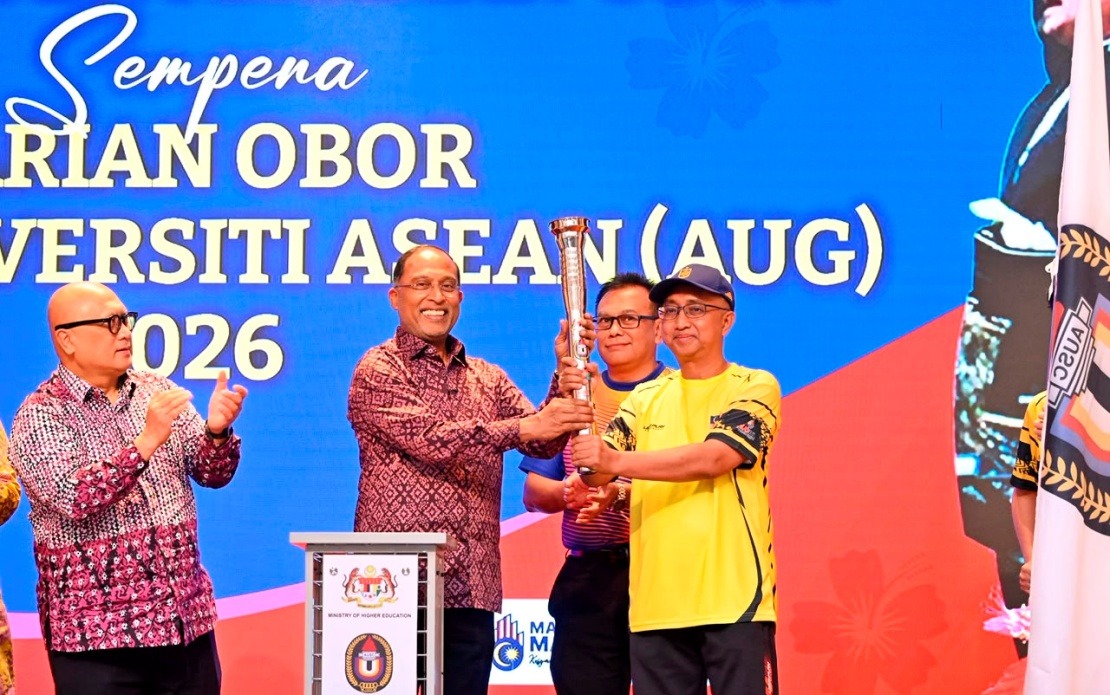
The flame of Malaysian sporting ambition was formally kindled when Higher Education Minister Datuk Seri Dr Zambry Abd Kadir handed the AUG 2026 torch to Malaysian contingent chief Prof Dr Mohammad Ismail during a ceremony at the Ministry of Higher Education headquarters in Putrajaya on August 20. The symbolic relay represents more than procedural pageantry; it embodies the nation's pledge to compete with distinction when Malaysia hosts the ASEAN University Games in December, a gathering that will bring together the region's most promising collegiate athletes under a unified banner of excellence.
Prof Dr Mohammad Ismail, who doubles as Universiti Malaysia Kelantan's Deputy Vice-Chancellor for Student and Alumni Affairs, accepted stewardship of the torch at an event integrated into the ministry's monthly assembly. His appointment as contingent chief signals institutional commitment at the highest levels of Malaysian higher education to ensuring that the athletes representing their universities maintain the standards expected of national ambassadors. The ceremonial handover underscored the hierarchical chain of responsibility that extends from government leadership through university administration to individual competitors.
Dr Zambry articulated the philosophical weight carried by those selected to represent Malaysia on the ASEAN stage, emphasizing that athletes assume a dual burden when donning the national colours. Beyond personal achievement or institutional glory, each competitor shoulders the collective aspirations of a nation watching from home. His exhortation to "carry the Malaysian torch and the torch of victory" framed athletic competition as an extension of national identity, transforming individual performances into expressions of state pride and cultural representation.
The inaugural relay phase featured four accomplished athletes who embody Malaysia's sporting depth across diverse disciplines. Long jumper Andre Anura Anuar and shot putter Nani Sahirah Maryata, both representing Universiti Putra Malaysia, brought field event expertise, while karate athlete Thevendran Kaliana Sundram from Universiti Pertahanan Nasional Malaysia and taekwondo competitor Lee Hui Yee from Sultan Salahuddin Abdul Aziz Shah Polytechnic demonstrated Malaysia's competitive standing in combat disciplines. Their selection for the ceremonial run acknowledged both individual excellence and the geographic and institutional spread of Malaysian sporting talent.
The physical journey of the torch itself traces a symbolic geography of Malaysian higher education and governance. Beginning at the Ministry of Higher Education grounds in Putrajaya, the flame travelled to the Ministry of Tourism, Arts and Culture before returning to MOHE, acknowledging the intertwined relationship between sports development and national cultural identity. Subsequent stages will visit Malaysia's premier universities—Universiti Kebangsaan Malaysia, UPM, UPNM, Universiti Malaya, and Universiti Teknologi MARA—ensuring that the torch's passage connects the institutional heartland where Malaysia's student-athletes train and compete.
AUG 2026 represents an undertaking of substantial logistical and organizational complexity. Scheduled for December 10 to 19, the games will assemble approximately 4,669 participants drawn from 11 ASEAN nations, comprising 2,849 athletes and officials alongside 700 referees and competition administrators and 920 volunteers. This confluence of regional talent reflects ASEAN's deepening integration in youth sports governance and the significance member states attach to university-level athletic development as a pipeline for future sporting excellence.
The competitive program spans 19 sporting disciplines, an expansive slate that tests participating nations across traditional Olympic sports alongside martial arts and other regionally popular activities. Host venues distributed across Shah Alam, Kuala Lumpur, Serdang, and Bangi maximize accessibility and distribute infrastructural demands across the Klang Valley region, allowing multiple institutions and facilities to contribute to the games' execution. This decentralized approach reflects Malaysia's capacity to mobilize resources across multiple locations while maintaining competitive standards.
The games' organizing theme, "HOLISTIC.EXCELLENCE," encapsulates a philosophy that extends beyond medal counts and national rankings. The framework suggests that Malaysian organizers envision AUG 2026 as a platform for developing well-rounded student-athletes who integrate sporting achievement with academic responsibility and personal character development. This thematic positioning distinguishes the games from purely competitive enterprises, positioning them instead as educational experiences that shape future regional leaders.
For Malaysia, hosting the ASEAN University Games carries strategic implications beyond the immediate December competition. As Southeast Asia's developed sporting infrastructure increasingly attracts regional and international events, successful hosting of AUG 2026 reinforces Malaysia's position as a reliable administrator of large-scale competitions. The games also provide Malaysian universities with opportunities to showcase their athletic programs and facilities to regional counterparts, potentially enhancing recruitment and inter-institutional partnerships across ASEAN.
The torch run's progression through government ministries and university campuses serves a mobilization function, building momentum and awareness among Malaysia's student population. By physically bringing the symbolic flame to campuses where athletes train and study, organizers transform an abstract international competition into a visible, tangible reality that captures institutional and student imagination. This grassroots engagement strategy may prove crucial for generating domestic spectator interest and volunteer enthusiasm as the games approach.
Looking forward, the AUG 2026 torch run marks the transition from planning and preparation into active countdown mode. With four months separating the August ceremony from December's competition, Malaysian institutions now face the concrete challenge of finalizing training regimens, resolving logistical details, and ensuring that facilities meet international standards. The flame's journey through the education system serves as a public reminder that preparation enters its critical final phase.
The symbolic weight of the torch extends beyond Malaysia's borders. For other ASEAN nations, Malaysia's evident preparedness and organizational confidence signal that AUG 2026 will be conducted with the rigor and professionalism that the region's universities and athletes deserve. The torch run implicitly communicates that Malaysia takes seriously its responsibility as host, setting expectations for a well-managed, competitive environment where regional talent can flourish and be properly recognized.

