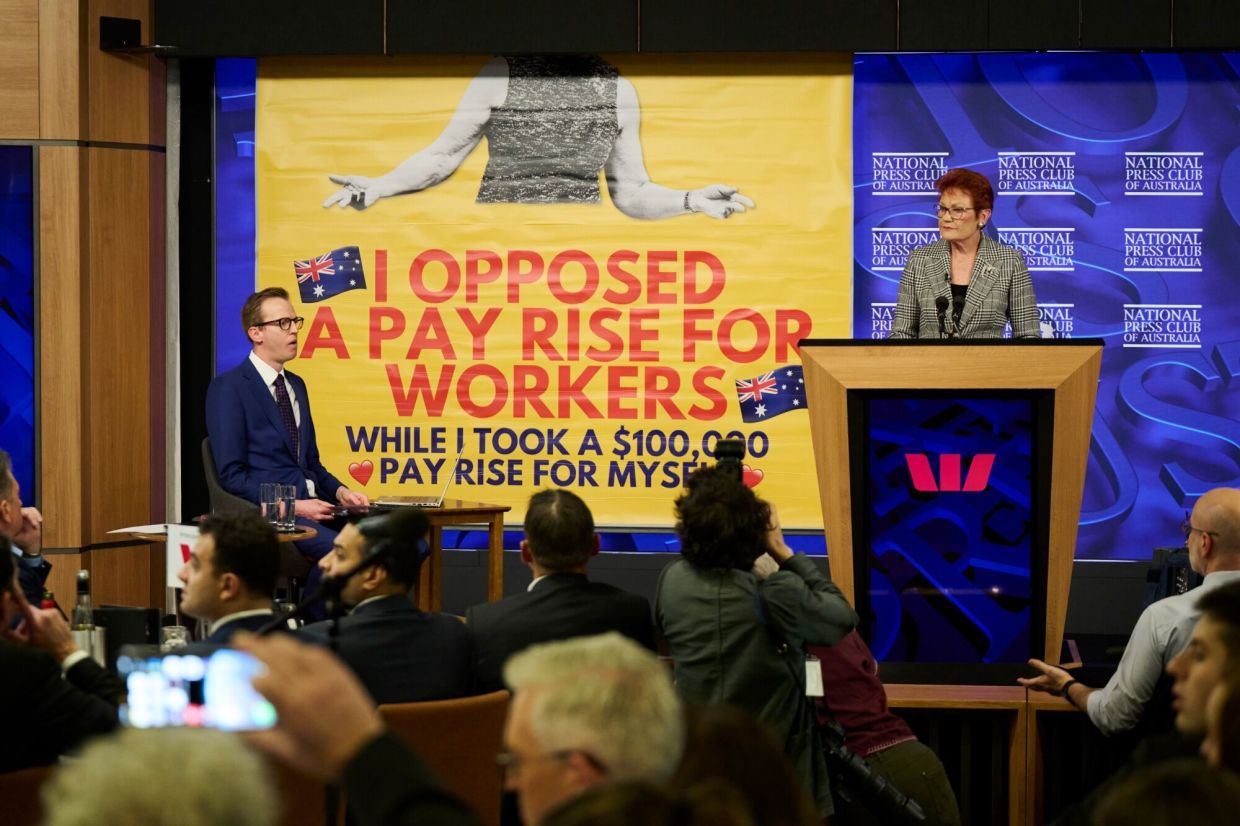
Pauline Hanson, leader of Australia's One Nation party, has made a bold ideological statement by calling for her nation to abandon its longstanding multicultural model in favour of what she describes as a monocultural society. Speaking at the National Press Club in Canberra on Wednesday, the hard-right populist leader positioned her challenge to decades of established policy as essential to addressing the country's escalating housing crisis and other economic pressures facing ordinary Australians.
Hanson's rhetoric distinguishes between racial and cultural dimensions of Australian identity, a distinction that underscores her political strategy. While she acknowledges that Australia is inevitably multiracial given its demographic reality, she insists the nation must operate under a single cultural framework. "We are a multiracial society, but we must be monocultural," she stated, arguing that Australians should "live under the one cultural umbrella." This framing allows her to avoid accusations of racism while fundamentally challenging the institutional embrace of cultural pluralism that has defined Australian policy since the 1970s.
The One Nation leader's appearance at the National Press Club marked a significant moment in her political trajectory, being her first speech at the prestigious forum despite three decades in Australian politics. Her choice to use this platform to launch a comprehensive critique of multiculturalism signals her intention to place cultural identity at the centre of Australia's political debate. The timing is strategic, as her party has experienced a notable surge in opinion polling over the past year, a momentum that accelerated following the collapse of the centre-right coalition's electoral dominance in May of the previous year.
Hanson's proposed solutions extend beyond rhetorical criticism to concrete policy positions. She has pledged to dramatically reduce migration levels, with particular emphasis on restricting entry from regions she characterises as centres of extremism, specifically naming "radical Islam" as a concern. These proposals resonate with sections of the Australian electorate grappling with tangible economic anxieties, transforming immigration from a peripheral policy matter into a central election issue.
The broader economic context has provided fertile ground for One Nation's rise. Australians have endured mounting inflationary pressures, escalating interest rates that have squeezed household budgets, and volatile fuel costs exacerbated by geopolitical tensions involving Iran. These compounding economic shocks have shifted public sentiment and created opportunities for populist messaging that offers simple explanations for complex problems. Hanson has seized upon these conditions, attributing economic difficulties directly to immigration policy and the costs associated with renewable energy transitions, thereby channelling genuine public anxiety into her party's political project.
The housing affordability crisis, which has become increasingly acute across Australia's major cities, occupies particular prominence in Hanson's argument. By framing immigration as the root cause of housing scarcity and unaffordability, she presents a straightforward narrative that resonates with voters struggling to enter the property market. This causal link, while contested by economists and housing analysts who point to supply-side constraints, zoning restrictions, and investment dynamics as primary factors, offers an intuitive explanation that appeals to frustrated Australians.
Prime Minister Anthony Albanese's Labor government has attempted to address economic pressures through targeted fiscal interventions. These measures have included a temporary reduction in fuel excise tax to ease immediate cost-of-living pressures and broader tax reform initiatives designed to improve housing affordability. However, these conventional policy responses have struggled to fully counter the political momentum generated by One Nation's populist messaging.
Albanese has diagnosed the rise of One Nation and similar movements as symptomatic of deeper economic dysfunction. He has explicitly identified "simplistic grievance-based politics" as a reaction to an economy that is failing to deliver prosperity for ordinary citizens. This analysis suggests that One Nation's gains reflect genuine dissatisfaction rather than purely ideological shifts, implying that economic policy reform may be as important as cultural messaging in addressing the party's electoral surge.
For Malaysian and Southeast Asian observers, Australia's political trajectory offers instructive parallels and contrasts. Malaysia itself has grappled with questions of cultural identity and national cohesion within a diverse society, though through different institutional frameworks and constitutional arrangements. Hanson's explicit rejection of multiculturalism represents a marked departure from Australia's post-war settlement and challenges the model that many Asian democracies, including Malaysia, have attempted to navigate. The electoral success of anti-immigration and monocultural messaging in Australia suggests that developed economies are not immune to populist backlash against diversity and globalisation.
The implications for regional security and cooperation merit consideration as well. Australia's potential shift toward restrictive immigration policies and inward-looking cultural nationalism could affect bilateral relationships with Southeast Asian nations, which have sent significant diaspora populations to Australia and rely on educational and commercial ties with the country. Furthermore, One Nation's explicitly Islamophobic positioning carries particular significance for the predominantly Muslim nations of Southeast Asia, potentially complicating regional diplomatic relations if such sentiments gain greater political influence in Australian governance.
The convergence of economic distress, housing unaffordability, and inflationary pressures with Hanson's cultural nationalism demonstrates how economic grievances can be channelled into identity-based political movements. As Australian voters face genuine hardship, the party offering the clearest villain—immigration and multiculturalism—gains ground despite contested economic analysis. Whether this represents a fundamental realignment of Australian politics or a temporary protest vote against incumbent governments remains to be determined in forthcoming electoral cycles.