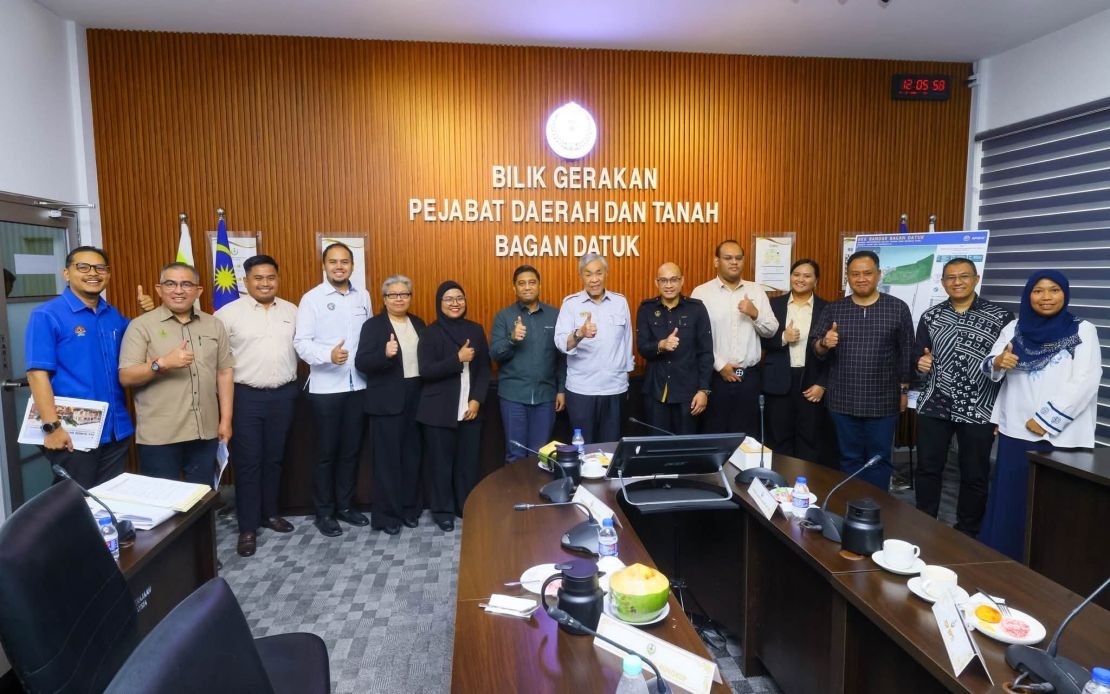
Deputy Prime Minister Datuk Seri Dr Ahmad Zahid Hamidi has articulated an ambitious vision for transforming Bagan Datuk into a modern administrative town that balances development with livability, presenting the Perak district as a key growth area for the region. Speaking during a visit to review the special area plan for the constituency, Zahid stressed that the district possesses significant untapped potential waiting to be mobilized through strategic planning and infrastructure investment.
As the Member of Parliament representing Bagan Datuk, Zahid framed the development agenda as a collective responsibility among local authorities, federal agencies, and private stakeholders to translate theoretical potential into tangible benefits for residents. His comments came following a detailed presentation on the special area plan (RKK) conducted jointly with the Teluk Intan Municipal Council, Bagan Datuk District Office, and engaged consultants, signaling a multi-agency approach to the constituency's future trajectory.
The proposed development model emphasizes creating an integrated administrative centre characterized by deliberate urban planning that prioritizes green spaces, quality public amenities, and modern infrastructure networks. This "administrative town in a park" concept reflects contemporary thinking around sustainable urban development, where density and functionality coexist with environmental considerations and community wellbeing.
For Malaysian readers, the Bagan Datuk initiative demonstrates how secondary towns outside major metropolitan areas are being repositioned within national development frameworks. Perak, historically dependent on resource extraction and agriculture, is increasingly seen as an opportunity area for administrative decentralization and economic diversification, particularly as federal and state governments seek to distribute economic growth beyond the Klang Valley and Penang.
The emphasis on competitive economic opportunities within the planned development suggests intentions to attract businesses and skilled workers to the district, potentially through incentives related to administrative functions, technology parks, or service sector hubs. Such developments could reshape labour patterns in northern Perak and provide alternatives to migration toward Kuala Lumpur and other established metropolitan centres.
Zahid's reference to his personal connection to Bagan Datuk as a native of the area adds political significance to the initiative, potentially signaling increased federal attention to his constituency. The involvement of high-ranking government figures in local planning decisions can accelerate implementation timelines and secure resources that might otherwise face bureaucratic delays or budget constraints.
The special area plan represents a departure from ad-hoc development patterns that have characterized many Malaysian towns, where growth occurs incrementally without comprehensive vision or coordination. A structured planning approach allows authorities to manage infrastructure expansion strategically, prevent haphazard urban sprawl, and maintain quality of life standards as population and economic activity increase.
For the broader Perak region and neighbouring states, successful implementation of the Bagan Datuk model could establish replicable templates for developing secondary administrative centres. This has implications for national urban planning strategy, particularly the distribution of government services and the creation of employment poles outside the overextended capitals of Kuala Lumpur and Putrajaya.
The consultation process involving municipal councils, district offices, and professional consultants indicates engagement with stakeholder input, though the extent to which community voices genuinely shape outcomes rather than rubber-stamp predetermined plans remains an open question. Effective consultation mechanisms can prevent social friction and ensure developments align with resident expectations regarding land use, environmental impact, and service provision.
Implementing the Bagan Datuk vision will require sustained political commitment beyond the initial announcement phase, securing consistent funding allocations across multiple budget cycles, and maintaining coordination between agencies with varying priorities and timelines. Infrastructure development in secondary towns frequently experiences delays and cost overruns when political momentum dissipates or competing national priorities emerge.
The initiative also reflects recognition that Malaysia's development cannot remain concentrated in existing metropolitan zones without creating regional imbalances, infrastructure congestion, and unsustainable resource consumption. Distributed growth across secondary towns, properly planned, offers pathways toward more balanced national development that benefits Perak residents while easing pressures on established urban centres.
Success in Bagan Datuk would require demonstrating that administrative functions can operate effectively in non-capital locations, that quality public services attract and retain skilled workers outside metropolitan areas, and that livable communities with strong local economies develop without extensive government subsidies. These are not merely technical urban planning challenges but questions about how Malaysia envisions its future spatial organization and development distribution.

