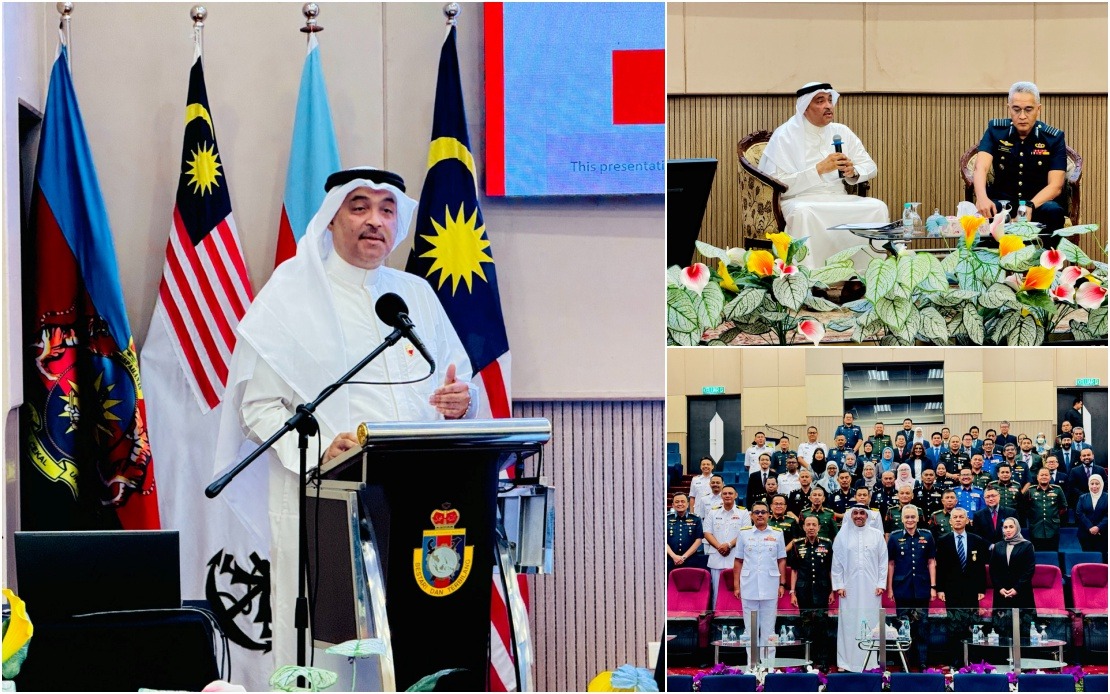
The relationship between Bahrain and Malaysia is entering a new phase of substantive cooperation, according to remarks made by Bahrain's top diplomatic representative in the country during a high-level security lecture in Putrajaya. Dr Waleed Khalifa Al Manea, serving as ambassador, underscored that both nations are working in concert across numerous domains to advance their mutual interests and strengthen ties rooted in personal bonds between their respective monarchs and executive leadership.
The foundation for this deepening engagement rests squarely on the established rapport between His Majesty King Hamad bin Isa Al Khalifa of Bahrain and His Majesty Sultan Ibrahim, the Malaysian King, supplemented by active engagement from their prime ministerial counterparts. His Royal Highness Prince Salman bin Hamad Al Khalifa, who holds the dual portfolio of crown prince and prime minister in Bahrain, and Datuk Seri Anwar Ibrahim, Malaysia's prime minister, have both invested considerable diplomatic energy into broadening collaborative frameworks. This two-track leadership approach—combining monarchical goodwill with executive-level implementation—creates institutional momentum for sustained partnership development.
One striking indicator of the partnership's trajectory emerged through an unexpected channel: sporting diplomacy. Malaysia's confirmed hosting of the 2026 Formula 1 Gulf Air Bahrain Grand Prix represents more than a calendar fixture; it functions as a tangible manifestation of bilateral confidence and coordinated vision. The selection symbolizes mutual recognition of shared interests in projecting influence through global sporting platforms while simultaneously fostering people-to-people connections that transcend traditional governmental channels. For Southeast Asian observers, this arrangement also demonstrates how regional nations can leverage major international events to elevate their standing and create platforms for broader strategic messaging.
The ambassador's address took place within a distinctly Malaysian institutional context—the National Resilience College, housed within the Malaysian National Defence Studies Centre—and attracted an impressive cross-section of the security establishment. The assembled audience encompassed senior military figures including Major General Dr Abdul Karim Ahmad and Major General Datuk Abdul Rahim Yusuf, alongside representatives from the Royal Malaysia Police and Malaysian Maritime Enforcement Agency, several government ministries, elected parliamentarians, and academic specialists in defence and strategic studies. This congregation reflected the seriousness with which Malaysian officials regard Bahrain's perspectives on emerging security dynamics.
Bahrain's security doctrine, as articulated during the lecture, operates along multiple integrated lines of effort. The kingdom prioritises safeguarding its territorial sovereignty while simultaneously protecting civilian populations from external threats. Critically, the approach emphasizes factual documentation of incidents and incidents—a seemingly technical point that carries significant implications in the information-saturated environment of Middle Eastern geopolitics, where competing narratives often obscure underlying facts. Diplomatic engagement and coordinated multilateral action represent the third pillar, reflecting Bahrain's conviction that unilateral responses prove insufficient for addressing region-wide security challenges.
The elephant in the room throughout the lecture concerned Iranian actions targeting Gulf Cooperation Council member states. According to Al Manea's characterization, these activities extend beyond military installations to encompass civilian infrastructure and critical maritime shipping lanes that underpin global commerce. The strategic importance of these waterways reverberates far beyond the immediate region; disruptions reverberate through supply chains affecting economies across Asia-Pacific, including Malaysia. Tensions in the Strait of Hormuz and surrounding waters carry unmistakable implications for energy security and commercial navigation patterns that directly touch Malaysian interests and those of the broader ASEAN community.
Bahrain's recent stewardship of the United Nations Security Council provided an opportunity to translate regional security concerns into international frameworks with binding implications. During its April presidency, the kingdom prioritised initiatives aimed at protecting maritime freedom of navigation and safeguarding critical infrastructure from attack. These efforts sought to mobilize the international community toward establishing clearer norms and consequences regarding attacks on commercial shipping and vital installations—precedents with implications extending well beyond the Persian Gulf into waters where ASEAN members maintain significant economic interests and through which vital shipping passes.
Malaysia's co-sponsorship of UN Security Council Resolution 2817 revealed strategic alignment with Bahrain's positioning on these matters. The resolution reaffirmed national sovereignty principles while establishing explicit protections for civilian populations and demanding cessation of attack patterns. For Malaysia, such sponsorship signals willingness to engage in the broader international security architecture rather than maintaining purely neutral posturing, and reflects calculation that Southeast Asian stability ultimately depends on acceptable international norms governing state conduct even in distant regions.
The participation of Malaysian parliamentarians and defence officials in Al Manea's lecture suggests that substantive engagement on Middle Eastern security matters has penetrated Malaysia's political establishment more deeply than sometimes appreciated. Rather than viewing the Middle East as geographically and strategically distant, Malaysian policymakers increasingly recognize that major regional conflicts generate reverberations affecting ASEAN security through multiple mechanisms: maritime disruption, sectarian complications, refugee flows, and ideological currents that cross borders with relative ease. Bahrain's ambassador thus functioned partly as regional educator, helping Malaysian audiences understand connection points between Gulf security developments and their own national interests.
The breadth of cooperation between these two nations extends beyond the security realm into what might be termed strategic affinity. Both are regional powers with specific geopolitical roles and concerns: Bahrain as a Gulf state navigating the complex dynamics between larger neighbours, Malaysia as a Southeast Asian anchor committed to preserving regional equilibrium. Their partnership reflects recognition that middle-power nations frequently benefit from coordinated approaches to international questions, particularly when addressing challenges emanating from more powerful actors whose interests may not align with smaller nations' preferences. The 2026 Formula 1 arrangement thus represents not merely a sporting agreement but rather symbolic reaffirmation of mutual commitment to sustained engagement regardless of external pressures.
Looking forward, the deepening partnership between Bahrain and Malaysia carries implications for ASEAN's regional positioning. As the bloc navigates its own security challenges—from maritime disputes to great-power competition—bilateral partnerships with non-Southeast Asian actors become increasingly valuable. Bahrain's demonstrated commitment to dialogue and multilateral solutions, combined with Malaysia's diplomatic weight within ASEAN, positions both nations to contribute toward regional stability frameworks that extend beyond traditional Southeast Asian boundaries. The ambassador's lecture thus functioned not merely as diplomatic courtesy but as substantive engagement with Malaysia's security establishment, reinforcing partnerships that may prove instrumental in managing future regional crises.

