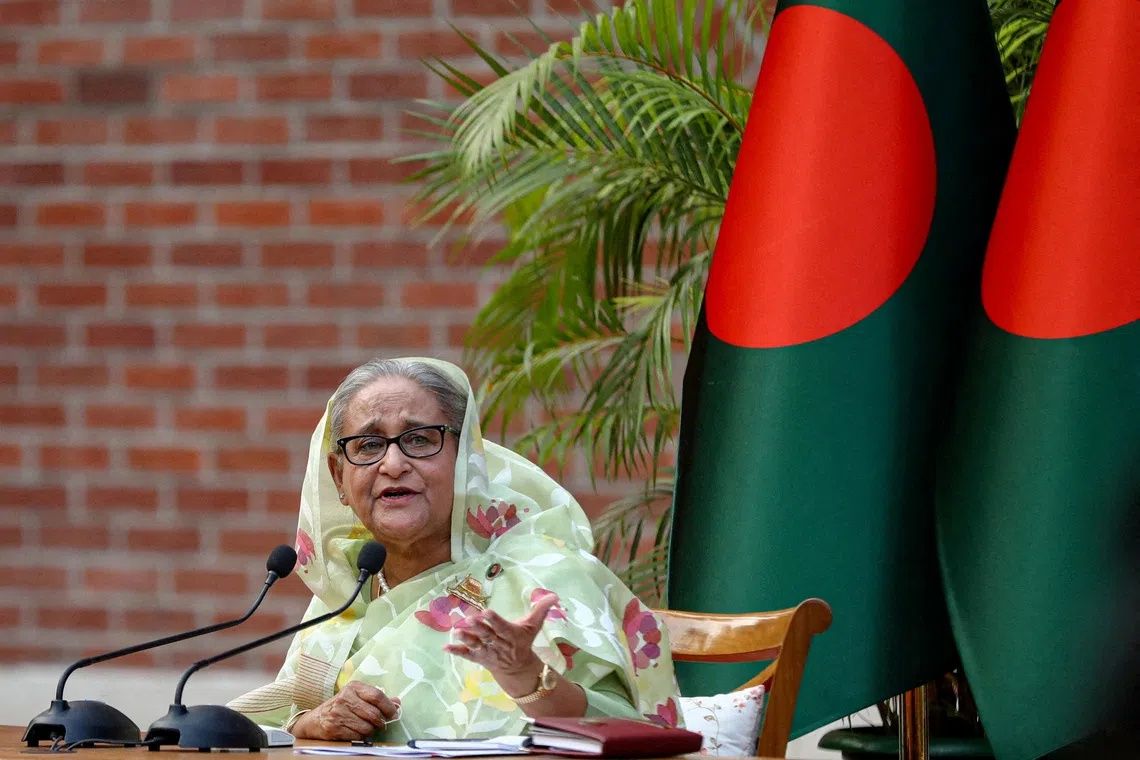
Bangladesh has formally requested that India take a clear position on whether it will permit exiled former prime minister Sheikh Hasina to participate in a virtual political event scheduled for August 5 in New Delhi. The demand represents Dhaka's first official statement regarding Hasina's planned appearance at an anniversary gathering hosted by the Foreign Correspondents' Club of South Asia, which will commemorate two years since the student-led uprising that swept her administration from power in August 2024. Bangladesh's State Minister for Foreign Affairs Shama Obaed Islam delivered the statement on Monday, signalling that Dhaka views the matter as significant enough to warrant high-level diplomatic intervention.
The timing of Hasina's planned speech carries particular sensitivity given the current trajectory of Bangladesh-India relations. Since Tarique Rahman's interim government assumed office following February's elections, both nations have made visible efforts to improve bilateral engagement and cooperation. Bangladesh officials fear that permitting a fugitive former leader to conduct political activities from Indian territory could undermine this fragile rapprochement. Islam emphasized that Dhaka has consistently raised concerns with New Delhi about Hasina and other Awami League figures making political statements and conducting party activities from across the border. Her statement suggested that India had previously communicated its opposition to fugitives using its soil for political organising, making the current situation appear at odds with earlier understandings.
Hashina, now 78 years old, has resided in India continuously since fleeing Bangladesh in August 2024 as her government collapsed under mounting civil unrest. The uprising, which resulted in an estimated 1,400 deaths according to United Nations assessments, exposed deep public anger over her administration's response to anti-government demonstrations. Since her departure, Bangladesh has launched formal extradition proceedings, viewing her continued presence in India as problematic. The situation grew more complicated in 2025 when Bangladeshi courts convicted Hasina in absentia on charges relating to crimes against humanity connected to the 2024 security crackdown. She has dismissed the verdict as legally invalid, refusing to acknowledge the court's authority.
The planned New Delhi event will feature Hasina delivering her address via video link, alongside her son Sajeeb Wazed Joy and other speakers at the Foreign Correspondents' Club gathering. While the FCCSA event is not officially organised by the Indian government, Bangladesh views it as a platform that could amplify Hasina's political messaging and influence domestic politics back home. The club has not yet responded to inquiries about Dhaka's concerns, leaving the diplomatic situation in a state of uncertainty. Islam made clear that Dhaka would escalate the matter through formal diplomatic channels if necessary, indicating that this initial public warning represents just the opening move in what could become a more serious confrontation.
Remarking on Hasina's stated intentions, the former premier told Reuters in a recent interview that she plans to return to Bangladesh in December, despite facing multiple criminal cases and a death sentence conviction. This announcement further complicates the current crisis, suggesting that Hasina views her exile as temporary rather than permanent. For Bangladeshi officials, allowing her to conduct political activities while in India could embolden her supporters domestically and undermine the new government's authority. The statement from Islam—that India must clarify its position—reflects Dhaka's calculation that New Delhi has sufficient leverage and responsibility to prevent its territory from becoming a staging ground for political opposition to the current Bangladeshi administration.
The broader context reveals how the upheaval of August 2024 has left deep fissures in Bangladesh's political landscape that neighbouring nations now must navigate carefully. India, as Bangladesh's largest and most influential neighbour, finds itself in a delicate position. Maintaining strong relations with Dhaka's current government is strategically important, yet India also has established practices regarding asylum seekers and political refugees. The Foreign Correspondents' Club event, as a civil society gathering rather than a state function, exists in a grey zone where India's government may claim limited ability to restrict participation without appearing to compromise press freedom principles.
For Malaysian and Southeast Asian observers, the situation underscores how regional stability remains vulnerable to unresolved political transitions and the complications that arise when former leaders seek refuge across borders. The Bangladesh crisis demonstrates that such situations cannot be treated as purely bilateral matters—they inevitably implicate neighbouring states and regional mechanisms. The way India handles this question could establish precedent for how regional powers approach similar dilemmas in future political upheavals throughout South and Southeast Asia, where leadership transitions often occur amid civil unrest.
Dhaka's diplomatic strategy appears calibrated to pressure India without creating a public rift that would further damage the neighbourly relationship. By framing the issue as a matter requiring clarification rather than demanding outright prohibition, Bangladesh signals willingness to negotiate while maintaining that allowing Hasina's political activities crosses an unacceptable line. Whether India will ultimately intervene to prevent the FCCSA event remains unclear, with the Indian foreign ministry having offered no immediate response to Dhaka's representations. The coming weeks will likely see intensified behind-the-scenes negotiations as both governments attempt to reconcile their interests and international obligations.
The extradition question adds another layer of complexity. Bangladesh has consistently pursued Hasina's return through legal channels, viewing this as essential to demonstrating that the new government can hold former leaders accountable. India's role in either facilitating or preventing such proceedings remains ambiguous, particularly given that India itself has not formally rejected Bangladesh's extradition request. Allowing Hasina to operate politically from New Delhi while simultaneously considering an extradition demand creates an inherent contradiction that Bangladesh has now made impossible for India to ignore. This calculated public criticism may ultimately prove more effective than quiet diplomacy in moving India toward a position that aligns with Dhaka's expectations.

