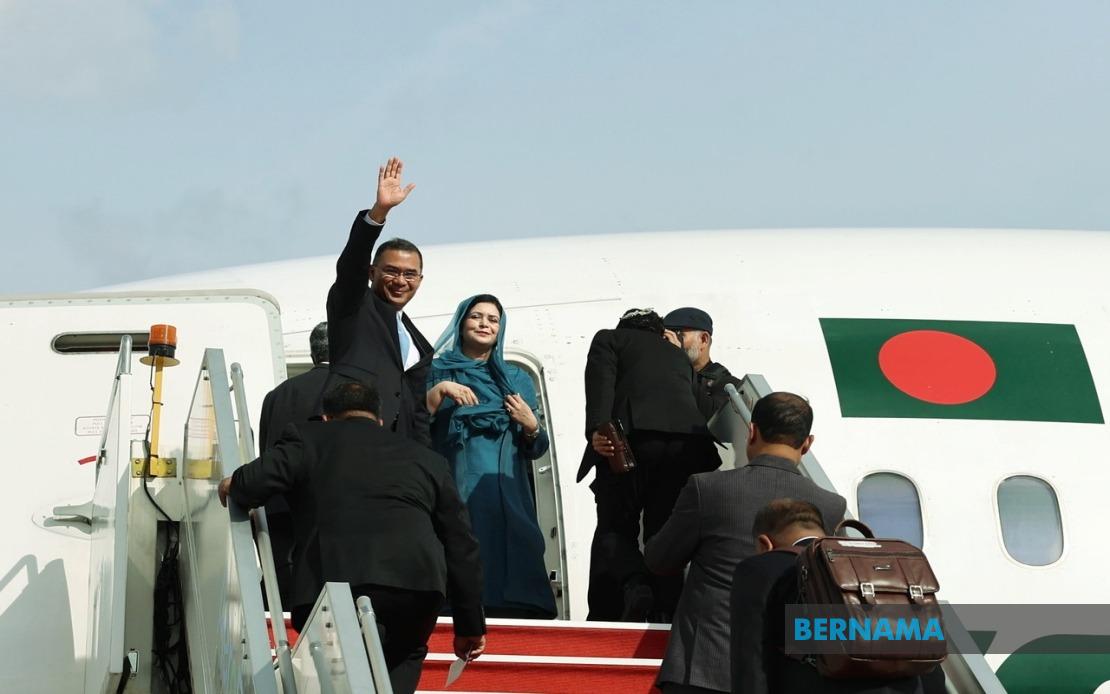
Bangladesh Prime Minister Tarique Rahman concluded his two-day official visit to Malaysia on June 22, departing Kuala Lumpur International Airport for China. The special aircraft carrying the Prime Minister and his entourage lifted off from the Bunga Raya Complex at 5 pm, following a formal ceremonial send-off featuring a guard of honour composed of 28 officers and personnel from the First Battalion of the Royal Ranger Regiment. Minister in the Prime Minister's Department (Religious Affairs) Dr Zulkifli Hasan attended the departure ceremony to bid farewell to Tarique, his spouse Dr Zubaida Rahman and members of the Bangladeshi delegation.
The visit marked Tarique's first bilateral overseas trip since assuming office in February 2026, underscoring Malaysia's strategic importance to Bangladesh's early diplomatic engagements. This timing reflects the new administration's prioritisation of Southeast Asian partnerships as foundational to its regional integration strategy. The decision to visit Malaysia before other regional capitals signals the significance both nations place on their relationship, particularly given Bangladesh's evolving role in regional economic and geopolitical architecture.
On the morning of his departure, Tarique met with Prime Minister Datuk Seri Anwar Ibrahim at the Perdana Putra Complex to review pressing bilateral and international matters. The bilateral meeting provided an opportunity for both leaders to address regional and global concerns of shared interest, demonstrating alignment on multiple fronts. The conversation extended beyond economic partnership to encompass strategic challenges confronting South and Southeast Asia, indicating a broadening scope of cooperation beyond traditional trade considerations.
Trade relations featured prominently in discussions, with both leaders committed to accelerating economic integration through a fast-track free trade agreement. The current trade architecture reveals Malaysia's dominant position as an exporter to Bangladesh, with 2025 figures showing Malaysian exports valued at RM10.08 billion, predominantly petroleum products and energy-related commodities. Bangladesh's reciprocal exports of RM2.10 billion primarily comprised textiles, apparel and footwear, reflecting complementary economic structures. Total bilateral trade reached RM12.18 billion in 2025, positioning Bangladesh as Malaysia's 28th-largest trading partner globally and second-largest within South Asia after India.
Beyond commercial ties, the leaders explored cooperation across multiple strategic sectors. Energy emerged as a critical area, with both nations recognising opportunities for enhanced collaboration in power generation and renewable energy initiatives. The semiconductor industry was identified as another growth avenue, capitalising on Malaysia's established expertise and Bangladesh's expanding manufacturing base. Agricultural partnerships and human resource development were similarly highlighted, reflecting the demographic dividends both nations possess and the potential for skills transfer and knowledge exchange.
The halal industry featured distinctly in sectoral discussions, leveraging both nations' Islamic heritage and consumer bases. Malaysia's established halal certification and production ecosystem could support Bangladesh's development of its own halal sector, creating opportunities for trade expansion and investment flows. This focus aligns with broader regional trends toward faith-based economic frameworks that integrate religious principles with commercial objectives.
Three formal instruments were executed during the visit, formalising commitments across cultural, security and economic dimensions. A Memorandum of Understanding on Cultural Cooperation establishes frameworks for educational exchanges, artistic collaboration and cultural tourism initiatives. Simultaneously, an Exchange of Notes on Counter-Terrorism Research addresses shared security concerns, recognising the transnational nature of contemporary terrorism and the necessity for intelligence and operational cooperation. A separate Exchange of Notes on Investment Promotion and Facilitation aims to streamline foreign direct investment procedures, reducing bureaucratic barriers and encouraging capital flows between the two economies.
Bangladesh's positioning within regional institutional architecture featured significantly in discussions. Tarique reiterated his country's aspiration to obtain ASEAN Sectoral Dialogue Partner status, a development that would grant enhanced participation in ASEAN processes and mechanisms without full membership obligations. Simultaneously, Bangladesh expressed formal interest in acceding to the Regional Comprehensive Economic Partnership, the megaregional trade agreement encompassing ten ASEAN members plus China, Japan, South Korea, Australia and New Zealand. Malaysian support for these endeavours could prove instrumental in facilitating Bangladesh's deeper integration into Southeast Asian institutional frameworks.
Global affairs revealed substantial convergence between Kuala Lumpur and Dhaka. Both governments affirmed unwavering support for the Palestinian cause and expressed grave concern regarding the humanitarian catastrophe in Gaza. The two leaders emphasised the imperative for sustained international diplomatic efforts aimed at establishing lasting peace arrangements in the Gulf region and addressing the Iran nuclear question through multilateral dialogue. This alignment on Middle Eastern affairs reflects broader trends among Muslim-majority nations positioning themselves as constructive intermediaries in regional conflicts.
The Rohingya refugee crisis commanded particular attention in bilateral discussions, representing a longstanding humanitarian and diplomatic challenge directly affecting both nations. Malaysia hosts one of the world's largest Rohingya populations, whilst Bangladesh harbours approximately one million refugees in sprawling camps in Cox's Bazar. Both governments committed to strengthening cooperation through existing ASEAN mechanisms to identify durable solutions, including renewed engagement with Myanmar authorities. This commitment acknowledges that third-country facilitation remains essential given the complex bilateral tensions between Bangladesh and Myanmar over repatriation arrangements.
The visit duration of two days, whilst brief, reflected the compressed schedule typical of inaugural bilateral trips by newly-assumed leaders. Nevertheless, the substantive outcomes—three formal agreements, comprehensive sector coverage and alignment on major international issues—demonstrate that qualitative depth compensated for temporal brevity. The progression from Malaysia to China immediately following signals Tarique's intention to establish relationship foundations across Asia's major powers early in his administration.
Looking ahead, the commitments made during this visit establish benchmarks for Malaysia-Bangladesh relations across the medium term. The proposed fast-track FTA, if executed promptly, could fundamentally reshape bilateral commerce and investment patterns. Bangladesh's potential elevation to ASEAN Sectoral Dialogue Partner status, supported by Malaysia's diplomatic backing, would represent a significant institutional advancement for the nation. Simultaneously, both countries' shared vision for addressing Palestinian suffering and regional peace indicates possibilities for joint advocacy within multilateral forums, enhancing their collective influence on pressing international questions.

