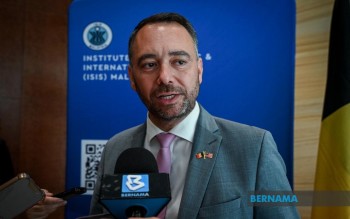
Belgium has expressed strong interest in deepening cooperation with Malaysia across offshore energy and several other strategic sectors, signalling Brussels' determination to expand its footprint in Southeast Asia amid the region's accelerating transition toward clean power. The overture came during a high-level visit by Belgian Deputy Prime Minister Maxime Prévot, who emphasised that offshore wind energy represents one of the most promising avenues for bilateral collaboration between the two nations. Speaking on the sidelines of the 39th Asia-Pacific Roundtable in Kuala Lumpur, Prévot outlined how Belgium's experience managing complex offshore projects could prove invaluable to Malaysia as it scales up renewable capacity to meet rising electricity demand and climate commitments.
The Belgian official painted an impressive picture of his country's offshore wind achievements, noting that despite possessing a modest coastline of just 60 kilometres, Belgium has constructed offshore wind farms currently capable of generating two gigawatts of electricity for its population. He disclosed plans to expand this capacity significantly, targeting six to seven gigawatts within the coming years—a figure equivalent to the output of five to seven nuclear power plants. This expansion strategy reflects Belgium's broader commitment to energy security and achieving climate neutrality, objectives that align closely with Malaysia's own renewable energy targets and the regional decarbonisation agenda being pursued across Southeast Asia.
Beyond offshore energy, Prévot identified several complementary sectors where Malaysia and Belgium could forge productive partnerships. Semiconductors, logistics, clinical trials, biotechnology research and development, and pharmaceuticals emerged as priority areas during discussions. The breadth of these proposed collaboration fields underscores Belgium's ambition to position itself not merely as a green energy partner but as a comprehensive technology and innovation ally for Malaysia. For Malaysian policymakers and industry stakeholders, such diversified cooperation could create multiple pathways for technology transfer, skills development, and investment flows across critical growth sectors.
A significant dimension of Belgium's regional strategy involves the European Union's Global Gateway Initiative, under which Brussels is helping to mobilise €10 billion in investment directed toward the ASEAN Power Grid and broader energy transition programmes across Southeast Asia. Prévot framed this commitment as evidence of Europe's dedication to fostering long-term, sustainable development that benefits local communities while simultaneously strengthening regional connectivity and resilience. For Malaysia, which sits at the heart of ASEAN's energy architecture and serves as a crucial node in regional power infrastructure planning, this EU funding mechanism could unlock substantial resources for grid modernisation, renewable deployment, and cross-border electricity trading arrangements.
The timing of Prévot's visit—his first to Malaysia since assuming office in February 2025—reflects a deliberate effort by Belgium to strengthen ties with the country at a moment when global energy markets are undergoing profound transformation. Geopolitical tensions, supply chain vulnerabilities, and the accelerating pace of renewable technology adoption have created new incentives for countries to diversify their energy partnerships and secure reliable access to clean technology expertise. Malaysia's position as a major energy producer and consumer in the region makes it an especially attractive partner for Belgium as it seeks to expand its influence in the Indo-Pacific and establish itself as a trusted collaborator in the green energy revolution.
Bilateral trade relations between Malaysia and Belgium provide a foundation upon which deeper sectoral cooperation can be built. In 2025, total trade reached RM9.74 billion, with Malaysian exports comprising RM6.85 billion and Belgian imports accounting for RM2.89 billion. These figures, while respectable, suggest considerable untapped potential for growth, particularly if new partnerships in renewable energy and advanced technology sectors generate additional commercial flows. Moreover, Belgian companies have demonstrated sustained confidence in Malaysia's business environment, with 67 projects involving Belgian participation approved to date, representing cumulative investments of RM5.1 billion and projected employment creation of 4,605 jobs.
Malaysia's energy security considerations lend particular urgency to Prévot's offshore wind proposals. As the nation grapples with growing electricity demand fuelled by economic development and industrial expansion, while simultaneously facing pressure to reduce carbon emissions, diversifying its renewable energy portfolio has become strategically imperative. Offshore wind, which can generate power more consistently than land-based solar installations and does not compete for limited terrestrial space, offers compelling advantages for an equatorial nation with extensive maritime zones. Belgium's technical expertise in developing, operating, and maintaining offshore wind infrastructure could prove transformative for Malaysian efforts to accelerate renewable capacity additions beyond current targets.
The EU's Global Gateway Strategy, which underpins the €10 billion commitment to ASEAN energy transition, represents a calculated European response to perceived shifts in global influence and investment patterns. By channelling substantial resources into regional infrastructure and clean energy, the EU aims to cement its position as a reliable development partner while competing with other major powers for economic and political influence in Southeast Asia. Malaysia stands to benefit considerably from this strategic competition, provided it can effectively coordinate investment absorption, regulatory harmonisation, and technology deployment across relevant sectors.
For Malaysian stakeholders in renewable energy and advanced manufacturing, Belgium's offshore wind sector offers instructive lessons. Despite geographic constraints and high labour costs comparable to those in developed economies, Belgium has built world-class capabilities through sustained investment in research, workforce training, and supply chain development. Such experience could inform Malaysia's own efforts to develop competitive advantages in renewable technology manufacturing and deployment, creating opportunities for local companies to integrate into regional and global clean energy value chains.
Looking ahead, the success of Malaysia-Belgium cooperation in offshore energy will depend on several factors: clarity regarding investment frameworks and technology transfer arrangements, alignment of regulatory standards, and sustained political commitment from both governments. The visit by Prévot signals that Belgium is prepared to move beyond rhetorical expressions of interest toward substantive engagement. Whether Malaysia reciprocates with equally concrete policy measures and institutional support will determine whether this diplomatic initiative translates into tangible investments and technological advancement.
The convergence of Belgium's green energy expertise, EU financial backing, and Malaysia's energy transition needs creates a genuinely propitious moment for partnership. As both nations pursue ambitious climate and sustainability objectives within their respective contexts, deepening cooperation across offshore wind and related sectors could yield benefits extending well beyond bilateral trade figures. Enhanced technical capacity, accelerated renewable deployment, and improved regional energy security all stand to gain from such collaboration, positioning Malaysia as a pioneer in Southeast Asian offshore wind development and strengthening the region's overall energy resilience in an increasingly complex geopolitical landscape.

