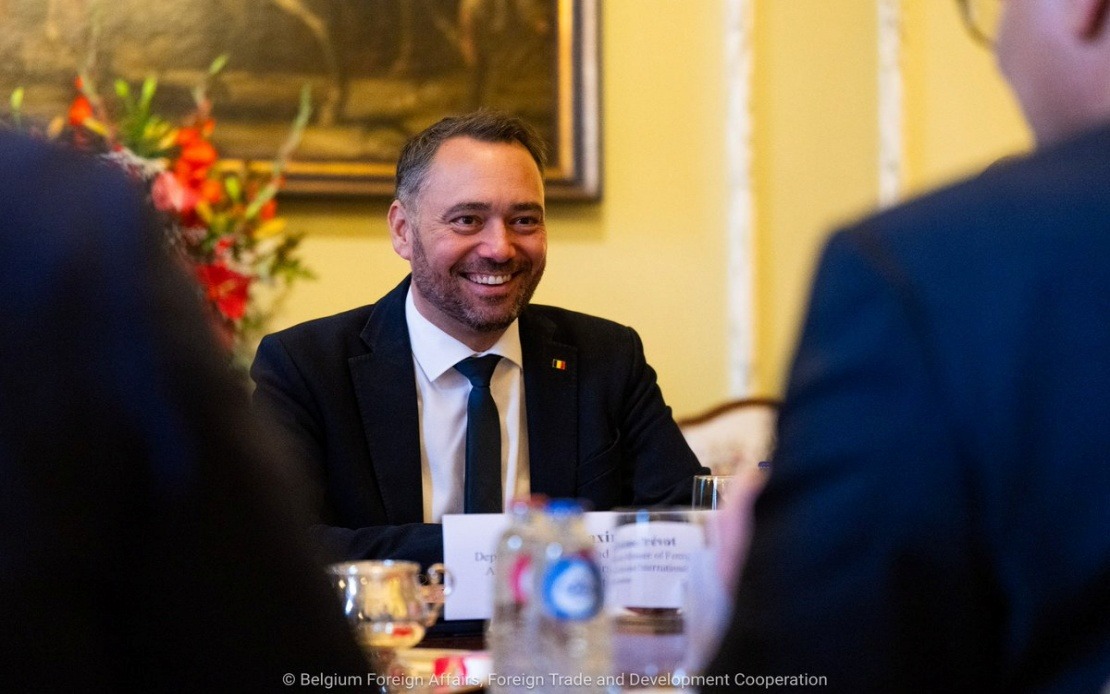
Belgium's Deputy Prime Minister and Foreign, European Affairs and Development Cooperation Minister Maxime Prévot is arriving in Malaysia on Thursday for a two-day working visit that underscores deepening European interest in the region's energy transition and industrial capacity. The visit, the first by Prévot since taking office in February 2025, signals Brussels's commitment to engaging Southeast Asia on critical economic and technological fronts at a time when renewable energy deployment and critical mineral sourcing are reshaping global supply chains.
The centrepiece of Prévot's itinerary will be a meeting with Deputy Prime Minister Datuk Seri Fadillah Yusof on July 2, according to a statement from Malaysia's Foreign Ministry released Wednesday. Fadillah's concurrent portfolio as Energy Transition and Water Transformation Minister reflects Malaysia's strategic priority in positioning itself as a clean energy hub and underscores the alignment between Kuala Lumpur and Brussels on sustainability objectives. Both ministers will review the bilateral relationship's foundation while charting new pathways forward across several domains critical to Malaysia's economic diversification.
Renewable energy cooperation stands as the primary focus of these discussions, reflecting the urgent global shift toward decarbonisation and Malaysia's own commitments under regional climate frameworks. Belgium, a relatively small but technologically advanced nation, brings expertise in wind energy, solar integration, and grid modernisation that could complement Malaysia's tropical advantages and established manufacturing base. The convergence of Belgian technical know-how with Malaysian resources and infrastructure capacity presents genuine partnership potential, particularly as both nations navigate the complexities of rapid energy system transformation.
Rare earth elements constitute another substantive agenda item, a sector where Malaysia possesses historical significance and ongoing involvement. These materials are indispensable for renewable energy technologies, electric vehicles, and advanced electronics—industries central to Europe's Green Deal ambitions. Belgium's position within the European Union's supply chain strategies and its role in processing and refining operations make cooperation on rare earth sourcing and value-added production strategically logical. For Malaysia, formalising such partnerships could enhance its position within global critical mineral networks while adding value to raw material exports.
The halal industry discussion reveals Belgium's pragmatic recognition that Malaysia's established halal ecosystem—encompassing certification, manufacturing, finance, and logistics—represents a legitimate economic opportunity. As Muslim populations grow across Europe and demand for certified halal products expands, Belgian businesses see potential in supply chain partnerships and knowledge transfer. For Malaysia, this sector already generates substantial export revenues and employment; Belgian engagement could accelerate technological adoption in halal food processing and expand market access across EU member states.
Beyond bilateral matters, Prévot's agenda encompasses broader Malaysia-European Union relations, positioning this visit within the wider context of EU engagement with Southeast Asia. Recent EU strategic pivots toward the Indo-Pacific reflect European recognition that Asian growth, technological advancement, and geopolitical weight necessitate sustained diplomatic presence and economic partnerships. Prévot's presence at regional forums, combined with bilateral discussions, reinforces Brussels's commitment to treating Malaysia and ASEAN not as peripheral markets but as central actors in shaping the 21st-century global order.
The Deputy Prime Minister is scheduled to address the 39th Asia-Pacific Roundtable, an annual gathering organised by the Institute of Strategic and International Studies (ISIS) Malaysia that attracts senior officials, analysts, and academics from across the region and beyond. This speaking platform provides Prévot with an opportunity to articulate Belgium's and the EU's vision for Indo-Pacific engagement, energy security, and economic cooperation to a discerning audience of policymakers and thought leaders. His remarks will likely emphasise the mutual benefits of Europe-Asia collaboration on green transitions and resilient supply chains.
A scheduled audience with the Sultan of Perak, Sultan Nazrin Muizzuddin Shah, adds ceremonial weight to the visit, reflecting diplomatic protocol and recognition of royal patronage in Malaysian affairs. Such courtesies underscore the seriousness with which Belgium approaches its relationship with Malaysia and demonstrate respect for Malaysia's constitutional framework and institutional structures. The visit thus operates on multiple registers—governmental, diplomatic, and institutional—rather than as a narrowly technical exercise.
Bilateral trade between Malaysia and Belgium reached RM9.74 billion in 2025, with Malaysia exporting RM6.85 billion in goods and importing RM2.89 billion, demonstrating substantial two-way economic engagement. This volume reflects Malaysia's role as a significant supplier of intermediate and finished goods to European markets, particularly in electronics, chemicals, and palm oil derivatives. The trade imbalance, favouring Malaysian exports, indicates Malaysian competitiveness in sectors of European demand while Belgium's imports reflect high-value goods and services Malaysia requires.
Investment data further substantiate the partnership's depth and potential. As of 2025, Belgian companies have secured approval for 67 projects valued at RM5.1 billion, with potential job creation estimated at 4,605 positions. These figures, while modest compared to total Malaysian foreign direct investment, reflect established Belgian corporate presence and confidence in Malaysia's business environment. The concentration of Belgian investment likely reflects manufacturing, distribution, and service sectors where Belgium firms leverage Malaysia's skilled workforce and strategic location.
Prospects for expanded cooperation appear favourable given complementary needs and capabilities. Malaysia's development stage, abundant energy resources, and growing manufacturing sophistication align well with Belgium's technological strengths and capital availability. Energy transition represents perhaps the most urgent shared priority, as both nations—albeit from different starting points—require massive infrastructure investment, grid modernisation, and industrial adaptation. Concrete outcomes from Prévot's visit might include working group formations, pilot project agreements, or research collaboration frameworks that translate political commitment into tangible economic activity.
For Malaysia, this visit represents an opportunity to strengthen European engagement beyond traditional partners and to position itself advantageously within EU strategic thinking about Asian partnerships. As global energy systems undergo fundamental transformation and supply chains reorganise around sustainability and resilience criteria, Malaysia's ability to forge collaborative relationships with technologically advanced partners like Belgium becomes increasingly valuable. The visit also signals to Malaysian businesses and investors that European engagement remains substantial and that sectors aligned with energy transition and sustainable development offer expanding opportunities for partnership and growth.

