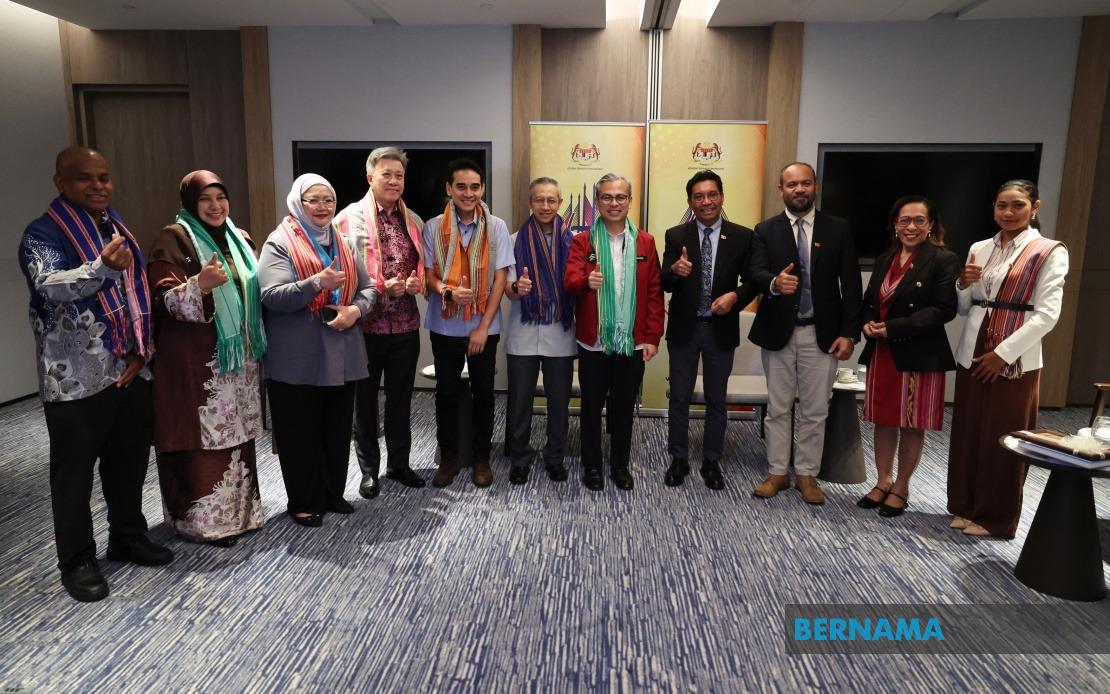
Malaysia's Bernama and Timor-Leste's national news agency TATOLI have formalised a strategic partnership aimed at reinforcing media cooperation between the two ASEAN nations. The memorandum of understanding, signed during the National Journalists' Day (HAWANA) 2026 celebration in Butterworth, marks a significant step in regional media collaboration and reflects the growing integration of Southeast Asian news organisations.
Bernama Chief Executive Officer Datin Paduka Nur-ul Afida Kamaludin outlined the scope of the partnership, emphasising that the initiative encompasses news, photographic content, and multimedia material sharing alongside structured training and journalism education. The arrangement aims to strengthen Bernama's position within regional and global news networks while ensuring that ASEAN narratives are shaped principally by indigenous news agencies rather than external entities. This approach underscores a broader regional commitment to media sovereignty and independent journalism capacity-building.
A particularly significant dimension of the collaboration involves expanding Bernama's linguistic reach. Currently publishing in six languages—Bahasa Melayu, English, Tamil, Mandarin, Arabic, and Spanish—the agency now plans to add Portuguese following this agreement. This expansion will allow Bernama content to reach Portuguese-speaking audiences globally, while simultaneously enabling Timorese readers to access Malaysian perspectives through TATOLI's distribution channels in Tetum, Portuguese, Bahasa Indonesia, and English. For Malaysian media institutions, the arrangement demonstrates a strategic approach to regional influence and cultural exchange within the ASEAN framework.
The partnership was formalised during a high-level ceremony attended by Communications Minister Datuk Fahmi Fadzil, Timor-Leste's Secretary of State for Social Communication Expedito Loro Dias Ximenes, and Prime Minister Datuk Seri Anwar Ibrahim, underscoring its importance to both governments. The presence of Penang Chief Minister Chow Kon Yeow and Bernama Chairman Datuk Seri Wong Chun Wai further reflected the stature accorded to the initiative. Such political backing indicates that media cooperation forms part of broader bilateral relations and ASEAN integration efforts.
TATOLI's interest in collaboration preceded Timor-Leste's formal accession to ASEAN in October 2025, signifying genuine intent from the Southeast Asian newcomer to engage with established regional institutions. Bernama's deliberate evaluation of the proposal ensured mutual benefits for both organisations and their respective staffing structures. This measured approach to partnership development reflects professional maturity in addressing not merely institutional but human resource dimensions of international cooperation.
The training component represents a concrete deliverable with immediate impact. Timorese journalists are expected to participate in Bernama-led programmes before year's end, accessing expertise across multiple media formats. Bernama's infrastructure includes specialised editors and instructional staff proficient in online journalism, television production, digital media platforms, radio reporting, and photography. Drawing on more than two decades of training experience and operating the Bernama School of Journalism through its Excellence Centre, the Malaysian agency possesses substantial capability to elevate professional standards at TATOLI.
TATOLI President Noémio Mateus Soares Falcão articulated the partnership's broader significance, emphasising that cooperative media development strengthens journalistic capacity and fosters innovation across the region. He positioned accurate information and ethical journalism as foundational to functional democratic societies, particularly as digital platforms accelerate information dissemination. This framing resonates with contemporary challenges facing Southeast Asian media landscapes, where misinformation and unverified content threaten public discourse and social cohesion.
Falcão specifically commended Malaysia's commitment to press freedom and journalistic ethics, values increasingly under pressure globally. His acknowledgment reflects how even new entrants to regional institutions appreciate established democracies' foundational work in defending media independence. For Malaysian readers, such recognition validates the domestic importance of safeguarding editorial independence and professional standards as regional contributions.
The timing of this partnership illuminates ASEAN's maturation as an institutional framework. Timor-Leste's membership expansion to eleven states necessitated integration mechanisms for shared challenges. Media cooperation addresses information asymmetries, capacity disparities, and the imperative for coordinated regional narratives in an era of geopolitical competition. Through Bernama-TATOLI collaboration, Southeast Asian voices gain amplification while less-resourced members access institutional knowledge and training.
For Malaysian media professionals, the partnership extends opportunities for international engagement and professional development. Bernama's positioning as a training hub for regional agencies consolidates its standing as an institution transcending purely domestic functions. This evolution reflects Malaysia's broader regional role and media infrastructure advantages that position the country as a natural leader in journalism capacity-building across ASEAN.
The collaborative framework also addresses contemporary misinformation challenges through professional standards diffusion. By elevating journalistic practices across member states, the partnership indirectly strengthens information quality accessible to broader Southeast Asian populations. This systemic approach to media quality improvement carries implications beyond bilateral ties, potentially contributing to more informed public discourse regionally.
Bernama's establishment in 1967 and TATOLI's founding in 2016 represent contrasting institutional maturity levels, yet the partnership treats both as professional peers committed to similar values. This egalitarian framing within ASEAN architecture acknowledges that institutional age matters less than shared commitment to accuracy, ethics, and democratic participation. Such partnerships model how capacity-building and knowledge transfer can occur between Southeast Asian institutions without replicating colonial-era dependency patterns.
Moving forward, the success of this collaboration will likely influence other regional media partnerships and establish templates for institutional cooperation within ASEAN's media sector. Malaysian observers should monitor how journalist training outcomes translate into improved coverage of mutual interests, whether linguistic expansion achieves projected reach, and how collaborative reporting initiatives develop. The partnership represents incremental but meaningful progress toward an information environment where Southeast Asian nations shape their own narratives.

