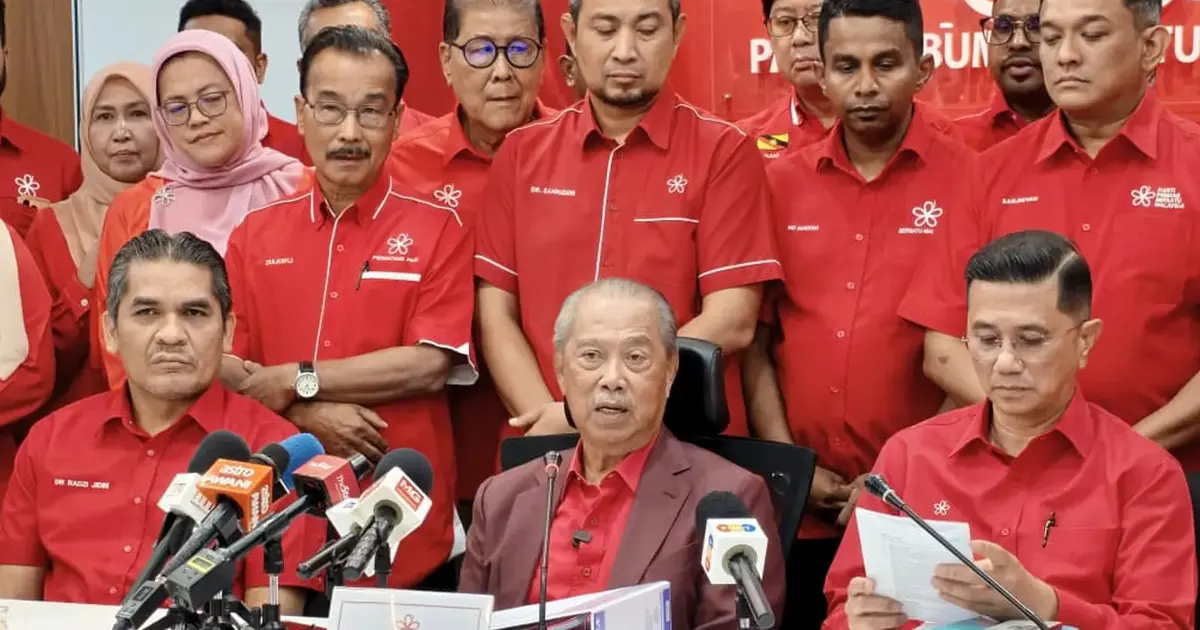
Bersatu will continue as an integral component of the Perikatan Nasional coalition, according to party president Muhyiddin Yassin, who grounded the decision in what he characterised as widespread public endorsement of the political arrangement. The statement comes at a significant juncture for the coalition, which has undergone substantial evolution since its formation and continues to define Malaysian politics at the federal and state levels.
Muhyiddin's declaration represents a formal reaffirmation of Bersatu's strategic positioning within PN, a coalition that has proven instrumental in shaping the country's political landscape over the past several years. The timing of such statements typically carries weight in Malaysian politics, as they signal stability or intentions regarding future electoral and parliamentary cooperation. This confirmation may be interpreted as Bersatu leadership's response to internal discussions or external speculation about the party's long-term alignment within Malaysia's fractious political ecosystem.
The emphasis on public acceptance as a foundation for the party's coalition commitment reveals the strategic calculus underlying Bersatu's decision-making. In Malaysian politics, where electoral fortunes can shift rapidly and coalition arrangements remain fluid, leaders frequently invoke popular mandate or public sentiment to legitimise their political choices. Muhyiddin's framing suggests that Bersatu's grassroots and broader constituency have demonstrated sufficient support for PN to warrant continued participation, even amid the pressures and negotiations that characterise multi-party alliances.
For Malaysian observers, Bersatu's sustained membership in PN carries implications for the broader political balance. The party, which emerged from a faction of the United Malays National Organisation, has carved a distinct political space in the past decade. Its retention within PN affects state-level governance arrangements, particularly in states where PN commands significant influence or governs independently. Perak, Kedah, Terengganu, and other territories depend partly on Bersatu's parliamentary and state assembly contributions to maintain their respective administrations.
The coalition itself comprises diverse political interests, including PAS, which brings substantial grassroots organisation and Islamic ideological positioning, and several smaller parties representing regional or demographic constituencies. Bersatu's continuation within this structure ensures a centrist counterweight to some of PAS's more conservative impulses, while also providing Muhyiddin and his lieutenants with a platform for national influence. The internal dynamics of PN, therefore, remain consequential for Malaysian governance and policy direction across social, economic, and religious domains.
Bersatu's loyalty to PN also reflects practical considerations regarding the fragmentation of Malaysian politics. The country's electoral system and parliamentary mathematics create powerful incentives for parties to consolidate within larger coalitions rather than operate independently. A Bersatu exit from PN would diminish both the departing party's leverage and potentially destabilise existing state governments where PN maintains its grip. Such fragmentation could inadvertently benefit the opposition Pakatan Harapan coalition or create openings for realignment that neither Bersatu nor other PN components may favour.
The public acceptance Muhyiddin cited encompasses both party members and broader electoral constituencies that have supported PN-aligned candidates and policies. State elections and electoral cycles have provided data points regarding PN's popular standing, though national sentiment toward the coalition remains mixed and geographically varied. Peninsular Malaysia's urban centres harbour significant opposition to PN, while rural and East Malaysian territories have delivered more consistent support. Bersatu's position benefits from this geographic diversity, as the party holds meaningful representation across multiple states and demographic segments.
Looking forward, Bersatu's commitment to PN establishes parameters for the coalition's trajectory toward the next general election. Coalition stability enhances negotiating capacity during pre-electoral seat allocation discussions and strengthens the alliance's ability to present itself as a cohesive governing alternative. Conversely, internal tensions within PN—whether ideological, personal, or strategic—could test this commitment, particularly if electoral prospects appear to deteriorate or if opportunities arise for more advantageous alternative arrangements.
Muhyiddin's statement also carries significance for relations between PN and Pakatan Harapan. The two coalitions represent fundamentally different political orientations regarding governance, race relations, Islamic policy, and economic direction. Bersatu's continued PN membership solidifies one pole of Malaysia's bipolar coalition system, reducing the likelihood of coalition-switching that could create parliamentary gridlock or repeated snap elections. Such stability, whatever one's political preferences, provides some predictability for policymaking and investor confidence.
Regionally, Malaysia's coalition politics influence ASEAN dynamics and Southeast Asian political alignment more broadly. A stable, coherent PN under clear leadership potentially positions Malaysia more effectively in regional engagements, though this calculus depends equally on DAP, PKR, and Amanah's cohesion within Pakatan Harapan. The rivalry between these coalitions, while sometimes acrimonious, has not destabilised ASEAN cooperation or Malaysia's regional standing. Nevertheless, domestic coalition arrangements necessarily shape how Malaysian governments approach regional diplomacy and cooperation initiatives.
For now, Bersatu's reaffirmation of PN membership provides the coalition with the organisational continuity required to navigate upcoming electoral cycles and state-level governance challenges. Muhyiddin's invocation of public backing represents a rhetorical investment in legitimacy, even as the underlying mechanics of coalition politics—resource distribution, ministerial appointments, electoral seat negotiations—continue operating beneath surface declarations of unity and popular support.