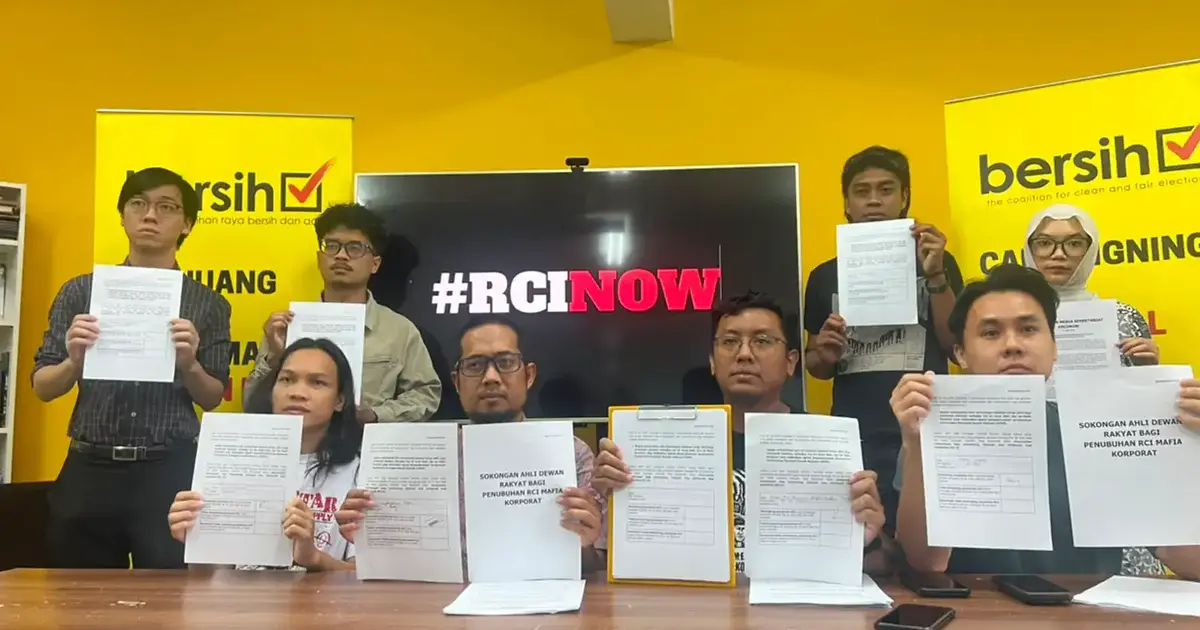
The electoral watchdog Bersih has announced that 34 members of Parliament have signalled backing for the establishment of a royal commission of inquiry into what the organisation characterises as corporate mafia activities operating within Malaysia's business landscape. According to Bersih, the cross-party support spans representatives from the People's Justice Party (PKR), the Pan-Malaysian Islamic Party (PAS), the Democratic Action Party (DAP) and the United Malays National Organisation (Umno), suggesting a degree of parliamentary consensus on the issue that transcends traditional political dividing lines.
The announcement carries significance for Malaysia's ongoing political conversation around corporate governance and regulatory oversight. Bersih's assertion that such diverse political groupings have come together on this proposal indicates growing concern across the political spectrum about the scope and scale of alleged corporate impropriety. The fact that the coalition spans from secular and urban-focused parties like DAP to traditional Malay-Muslim parties like PAS and Umno suggests the issue resonates beyond conventional ideological boundaries and touches on fundamental questions about economic integrity that affect parliamentarians' constituents regardless of their party affiliation.
A royal commission of inquiry represents one of Malaysia's most formal investigative mechanisms, typically deployed when authorities need to examine matters of significant public concern with comprehensive mandate and independence. The creation of such a body would require substantial political will and coordination, particularly in Malaysia's current parliamentary configuration where no single party commands overwhelming numerical dominance. The apparent cross-party support that Bersih claims suggests that if these parliamentary numbers translate into concrete legislative action, the government could face mounting pressure to formally establish such an inquiry.
The invocation of the term "corporate mafia" by Bersih points toward concerns about systematic, organised structures allegedly operating within Malaysia's corporate sector that function outside or above normal regulatory frameworks. This framing suggests the watchdog believes the issues at stake extend beyond isolated incidents of fraud or misconduct and represent entrenched patterns of behaviour that have resisted existing enforcement mechanisms. Such characterisation would justify the escalation to a commission-level investigation, as conventional regulatory processes overseen by individual agencies may lack sufficient scope or authority.
The timing of Bersih's statement warrants consideration within Malaysia's broader political context. Questions about corporate accountability have featured prominently in public discourse following high-profile corporate failures and regulatory controversies. The expression of parliamentary support for an inquiry into these matters reflects constituent pressure that lawmakers feel compelled to address publicly. For opposition and ruling coalition MPs alike, associating oneself with enhanced corporate oversight appeals to voters concerned about economic fairness and the integrity of Malaysia's business environment.
The participation of Umno parliamentarians in this apparent coalition carries particular weight. As the long-dominant party in Malaysian politics and custodian of substantial corporate networks through various linked entities, Umno's willingness to support an inquiry into corporate misconduct signals either genuine commitment to governance reform or sophisticated political calculation about how such support benefits the party's image. The inclusion of PAS members similarly demonstrates how corporate governance issues can unite legislators who might fundamentally disagree on other policy domains.
For Malaysian business and corporate sectors, an RCI focused on alleged corporate mafia operations could have far-reaching implications for how enterprises structure themselves and conduct dealings. Enhanced scrutiny would likely affect lending practices, supplier relationships, regulatory compliance, and corporate governance standards. Foreign investors currently evaluating Malaysia's investment climate would closely monitor any such inquiry's scope and findings, as the existence and severity of organised corporate misconduct directly influences assessments of business risk and regulatory reliability.
Bersih's ability to mobilise apparent cross-party support for this proposal demonstrates the electoral watchdog's continuing relevance as a convener of political consensus on governance matters. Rather than functioning primarily as an oppositional force, Bersih has positioned itself as an organisation capable of identifying issues where diverse political actors can find common ground. This approach contrasts with more partisan approaches to corporate governance reform and potentially makes its advocacy more palatable to multiple parliamentary groupings.
The actual translation of this claimed support into parliamentary action remains uncertain. While 34 MPs expressing backing represents meaningful numbers, converting such individual statements into coordinated legislative action requires navigating complex procedural and political terrain. Establishing an RCI typically requires cabinet approval and formal statutory authority, meaning executive branch cooperation remains essential regardless of parliamentary support levels. The challenge of maintaining cross-party unity on complex investigative procedures could prove more difficult than initial expressions of principle.
The implications for Malaysia's regulatory architecture extend beyond any single inquiry. Growing parliamentary interest in corporate accountability mechanisms suggests policymakers increasingly view existing regulatory structures as inadequate for addressing sophisticated corporate misconduct. This could eventually drive reforms to strengthen the mandates and resources of agencies like the Malaysian Anti-Corruption Commission, Securities Commission, and Companies Commission of Malaysia, independent of whether a specific RCI proceeds. The parliamentary momentum Bersih has apparently helped generate on this issue may catalyse broader discussions about modernising Malaysia's corporate oversight capabilities to match the complexity of contemporary business structures.

