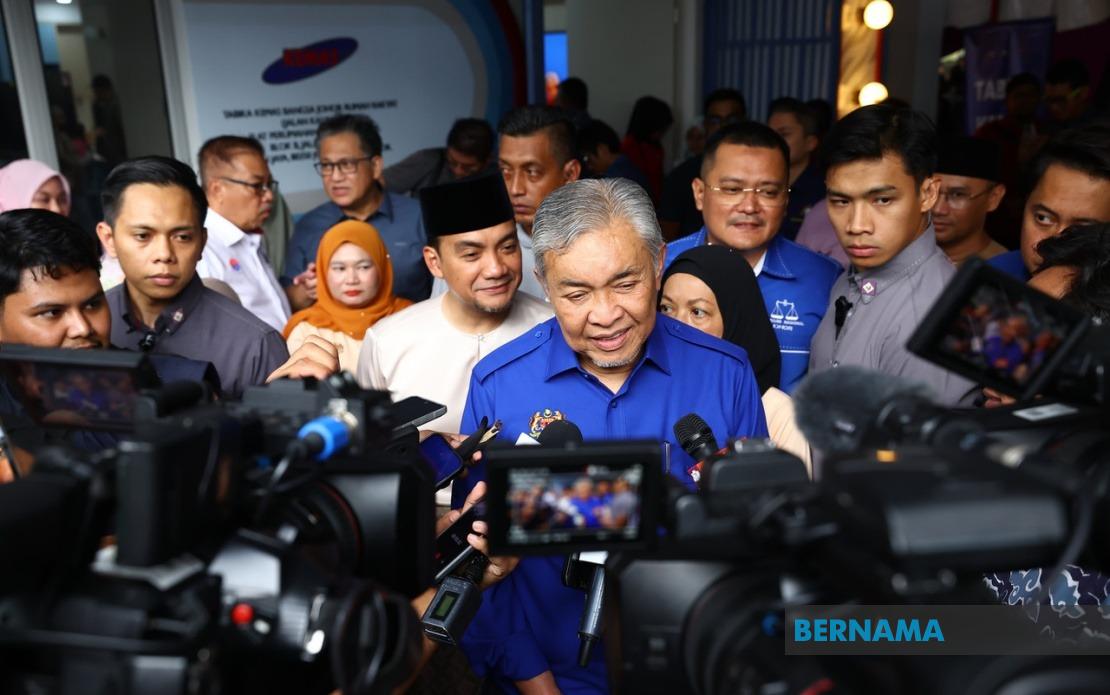
Barisan Nasional has extended formal recognition to Pakatan Harapan's policy platform ahead of the Johor state election, with BN Chairman Datuk Seri Dr Ahmad Zahid Hamidi indicating that the coalition views opposition proposals as a legitimate part of Malaysia's electoral process. The Deputy Prime Minister's acknowledgement, made during an engagement session with Tabika Kemas parents at Larkin Court 1 flats in Johor Bahru on July 3, underscores how even competitive political rivals operate within shared democratic conventions, a practice essential to Malaysia's parliamentary tradition despite intense electoral rivalry.
Ahmad Zahid's remarks came shortly after Pakatan Harapan unveiled a comprehensive ten-point platform designed to appeal to Johor voters across multiple demographic segments. The opposition coalition's manifesto spans healthcare expansion through the Johor Health Scheme, financial assistance for first-time property purchasers, a half-billion-ringgit youth empowerment initiative, and educational strengthening measures. By publicly endorsing the legitimacy of these proposals, Ahmad Zahid signalled that substantive policy competition—rather than personal or institutional attacks—characterises the rivalry between Malaysia's major political blocs.
BN's own electoral platform, Ahmad Zahid emphasised, draws credibility from the state government's demonstrated performance during its preceding term. He highlighted that the administration fulfilled more than ninety percent of its previous manifesto commitments, a metric intended to establish governmental competence and trustworthiness with voters evaluating alternative visions. This emphasis on administrative track record reflects a broader strategy in which ruling coalitions leverage incumbency advantages by showcasing tangible project delivery and policy implementation rather than relying solely on rhetorical appeals.
The BN manifesto itself addresses what party strategists characterise as universal social coverage, deliberately constructed to encompass all demographic groups without ethnic or class exclusion. Ahmad Zahid detailed how BN's proposals span the complete lifecycle: maternal and child support, educational provision from primary through tertiary levels, youth development initiatives, and targeted assistance for single-parent households. This inclusive framing responds to opposition accusations that certain communities have been historically marginalised, a persistent tension in Malaysian political discourse since independence.
Central to Ahmad Zahid's messaging is the concept of Bangsa Johor—a state-level identity transcending ethnic categories. By declaring that any Johor resident, regardless of background, qualifies for BN's proposed benefits, the coalition attempts to reframe electoral choice around territorial rather than communal lines. This rhetorical move carries particular significance in Johor, historically a BN stronghold yet increasingly competitive terrain where both coalitions compete for swing voters in rapidly urbanising constituencies.
Ahmad Zahid's role as Rural and Regional Development Minister adds institutional weight to BN's commitment. His pledge to continue championing Johor's infrastructure and economic development serves dual purposes: reinforcing his personal credibility with state voters while demonstrating that BN retains access to federal resources and ministerial authority. For Malaysian voters evaluating competing offers, ministerial involvement in manifesto promotion suggests that pledges carry backing from individuals with genuine implementation capacity, beyond mere campaign rhetoric.
The Johor state election framework—encompassing 172 candidates competing across 56 state seats, with July 11 set as polling day and July 7 for early voting—creates distinct electoral dynamics compared to federal contests. State-level competitions often turn on bread-and-butter issues: local infrastructure, municipal services, land management, and state budgetary allocation. Both BN and PH have calibrated their manifestos accordingly, offering concrete projects rather than constitutional reform or national-level restructuring that typically feature in parliamentary campaigns.
Former electoral patterns in Johor suggest competitive uncertainty. While BN traditionally dominated the state, the 2018 federal election demonstrated that voter preferences could shift rapidly when national narratives dominated political discourse. The 2023 federal election consolidated BN's recovery, yet state contests sometimes produce different verdicts as voters employ distinct criteria evaluating state versus federal governance. This possibility means both coalitions face genuine competitive pressure, making manifesto credibility and track record assessment central to campaign strategy.
The opposition's healthcare, housing, and youth development priorities reflect response to documented social challenges facing Johor's diverse population. Housing affordability particularly resonates in districts experiencing rapid urban expansion and demographic change, where younger voters struggle with property acquisition despite employment. Youth unemployment and skill development remain persistent concerns across Malaysia's working-age population. By directly addressing these grievances, Pakatan Harapan positions itself as responsive to material concerns that affected citizens experience daily.
Ahmad Zahid's public respect for opposition proposals, while seemingly magnanimous, carries strategic calculation. By appearing confident enough to acknowledge competitor competence, BN projects security and institutional maturity—qualities voters associate with stable governance. Dismissing or denigrating opposition platforms invites voter perception that the ruling coalition fears electoral competition or operates defensively. Conversely, gracious recognition allows BN to emphasise its own track record from a position of apparent strength and confidence.
The manifesto competition reflects broader Southeast Asian political trends where material welfare considerations increasingly dominate electoral choice over ideological or identity-based divisions. Malaysian voters increasingly evaluate parties by their capacity to deliver healthcare access, housing affordability, educational quality, and employment opportunity. Both coalitions have absorbed this lesson, focusing manifestos on concrete service provision rather than constitutional theory or institutional reorganisation that captures less voter attention.
As the Johor campaign proceeds toward July 11, these competing manifestos will likely shape voter deliberation in ways particular to the state's unique economic circumstances and demographic composition. The peninsula's southern industrial heartland faces distinct challenges from Selangor or Kelantan, requiring tailored policy responses rather than uniform national templates. Both BN and Pakatan Harapan have attempted state-specific positioning, suggesting that Malaysian electoral competition has become increasingly sophisticated in recognising regional variation and local preference heterogeneity.

