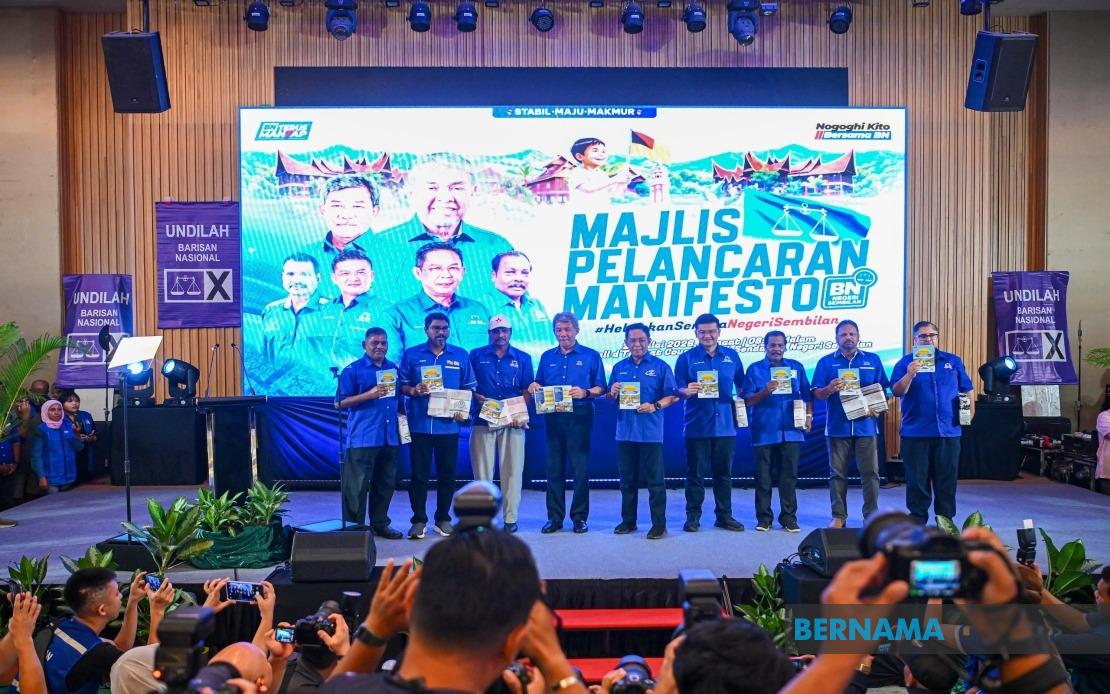
Barisan Nasional formally unveiled its election manifesto in Seremban on July 24, laying out an ambitious nine-pillar platform for voters ahead of the 16th Negeri Sembilan State Election scheduled for August 1. The comprehensive framework reflects the coalition's strategy to position itself as a party capable of delivering tangible improvements across multiple aspects of governance and daily life in the state.
At the foundation of BN's platform sits economic growth and development, signalling the coalition's intention to prioritise business expansion and infrastructure investment as engines for state prosperity. This opening pillar sets the tone for an approach that emphasises material advancement, a traditional strength of Barisan Nasional across its decades in power. The coalition appears intent on reminding Negeri Sembilan voters that economic momentum remains central to its governing philosophy.
The manifesto's second pillar directly addresses the cost of living and social welfare concerns that have dominated political discourse in Malaysia in recent years. By explicitly pledging to enhance living standards and overall well-being for residents, BN acknowledges the household pressures facing ordinary Malaysians, from transportation and utilities to healthcare access. This dimension of the platform reflects efforts to counter criticisms that the coalition has lost touch with grassroots economic anxieties.
Education and human development form the third pillar, encompassing youth empowerment, women's advancement, and entrepreneurship support. This holistic approach to skills development and opportunity creation signals recognition that sustainable economic progress depends on developing a capable workforce and unlocking talent across all demographic groups. The inclusion of women and youth-focused initiatives demonstrates awareness of shifting demographic priorities in Malaysian politics.
Negeri Sembilan's agricultural heritage is central to the fourth pillar, which emphasises modernising farming practices while strengthening rural communities and Federal Land Development Authority (Felda) settlements. This focus acknowledges the state's significant farming population and the particular vulnerabilities of smallholder agriculture in the region. By prominently featuring agro-food development, BN indicates its commitment to preserving rural livelihoods while adapting them to contemporary market demands.
Housing and residential development comprise the fifth pillar, addressing what remains a critical concern for working-class and middle-income families throughout Malaysia. Affordable housing availability has become an increasingly contentious political issue, and BN's inclusion of this commitment reflects its need to demonstrate responsiveness to property market challenges that burden young families and first-time buyers.
Environmental stewardship and tourism advancement constitute the sixth pillar, positioning BN as concerned with sustainable development and economic diversification beyond traditional sectors. This environmental dimension represents evolving political priorities, particularly among younger and urban voters who increasingly prioritise climate and conservation issues in their electoral calculus.
The seventh pillar focuses on religious affairs, cultural preservation, and indigenous community support, reflecting Malaysia's multicultural and multi-religious character. By emphasising faith, customs, heritage, and Orang Asli welfare, BN signals its commitment to protecting Malaysia's plural identity while supporting historically marginalised indigenous populations. This pillar carries particular weight given ongoing debates about indigenous land rights and cultural recognition.
Sports, recreation, and national cohesion form the eighth pillar, recognising that shared recreational pursuits and athletic achievement can build social bonds across diverse communities. This focus on unity through sports reflects broader efforts to promote inter-communal harmony and shared national identity beyond purely political or religious lines.
The manifesto's final pillar addresses service delivery and government responsiveness, promising effective and efficient administration. This commitment to operational excellence acknowledges voter frustration with bureaucratic inefficiency and poor service standards that have plagued Malaysian government agencies. Strong service delivery has become a competitive differentiator in Malaysian state elections.
The manifesto launch gathered significant BN figures including Negeri Sembilan UMNO Liaison Committee chairman Datuk Seri Jalaluddin Alias, who serves as election director, alongside coalition partners MCA deputy president Datuk Dr Mah Hang Soon and MIC vice-president Datuk M. Asojan. The presence of Perikatan Nasional deputy chairman Datuk Seri Tuan Ibrahim Tuan Man underscores the broader political landscape in which this state election occurs, reflecting ongoing alignments and negotiations within Malaysia's fractured political ecosystem.
With early voting scheduled for July 28 and polling day set for August 1, the manifesto launch signals the campaign's formal commencement. BN's nine-pillar framework represents an attempt to appear comprehensive and inclusive, addressing diverse voter concerns from economic opportunity to cultural preservation. The breadth of this approach reflects the coalition's need to maintain broad appeal across Negeri Sembilan's varied communities and constituencies, even as it confronts stronger opposition than it has faced in previous decades.

