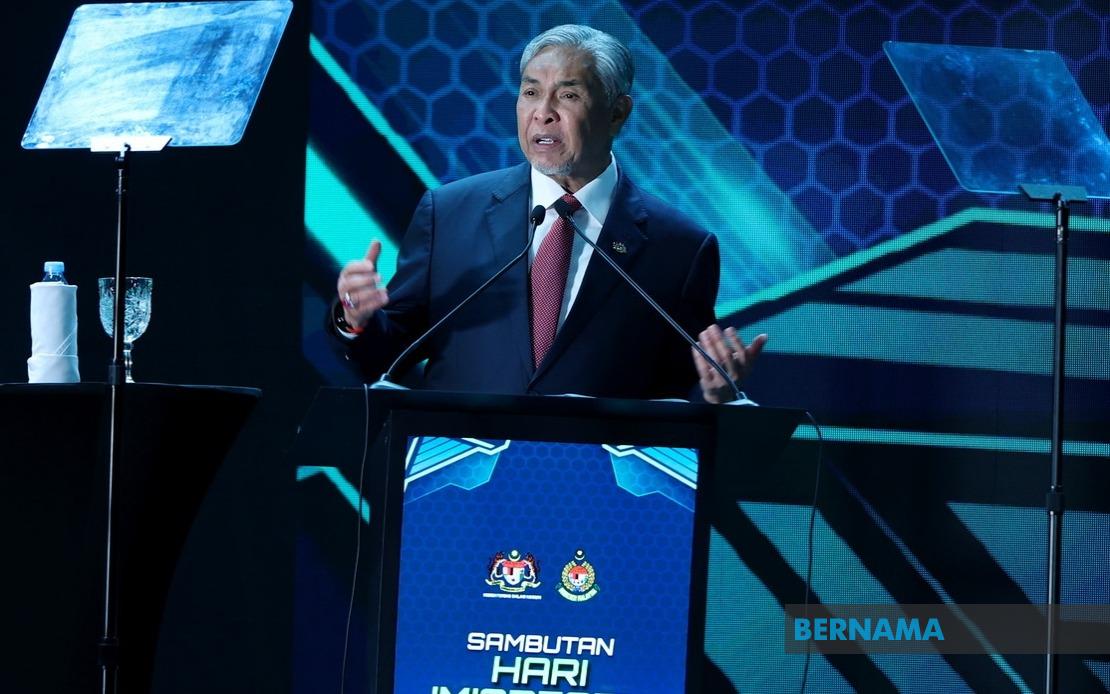
Barisan Nasional remains committed to its participation in the Unity Government, a commitment reinforced by its chairman Datuk Seri Dr Ahmad Zahid Hamidi at a media gathering in Cyberjaya on July 21. The declaration comes in direct reference to the formal position adopted at UMNO's most recent General Assembly, underscoring the ruling coalition's stability as the country navigates complex political dynamics and state-level electoral contests. Ahmad Zahid, who holds the concurrent positions of UMNO president and Deputy Prime Minister, emphasised that the party hierarchy regards the assembly's decisions as binding and beyond reconsideration, signalling that internal party structures have settled any lingering questions about BN's future alignment.
The reaffirmation holds particular significance given the sensitive nature of coalition politics in Malaysia's current environment. The Unity Government, formed following the 2022 general election, has required careful management of competing interests between its partner parties. By anchoring BN's commitment to an assembly resolution—the highest decision-making body within UMNO—Ahmad Zahid effectively placed the matter beyond individual minister discretion, creating institutional weight behind the position. He urged all stakeholders to respect this determination made at the party's apex, signalling that any speculation about withdrawals or shifts in coalition positioning should be dismissed.
The timing of this statement reflects growing attention to ministerial conduct within the Unity Government framework. Prime Minister Datuk Seri Anwar Ibrahim had recently issued a warning to cabinet members, deputy ministers, and officials across government agencies, cautioning them against leveraging their positions to criticise or attack their coalition partners, particularly during state-level electoral campaigns. This directive underscores tensions that inevitably arise when multiple parties with distinct electoral bases operate within a single cabinet structure, each competing for voter support in their respective strongholds while maintaining collective responsibility for government policy.
Ahmad Zahid made clear that consequences would follow ministerial violations of this protocol. Those who breach the Prime Minister's guidelines by using their office to campaign against Unity Government partners would face dismissal from their roles, effectively placing the burden of coalition discipline on individual accountability and executive action rather than party-level intervention. This delineation of responsibility is crucial for understanding the operational dynamics of Malaysia's current political structure, where the Prime Minister's prerogative in matters of ministerial appointment and removal provides the mechanism through which coalition conduct is regulated.
The Deputy Prime Minister's acknowledgment of the Prime Minister's absolute authority over cabinet composition represents an important statement of institutional clarity. In Westminster-derived systems like Malaysia's, the appointment and dismissal of ministers belongs exclusively to the Prime Minister's discretion, a principle Ahmad Zahid explicitly validated. He noted that should the Prime Minister receive verified information suggesting ministerial misconduct or disloyalty to coalition principles, the executive power to remove such individuals rests entirely with the Premier, requiring no consultation or approval from coalition partners or their respective party leadership.
This arrangement creates a potential tension within coalition governance: while BN has committed to remaining in the government at the institutional level, individual BN ministers remain subject to the Prime Minister's disciplinary authority. This dynamic requires trust between the Prime Minister and coalition partners, as well as clear communication regarding acceptable conduct within the shared framework. The warning Ahmad Zahid referenced demonstrates that the Prime Minister is prepared to exercise this power to maintain coalition cohesion, particularly when party-based interests threaten the unity the government purports to represent.
The context of state elections adds urgency to these guidelines. During electoral campaigns, cabinet members often return to their home constituencies to mobilise support for their respective parties, creating opportunities for them to prioritise partisan interests over coalition solidarity. When a BN minister campaigns in a state election, they naturally seek to advance UMNO or other component parties' prospects against opposition parties. However, the Prime Minister's directive specifically prohibits using government position or authority to attack coalition partners, a constraint designed to prevent the kind of internal fracturing that undermined previous coalition arrangements.
Malaysia's history with coalition politics provides instructive lessons about the fragility of multi-party governments. The previous UMNO-led Barisan Nasional coalition, which governed continuously from 1957 until 2018, periodically experienced internal strains as component parties pursued divergent strategies or leadership changed. More recently, the Perikatan Nasional coalition shifted and fragmented as party calculations shifted. The current Unity Government's explicit articulation of conduct standards and consequences represents a more formalized approach to managing these inherent tensions, attempting to establish rules that prevent small incidents of disloyalty from cascading into larger ruptures.
For regional observers and Malaysian political analysts, Ahmad Zahid's statement provides reassurance about the near-term stability of the government, though it simultaneously highlights the mechanisms required to maintain it. The fact that such reassurances must be continuously issued suggests underlying fragility; a fully stable coalition arrangement would not require regular affirmations of commitment or warnings about ministerial conduct. The reliance on the Prime Minister's disciplinary authority, combined with party-level resolutions, suggests a government held together by explicit agreements and enforcement capacity rather than organic alignment of interests.
Looking forward, the sustainability of this arrangement depends on several factors. The loyalty of individual ministers, the management of inter-party competition during elections, the maintenance of the Prime Minister's authority to discipline coalition members, and the continued willingness of major parties like UMNO to subordinate certain partisan interests to collective cabinet responsibility will all test the framework that Ahmad Zahid described. Any major breach—whether a senior minister openly attacking a coalition partner or a coalition party contemplating withdrawal—would force a reckoning with the principles he articulated.
The Deputy Prime Minister's framing of BN's commitment as rooted in party assembly decision-making, rather than personal or leadership preference, also carries implications for party succession and leadership transitions within UMNO. By placing the decision at the institutional level rather than attributing it to current leadership discretion, Ahmad Zahid anchored the coalition commitment to a structure that transcends individual personalities, potentially providing continuity should UMNO's leadership change in coming years. This approach distributes responsibility for maintaining the coalition across the party hierarchy, reducing the risk that internal party disputes could trigger coalition-level crises.
For Malaysian voters and the broader Southeast Asian region observing Malaysian political developments, the Unity Government's continued operation under these stated terms provides a degree of predictability regarding governmental stability. The alternative—a government riven by internal conflict or repeated coalition crises—would impose real costs on policy continuity and economic confidence. Whether the explicit frameworks Ahmad Zahid outlined prove sufficient to maintain coalition discipline through the remainder of the current administration and potential state electoral contests remains to be demonstrated through implementation.

