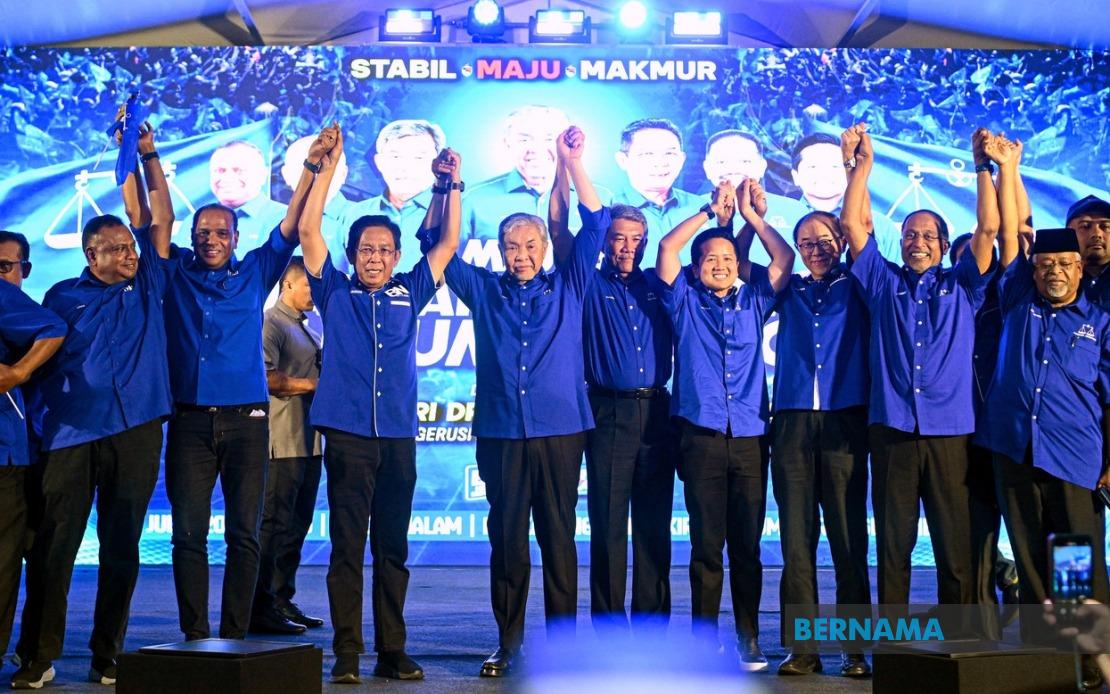
Barisan Nasional formally presented its full roster of 25 contenders for the 16th Negeri Sembilan state election during a campaign launch ceremony at Tuanku Abdul Rahman Stadium in Paroi, signalling the coalition's readiness for the ballot. The announcement underscores BN's continued grip on the peninsular state, where it has governed since independence, though recent electoral patterns across Malaysia have shown growing voter volatility that even established parties cannot take for granted.
Negeri Sembilan BN chairman Datuk Seri Mohamad Hasan will retain the Rantau state seat, a constituency he has represented continuously since 2004. His reselection reflects confidence from UMNO leadership in his organisational capabilities and political durability, particularly as the party seeks to consolidate support in what remains a BN stronghold. Mohamad's longevity in the Rantau seat suggests strong grassroots networks that have weathered Malaysia's turbulent political landscape over the past two decades, including the 2018 electoral upset that briefly dislodged BN from federal power.
Alongside Mohamad's candidacy, the coalition has confirmed Datuk Seri Jalaluddin Alias to contest the Pertang state seat for a fourth consecutive term, having first won the seat in 2013. Jalaluddin's retention as BN's standard-bearer in Pertang reflects the party's appreciation for incumbency advantage in state-level contests, where local issues and personal relationships often outweigh national political currents. As both Negeri Sembilan UMNO Liaison Committee chairman and a sitting Member of Parliament representing Jelebu at the federal level, Jalaluddin brings significant institutional leverage to his state candidacy, potentially benefiting from his dual mandate.
The coalition has also nominated several other sitting representatives to defend their existing constituencies. Datuk Mohd Faizal Ramli will seek re-election in Linggi, while Datuk Mustapha Nagoor is pursuing another term representing Palong. These selections demonstrate BN's strategy of leveraging proven electoral performers in their established fiefdoms, a conventional approach that contrasts sharply with the more experimental candidate selections occasionally adopted by opposition coalitions seeking to project change and renewal.
Yet the announcement reveals incomplete preparations, with BN still finalising its candidate selections for eleven state seats: Klawang, Serting, Lobak, Sikamat, Ampangan, Bukit Kepayang, Mambau, Paroi, Lukut, Bagan Pinang, and Gemas. This delay in finalising nearly half of the remaining candidate roster raises questions about internal deliberations within BN component parties, particularly regarding the balance of seats allocated to UMNO, MCA, and MIC. Such extended deliberations, while potentially reflecting careful candidate vetting processes, can also signal factional tensions or disagreements over seat distributions—dynamics that opposition parties may seek to exploit during the campaign period.
For Malaysian political observers, BN's performance in Negeri Sembilan carries significance beyond the state itself. The outcome will serve as a bellwether for coalition stability and voter sentiment in a state where BN retains substantial organisational infrastructure and historical dominance. In an era marked by shifting political allegiances and declining voter attachment to traditional parties, the Negeri Sembilan election offers insights into whether established coalitions can maintain support through conventional mechanisms of incumbency and local governance, or whether even strong traditional strongholds face erosion.
The retention of high-profile figures like Mohamad Hasan and Jalaluddin Alias signals BN's confidence in continuity, yet also reflects limited scope for renewal within the coalition's leadership echelon. Both candidates have been in their respective seats for extended periods, suggesting BN's reliance on familiar faces rather than dynamic new entrants. This approach may reinforce party loyalty among older voters and party machinery but could potentially limit appeal to younger, more mobile electorates seeking fresh representation.
Regionally, the Negeri Sembilan state election occurs within Malaysia's broader context of coalition politics and state-federal power dynamics. BN's performance here, coupled with electoral outcomes in other states, will influence perceptions about the coalition's capacity to remain electorally competitive without the centripetal force that federal power once provided. As states increasingly serve as alternative power bases for aspiring national leaders, control of Negeri Sembilan remains symbolically and strategically important for BN's political narrative.
The staggered finalisation of candidates across multiple constituencies also reflects practical realities of coalition politics, where negotiations between component parties and internal party mechanisms require time for resolution. By election day, BN hopes to present a unified front, but the extended timeline for candidate announcements may create messaging challenges and potentially allow opposition parties to define narratives during this interim period. How quickly the coalition resolves its outstanding candidacies will substantially influence campaign momentum and party cohesion as polling approaches.

