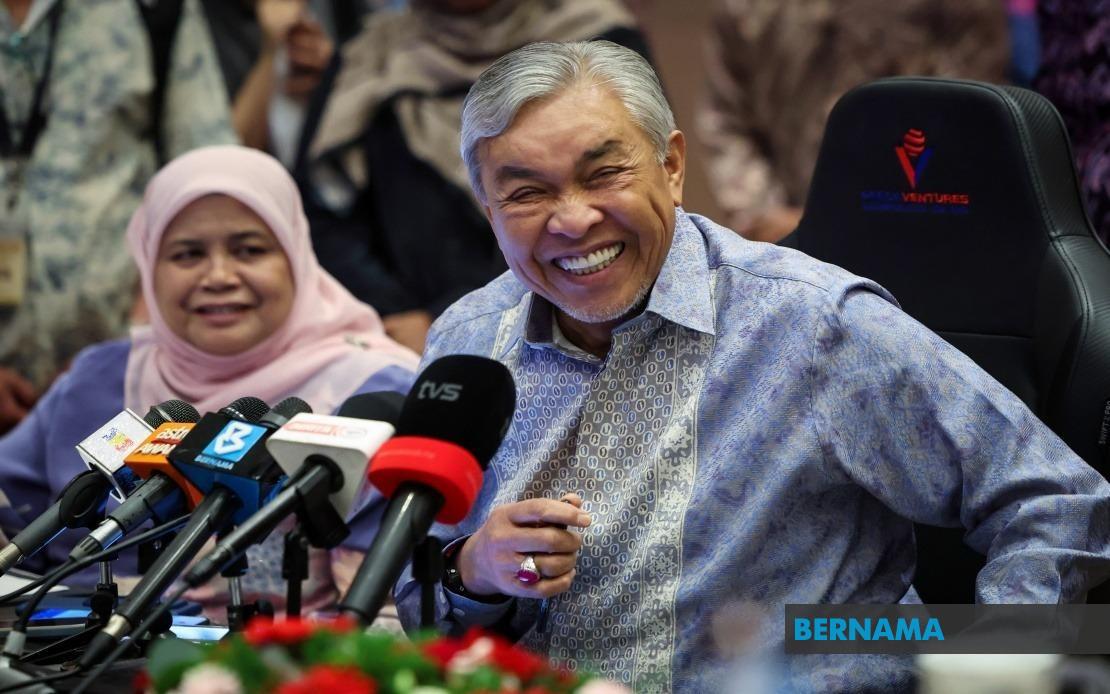
Barisan Nasional's leadership has moved to quash persistent speculation about the ruling coalition's stability, with Deputy Prime Minister Datuk Seri Dr Ahmad Zahid Hamidi issuing an unequivocal reaffirmation that the bloc intends to remain embedded within the Unity Government framework through the completion of the 15th Parliamentary term. Speaking in George Town, Ahmad Zahid explicitly rejected suggestions that the coalition harbours intentions to orchestrate any form of governmental upheaval, whether through regional political manoeuvres or backroom deals, directly addressing months of gossip that has occasionally rattled Malaysia's fragile political ecosystem.
The timing of Ahmad Zahid's declaration carries particular weight given the current Negeri Sembilan state election campaign, where BN finds itself campaigning against the Pakatan Harapan component of the federal coalition. This scenario illustrates the peculiar tension inherent to Malaysia's Unity Government arrangement—a structure that unites competitors at the federal level whilst permitting them to contest vigorously at state and local levels. Ahmad Zahid's emphasis on this duality suggests BN recognises the delicate balance required to maintain institutional cohesion whilst satisfying grassroots pressure to campaign aggressively in regional contests.
As UMNO president and the chair of the gathering focused on rural development coordination, Ahmad Zahid underscored that BN's commitment stems directly from the Yang di-Pertuan Agong's constitutional directive following the 2022 General Election. This framing is significant: by positioning BN's participation not merely as a political choice but as a response to royal instruction, the Deputy Prime Minister invoked constitutional legitimacy rather than voluntary political calculation. Such language historically carries substantial weight in Malaysian political discourse, where the monarchy's role in bridging factional divides carries deep institutional resonance.
The explicit rejection of hypothetical "Bangkok Move" or "Dubai Move" scenarios—colloquialisms referring to overseas backroom political dealings—demonstrates how contemporary Malaysian political culture has absorbed terminology from previous instances of alleged extraterritorial political plotting. Ahmad Zahid's preemptive dismissal signals awareness that external observers and domestic analysts habitually scan the political horizon for evidence of shifting alliances. By naming these possibilities directly and repudiating them, the Deputy Prime Minister attempted to establish a transparent, unambiguous record of BN's intentions.
Yet Ahmad Zahid's comments also reveal underlying friction within the broader coalition structure. The closure of a Klawang polling district centre in Negeri Sembilan, reportedly triggered by BN's decision not to field a candidate for that particular state constituency, illustrates how federal-level unity agreements can generate local resentment. The Deputy Prime Minister addressed this matter with pragmatic calm, indicating he had personally consulted with state-level leadership and expected resolution within the remaining campaign period. This granular attention to managing disappointment at the district level suggests BN comprehends that maintaining coalition discipline requires active engagement beyond top-level proclamations.
The three-way contest for the Klawang seat—pitting Pakatan Harapan's Bakri Sawir against Perikatan Nasional's Danni Rais and Bersatu's Muhammad Adib Musa—exemplifies the fragmented landscape within which BN now operates. The withdrawal of BN's candidacy from this particular contest, whether reflecting strategic calculations or internal political dynamics, has created space for PN to position itself as an alternative vehicle for opposition sentiment. For Malaysian observers tracking coalition stability, such contests serve as bellwethers indicating whether disparate political entities can maintain their commitments when local advantage might accrue from defection.
Ahmad Zahid's disclosure that no formal discussions have occurred between BN and PN regarding a prospective "Perikatan Barisan Nasional" alliance partnership carries significance beyond simple procedural clarification. The statement acknowledges that campaign rhetoric occasionally ventures into speculative territory without reflecting serious institutional negotiation. By carefully distinguishing between informal campaign speech and formal political deliberation, the Deputy Prime Minister sought to prevent speculation from hardening into perceived commitment or threat. This differentiation matters because Malaysian political actors remain acutely sensitive to signals that their adversaries might be repositioning themselves through alternative coalitional arrangements.
The apparent cordiality between Ahmad Zahid and Prime Minister Anwar Ibrahim—reflected in their exchange of traditional Malay verse, or pantun—underscores an important reality: elite Malaysian political relationships often remain multifaceted despite competitive campaigning. The capacity of senior figures to maintain personal rapport whilst leading opposing campaign efforts reflects a pragmatic understanding that today's adversaries may become tomorrow's governing partners. Anwar's pantun on unity and discipline, reciprocated by Ahmad Zahid with his own verse, signalled through cultural idiom that personal relationships transcend immediate electoral competition.
For Southeast Asian observers monitoring Malaysian political developments, Ahmad Zahid's pronouncements carry implications extending beyond domestic governance. Malaysia's experiment with broad-based coalitional government has attracted international scrutiny as a potential model for managing deep political divisions through inclusive rather than winner-take-all arrangements. Any deterioration of the Unity Government would reverberate across a region increasingly concerned with democratic backsliding and governmental instability. Conversely, successful maintenance of this arrangement through contested elections and competing interests could offer lessons for other polarised democracies navigating similar challenges.
The broader context reveals that BN's commitment statement arrived amidst a period when Malaysia's political class has gradually absorbed lessons from previous cycles of governmental instability. The collapse of previous governments through defections and realignment has created constituencies—both within Parliament and among the general electorate—that value continuity and predictability. Ahmad Zahid's assertion that BN intends to honour its commitments through Parliament's completion reflects acknowledgment of this preference for stable governance rather than perpetual coalition repositioning.
Moving forward, the intersection of federal unity with state-level competition will likely continue generating periodic friction requiring managerial attention from senior leadership. Ahmad Zahid's handling of the Klawang constituency issue—acknowledging local grievances whilst maintaining confidence in resolution—suggests BN possesses institutional mechanisms for managing such tensions. Whether these mechanisms prove sufficient through subsequent election cycles will substantially determine whether Malaysia's Unity Government represents a durable innovation in coalition governance or merely an interlude within its historical pattern of volatile political realignment.

