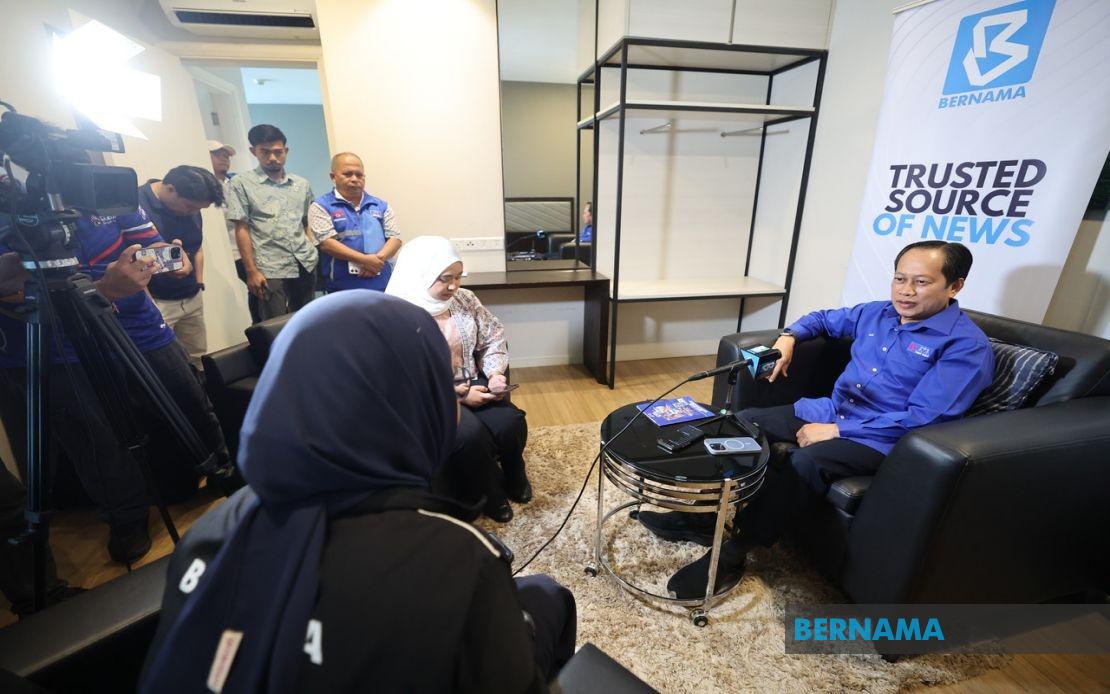
Barisan Nasional is banking on a decisive victory in the Johor state election scheduled for July 11, with party leaders publicly expressing confidence that they will secure more than 40 of the 56 seats in the State Legislative Assembly. Datuk Seri Dr Ahmad Maslan, the deputy chairman of Johor UMNO's liaison committee, underscored the coalition's optimism during recent campaign activities, framing the election as crucial for ensuring administrative continuity in Malaysia's southernmost mainland state.
Ahmad's assessment rests on extensive ground-level observation across nearly all of Johor's parliamentary constituencies. As Pontian UMNO division chief, he has been closely involved in BN's campaign machinery and claims to have monitored operations across 25 of the state's 26 parliamentary constituencies. This hands-on perspective has informed his conviction that BN is positioned to win, a judgment he attributes to systematic analysis of voter sentiment, candidate performance, and organizational readiness rather than speculation or wishful thinking.
The coalition's confidence is anchored in three observable factors that Ahmad emphasizes repeatedly: positive response from voters encountered during campaigning, the quality and effectiveness of individual candidates representing BN, and the operational strength of the party's grassroots network at the District Polling Centre level. These PDMs function as the party's nerve centers, coordinating daily activities and maintaining sustained engagement with communities. Rather than merely deploying campaign posters or relying on media advertisements, BN's approach centers on persistent, direct engagement with residents through house-to-house visits and voter data analysis.
The operational intensity Ahmad describes reveals the scale of organizational deployment BN has committed to Johor. Campaign activities run continuously from early morning through late evening, encompassing multiple simultaneous workstreams. These include systematic house-to-house canvassing to understand voter concerns and preferences, detailed voter data management to identify swing voters and ensure base mobilization, campaign simulations to rehearse messaging and counter-arguments, and coordination from centralized operations rooms that track progress and allocate resources dynamically. This multi-layered approach suggests BN views the election not as inevitable but as requiring disciplined execution across all levels of party structure.
Johor's strategic importance to Barisan Nasional cannot be overstated. As one of Malaysia's most populous states and a traditional BN stronghold, maintaining control here is essential to the coalition's broader political standing. A loss or significantly diminished majority would send tremors through BN's national leadership and potentially embolden opposition coalitions in other states. For Malaysian analysts tracking BN's recovery from previous electoral setbacks, the Johor result will serve as a crucial barometer of whether the coalition has successfully reconsolidated support among traditional constituencies.
Beyond domestic campaign machinery, BN has deployed reinforcement teams from other states to supplement Johor's local organizational capacity. These external teams bring different perspectives and campaign methodologies informed by their own state-level experiences. Ahmad specifically highlights the Pahang Menteri Besar leading a reinforcement contingent in Pontian and covering several state constituencies including Pulai Sebatang, Benut, Kukup, and Pekan Nanas. The introduction of approaches and insights from outside Johor's usual political ecosystem reportedly energized BN's campaign while introducing fresh strategic thinking that Ahmad believes will resonate with voters.
This strategy of cross-state reinforcement represents a notable evolution in BN's campaign methodology. Rather than viewing elections as purely local contests, the coalition is treating Johor as a battleground where techniques and insights from successful operations elsewhere can be systematically applied. The presence of senior figures like a state Menteri Besar from another state also signals high-level commitment and stakes, demonstrating to Johor voters that party leadership considers this election consequential. Such deployment also serves to distribute workload and prevent fatigue among local party machinery that might otherwise bear the full campaign burden.
The 56-seat assembly configuration means that 29 seats constitute a simple majority, placing BN's 40-plus target significantly above the minimum required to govern. This buffer suggests either genuine confidence in polling data or acknowledgment that some marginal seats remain genuinely competitive. The gap between 40 and a bare majority also provides cushion against possible surprises on polling day—a consideration particularly relevant given Malaysia's recent electoral volatility and demonstrated capacity for unexpected voter behavior shifts.
For Malaysian observers tracking political dynamics, the Johor election carries implications extending well beyond state boundaries. A strong BN performance would validate the coalition's ongoing rehabilitation efforts after previous electoral disappointments and reinforce Prime Minister Anwar Ibrahim's political coalition at the federal level. Conversely, a weaker-than-expected showing could embolden opposition forces and complicate federal-state relationships. The election thus functions as a referendum not merely on Johor governance but on broader trajectories in Malaysian politics.
Ahmad's public optimism, while politically expected, appears grounded in systematic assessment rather than mere rhetoric. His willingness to cite specific metrics—observation across 25 of 26 constituencies, continuous campaign operations at PDM level, detailed voter engagement data—suggests access to internal polling and organizational reports that have shaped BN's confidence. Whether this confidence translates into the anticipated victory will become evident on July 11, when Johor voters deliver their verdict on BN's governance record and vision for the state's future development.

