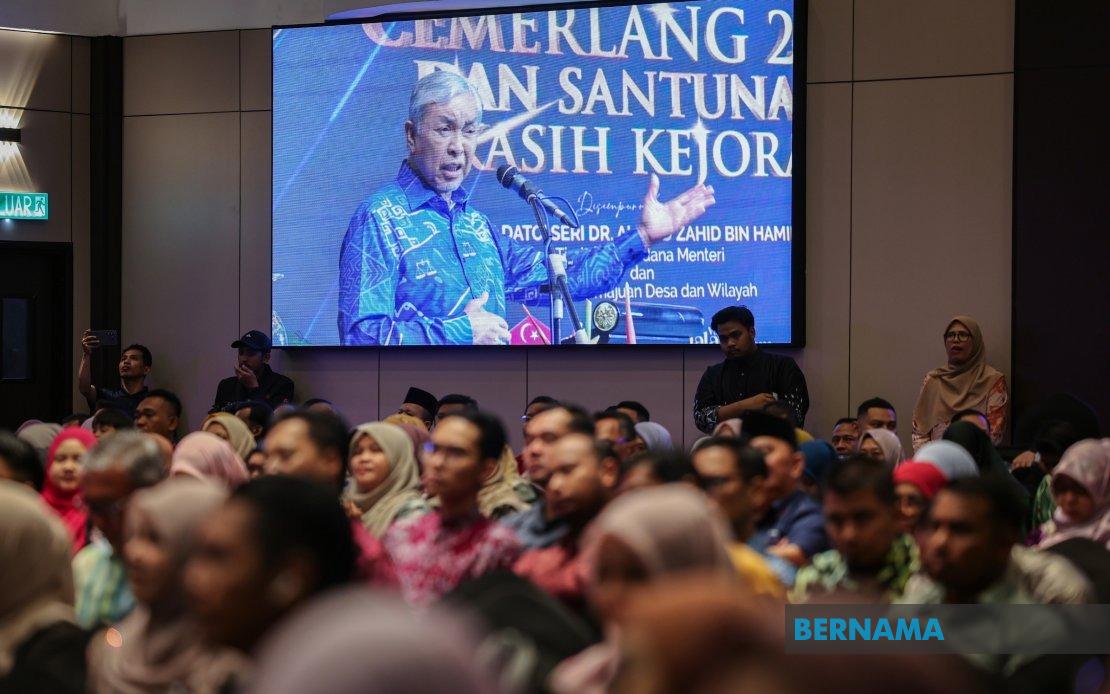
The Barisan Nasional is pushing back against suggestions that its campaign machinery for the Johor state election lacks vigour, with party chairman Datuk Seri Dr Ahmad Zahid Hamidi defending the coalition's grassroots efforts and casting criticism as merely a matter of political perspective rather than observable reality. Speaking after officiating the Southeast Johor Development Authority's service awards in Kota Tinggi on July 2, Zahid characterised the ongoing campaign as being in full swing, even as rival political groupings weighed in with their own assessments of BN's performance.
Zahid's remarks represent a strategic rebuttal to detractors who have questioned whether BN's campaign machinery has generated sufficient momentum ahead of polling day on July 11. By framing such assessments as subjective interpretations rooted in political rivalry rather than objective observations, the BN chairman sought to insulate the coalition from narratives of declining voter engagement. He acknowledged that other coalitions retain the right to their own viewpoints, whether supportive or adversarial, while maintaining that BN's internal evaluation shows an active and well-mobilised campaign structure.
One persistent concern raised by political commentators centres on potential voter confusion stemming from the federal-level cooperation between BN and Pakatan Harapan under the Unity Government. The concern holds that traditional BN supporters in Johor might find the partnership puzzling, particularly given long-standing rivalry between the two coalitions. However, Zahid addressed this directly by noting that Johor occupies a distinctive position within Malaysia's political landscape. The state government, he explained, was formed well before the federal Unity Government came into being, meaning there exists no temporal or constitutional ambiguity surrounding the arrangement.
Zahid further emphasised that cooperation between state and federal authorities operates smoothly and professionally, with no inherent contradiction between levels of government. This framing attempts to neutralise voter hesitation by presenting the BN-PH partnership as a pragmatic accommodation rather than a fundamental shift in political ideology or loyalties. For Johor voters, the message is that state-level governance under BN remains consistent with established expectations, even as federal dynamics have evolved.
The coalition's confidence appears rooted substantially in the economic performance of the Johor state government under Menteri Besar Datuk Onn Hafiz Ghazi. BN is contesting all 56 state seats and targeting an expanded mandate to consolidate its hold on power. The government reported collecting RM2.26 billion in revenue during the previous fiscal year, a figure Zahid highlighted as the highest achieved by any state government in Peninsular Malaysia. This achievement, he suggested, demonstrates effective administration and justifies voter confidence in BN's continued stewardship over the next five-year term.
The revenue performance carries significant implications for BN's electoral pitch. In Malaysian politics, tangible economic indicators often resonate powerfully with voters who assess governments through the lens of fiscal management and development capacity. By leading all peninsular states in revenue collection, Johor's government establishes a competitive advantage in appeals to economically-minded voters. Zahid's deployment of this statistic serves to anchor BN's campaign narrative in demonstrable performance metrics rather than abstract party ideology.
Zahid also addressed remarks by Perikatan Nasional leader Tan Sri Abdul Hadi Awang, who had called upon voters to reject Pakatan Harapan outright, including in contests directly pitting BN against PH. Rather than reciprocating such combative rhetoric, Zahid signalled that BN would maintain a professional approach focused on its own candidates and policy platform. This positioning reflects a strategic calculation that dignified campaigning appeals more effectively to moderate and undecided voters than does inflammatory partisan messaging.
The Electoral Commission has fielded a notably crowded field for the 56 state seats. Beyond BN's 56 candidates and PH's matching slate, Perikatan Nasional enters 33 candidates, Bersama fields 15, MUDA presents four, while smaller parties including Parti Orang Asli Malaysia, Parti Sosialis Malaysia, and six independent candidates round out the contest. This fragmentation potentially benefits the better-organised and better-resourced BN machinery, though it also reflects deeper divisions within the opposition that BN can exploit through strategic positioning.
The multi-cornered contest introduces unpredictability into seat-level outcomes. In constituencies where opposition votes fragment across multiple candidates, BN could secure victories with relatively modest vote shares. Conversely, in areas where either PH or Perikatan Nasional consolidates opposition support, BN faces steeper challenges. The existence of 15 Bersama candidates and four MUDA candidates suggests that some constituencies will feature three-way or four-way races, complicating traditional BN electoral calculations.
For Malaysian observers, the Johor election carries implications extending beyond state boundaries. Johor represents BN's traditional heartland and a crucial contributor to federal parliamentary mathematics. A decisive BN victory would reinforce the coalition's relevance and bargaining power within federal politics, while simultaneously validating the state-level competence narrative that Zahid has constructed. Conversely, any unexpected weakness in Johor could signal broader vulnerability in BN's electoral coalition, with ramifications for future national contests.
Zahid's confident framing of BN's campaign prospects reflects the coalition's historically strong position in Johor, where it has governed continuously for decades. The emphasis on economic performance, coupled with a measured response to rival critiques, suggests a strategy aimed at consolidating existing support rather than pursuing dramatic electoral advances. The Deputy Prime Minister's stated confidence that ballot results on July 11 would validate BN's position indicates the coalition sees little fundamental threat to its dominance, though the complexity of the contested field ensures no outcome remains predetermined.
Early voting is scheduled for July 7, giving the coalition several additional days to mobilise its ground machinery before the main election day. The campaign's final phase will likely focus on mobilising core supporters and appealing to persuadable moderate voters concerned with economic management and development delivery. For BN, translating campaign activity into expanded electoral margins will determine whether Zahid's assessment of on-ground momentum proves accurate.

