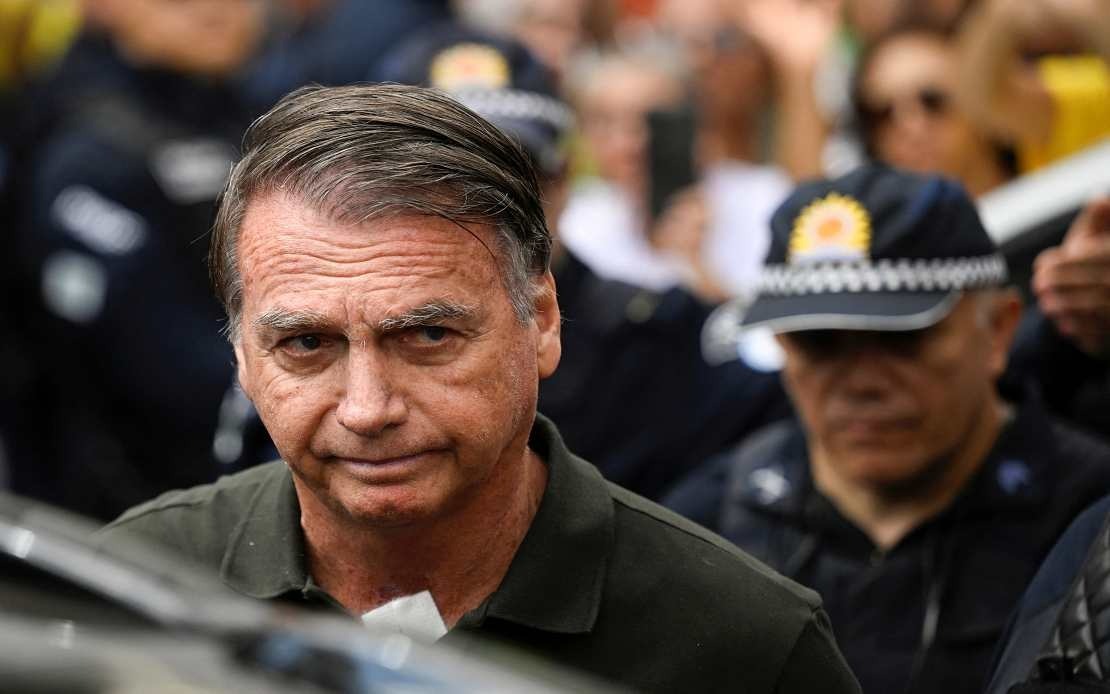
A Brazilian federal court has prohibited Argentine President Javier Milei from visiting Jair Bolsonaro at his residence in Brasília, rejecting the request on grounds that the visit would violate recently fortified house arrest restrictions. The decision arrived just hours after Judge Alexandre de Moraes tightened the conditions governing Bolsonaro's confinement, demonstrating how swiftly Brazil's judiciary has moved to contain the former leader's influence over the country's ongoing political competition heading into October's presidential election.
Milei had planned to travel to Brazil on July 25 specifically to meet with Bolsonaro and demonstrate solidarity with his son Flávio's emerging presidential campaign. The Argentine leader, himself a prominent voice within South America's conservative political sphere, intended the visit as a public show of support for the younger Bolsonaro's electoral ambitions. Such a gathering would have represented a significant moment for the region's rightist factions, signalling international backing for a potential challenger to incumbent President Luiz Inácio Lula da Silva.
The judicial intervention occurred after Bolsonaro's defence team formally requested permission for the meeting. However, Judge de Moraes dismissed the application as "moot" and cited the freshly revised house arrest terms that explicitly forbid political or electoral visitations until October's election concludes. The court's decision underscores the Brazilian judiciary's determination to prevent Bolsonaro from leveraging his still-considerable political stature to influence the campaign, despite his imprisonment.
The tightening of Bolsonaro's confinement conditions was prompted by a handwritten letter in which the former president endorsed his son's candidacy. Flávio Bolsonaro published the document on social media, inadvertently triggering the judicial response. The court interpreted this act as a violation of existing house arrest restrictions, using the violation as justification to impose the more stringent rules that now prohibit visits of any political character.
Bolsonaro's current legal predicament stems from his conviction on charges related to an attempted coup, for which he received a sentence exceeding 27 years imprisonment. Rather than serving his time in a traditional penal facility, he remains confined to his home owing to health considerations. This arrangement has nonetheless afforded him opportunities to maintain communication with political associates and supporters, possibilities that the judiciary has now substantially curtailed.
For Malaysian observers and regional analysts, the Brazilian court's actions highlight persistent tensions within South America's largest economy regarding the limits of judicial authority, the circumstances under which elected officials can be imprisoned, and the role of courts in shaping electoral outcomes. The scenario also illustrates how house arrest conditions can evolve strategically during critical political moments, raising questions about whether such modifications serve principled legal objectives or function as mechanisms of political control.
Flávio Bolsonaro's presidential ambitions represent one of the most significant challenges facing Lula's government as it prepares for re-election. The younger Bolsonaro has constructed a separate political identity while remaining deeply connected to his father's legacy and supporters. However, the restrictions now imposed on Jair Bolsonaro's activities severely constrain his ability to campaign overtly or coordinate strategy for his son's candidacy, potentially weakening the family's electoral prospects considerably.
The court's decision carries implications beyond Brazil's borders. Milei has positioned Argentina as a ideological ally to conservative movements across Latin America, and his rebuffed visit signals that leftist-aligned judiciaries in the region feel empowered to restrict cross-border political coordination among rightist leaders. The incident suggests a broader pattern whereby judicial systems in several South American nations have become instrumentalised within partisan political struggles, with different institutional actors wielding legal mechanisms to advantage their preferred candidates and factions.
The prohibition of Milei's visit also reflects asymmetries in how different political movements operate under judicial scrutiny. Whereas Bolsonaro remains confined and substantially restricted, other political actors across Brazil enjoy far greater freedom of movement and expression. This disparity raises enduring questions about whether Brazil's judicial approach maintains consistency in applying house arrest terms or whether such conditions have been selectively weaponised against particular individuals and ideological camps.
Looking forward, the Brazilian election promises to be fiercely contested, with Lula facing genuine electoral threats despite his current institutional advantages. The Bolsonaro family's capacity to mobilise its supporters without direct involvement from Jair Bolsonaro himself will substantially determine whether Flávio emerges as a viable contender. The judiciary's restrictions effectively attempt to neutralise the former president's residual political capital, suggesting that Brazilian power-holders view his potential influence as genuinely dangerous to their preferred electoral outcomes.
The situation underscores broader regional trends affecting Southeast Asian democracies and observers internationally. Whether judicial systems function as neutral arbiters of constitutional law or become enlisted as weapons within political competition remains contentious across multiple continents. Brazil's trajectory offers cautionary lessons regarding institutional independence, the weaponisation of legal mechanisms, and the risks that emerge when courts become perceived as partisan actors rather than impartial guardians of democratic norms.

