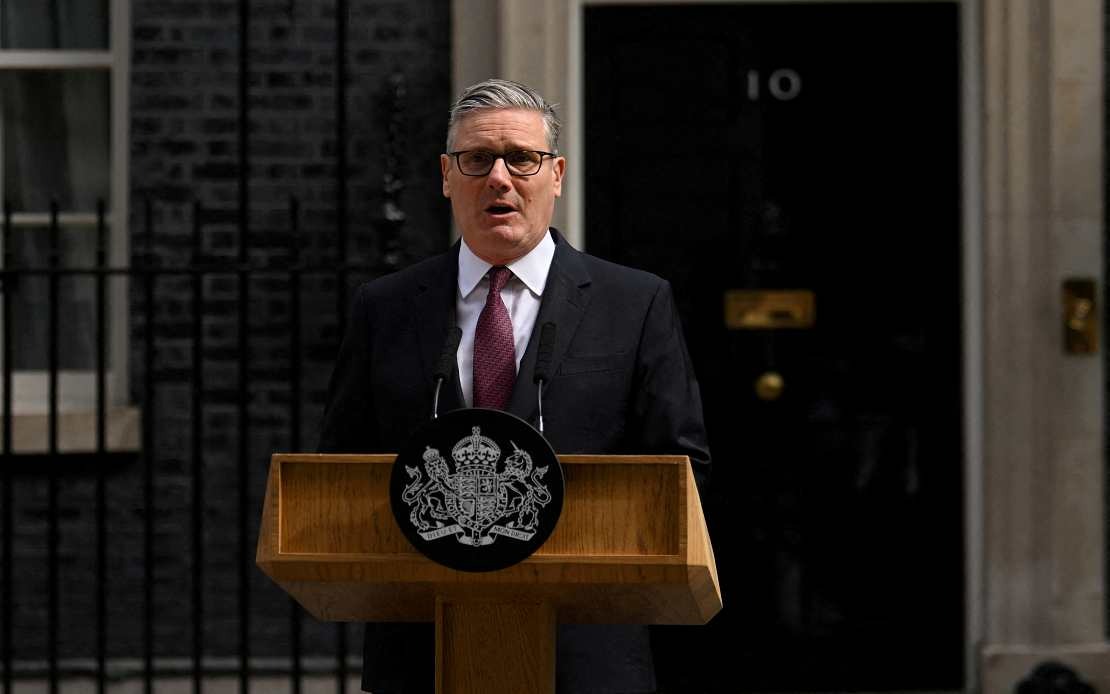
British Prime Minister Keir Starmer has pressed for an immediate resumption of ceasefire negotiations between the United States and Iran, declaring that the current standoff endangers vital global shipping corridors and regional stability. Speaking at a joint press conference in Paris alongside leaders from France, Germany and Ukraine on Monday, Starmer underscored the urgency of de-escalation while condemning Iranian attacks on commercial vessels and gulf-aligned partners.
The timing of Starmer's intervention reflects growing international alarm over the deteriorating situation in the Strait of Hormuz, one of the world's most critical maritime chokepoints. Through this narrow waterway between Iran and Oman, roughly one-third of all globally traded seaborne petroleum passes daily, making any disruption to shipping a matter of profound economic consequence for trading nations worldwide, including Malaysia which depends heavily on stable energy supplies and uninterrupted commerce.
Starmer's condemnation of Iranian maritime attacks was unequivocal, stating that such strikes against commercial shipping infrastructure and allied gulf states "must stop" immediately. His remarks signal that Britain views Iran's actions as a direct threat to international law and the established rules governing freedom of navigation—principles that underpin the entire global trading system upon which Southeast Asian economies depend.
Crucially, Starmer indicated Britain's willingness to contribute military and logistical resources to restore normalcy in the region. By pledging that "we are ready" to deploy assets aimed at facilitating the movement of vessels, the UK positioned itself as a practical stakeholder in any resolution, moving beyond rhetoric toward concrete commitment. This stance reflects Britain's historical role as a naval power with enduring interests in maintaining open sea lanes.
The ceasefire framework Starmer referenced had appeared to take shape following a memorandum of understanding signed in June, which was expected to conclude the broader US-Israeli military campaign that began in late February. That agreement had promised to reopen the Strait of Hormuz fully, restoring confidence among shipping companies and energy traders who had grown increasingly cautious about routing vessels through contested waters.
However, the recent exchange of strikes between Washington and Tehran has shattered that fragile understanding. President Donald Trump announced that the United States would reinstate comprehensive sanctions and establish a blockade against Iran, while simultaneously introducing a controversial fee system whereby vessels would be charged for safe passage through the strait. Such an arrangement would constitute an unprecedented militarisation of commercial shipping and would likely face fierce international resistance from nations already struggling with elevated energy costs and supply chain disruptions.
Iran's earlier closure of the Strait of Hormuz during the height of regional conflict represented a dramatic assertion of its ability to disrupt global energy markets and international commerce. The waterway's strategic importance cannot be overstated—any sustained interruption would send oil prices soaring and ripple through every economy dependent on affordable energy, with Southeast Asia particularly vulnerable given its limited domestic petroleum reserves and reliance on imports.
Starmer's call for "unrestricted freedom of navigation in the straits" reflects the international legal consensus embodied in the United Nations Convention on the Law of the Sea, which guarantees the right of all vessels to transit through international straits without interference. This principle is foundational to the rules-based international order that Britain and its allies claim to uphold, and any violation sets a troubling precedent that other nations might exploit to weaponise their own geographic advantages.
The "coalition of the willing" framework convened in Paris demonstrates that addressing this crisis requires coordinated multilateral action rather than unilateral measures. By bringing together the French, German, and Ukrainian leaderships, Starmer signalled that solutions must emerge through diplomatic channels with broad international participation, not through military posturing or economic coercion alone.
For Malaysia and other Southeast Asian nations, the implications are profound. The region's export-dependent economies require stable shipping lanes and predictable energy pricing to maintain competitiveness. Any prolonged disruption to the Strait of Hormuz would increase production costs, inflate consumer prices, and potentially trigger economic slowdown across the association of Southeast Asian nations. Malaysian policymakers must therefore monitor developments closely and consider whether regional voices should be amplified in international forums demanding de-escalation.
The fundamental challenge remains bridging the vast gulf between Washington's maximalist demands and Tehran's refusal to accept what it characterises as external dictation over its territorial waters and security interests. Starmer's appeal for negotiations on "remaining issues" acknowledges that deeper grievances underpin the current crisis and cannot be resolved through military means alone.
What remains uncertain is whether either Washington or Tehran possesses sufficient political flexibility to accept compromise, or whether the cycle of strikes and counter-strikes will continue escalating until a new crisis point forces reluctant negotiation. The international community's window for influence appears narrow, making urgent diplomatic engagement essential before miscalculation triggers wider conflict.

