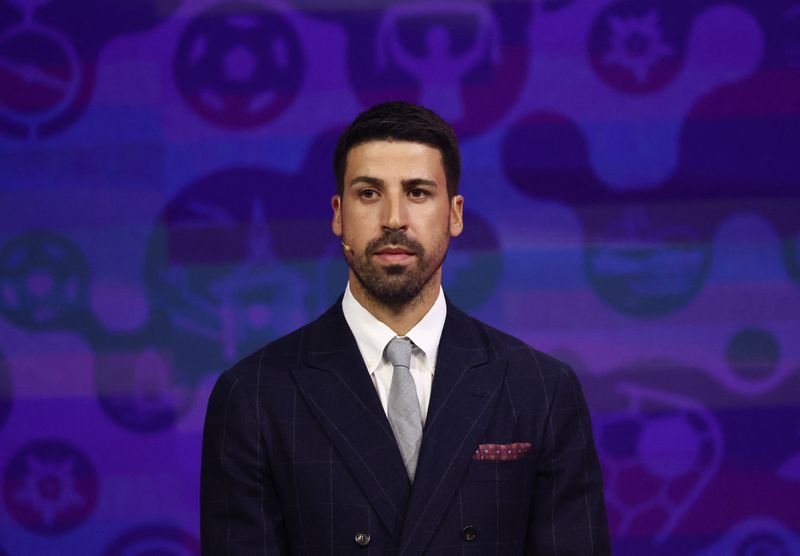
Sami Khedira carries a perspective shaped by lived experience: the Germany midfielder who won the World Cup in 2014 has navigated the intricate terrain of dual identity throughout his career, a journey that informs his refreshingly pragmatic view on the brothers who will represent opposing nations at the 2026 tournament. Speaking at the Home of Football museum in New York, Khedira rejected the notion that such family divisions constitute a problem, instead framing them as a testament to the interconnected, culturally fluid world that modern football increasingly reflects.
Khedira's own story anchors this philosophy. His brother Rani currently competes for Tunisia at the World Cup, representing their father's homeland, while Sami committed his international career to Germany, the country where both were raised. This family configuration is neither contradiction nor compromise—it is, in Khedira's assessment, simply the reality of contemporary life. Born to a German mother and Tunisian father, the brothers absorbed two cultures with equal authenticity, neither superseding the other in their personal or professional identities. Where some might see a conflict requiring resolution, Khedira perceives something far more valuable: evidence that belonging need not be singular or exclusive.
The midfielder articulated a nuanced understanding of identity that extends beyond the football pitch. He explained that his Germanness has occasionally been questioned by those who focused on his name and appearance, a reality faced by countless players with non-European heritage. Yet in Tunisia, where his father's roots run deep, he could just as easily be perceived as German. These contradictions are not failures of identity but rather reflections of a more honest, complex truth. "We have both nations in our heart," Khedira said. "Both mentalities as well. And this one makes us special." This formulation rejects the zero-sum framework that often dominates discussions of nationality and belonging, suggesting instead that multiple allegiances can coexist and even strengthen one another.
The 2026 World Cup will showcase this diversity on an unprecedented scale. Eight pairs of brothers are represented across the tournament, with four sets playing together for the same country and four split between different nations. The Williams brothers—Inaki and Nico—stand as prominent examples, both playing in the Premier League and Spanish domestic football respectively, yet representing Ghana and Spain at international level. Similarly, Guela and Desire Doue have taken divergent paths, with one representing the Ivory Coast and the other competing for France. Beyond these high-profile cases, deeper family configurations emerge: Derrick Luckassen and Brian Brobbey, brothers through their mother but carrying their respective fathers' surnames, represent Ghana and the Netherlands; Harry and John Souttar are divided between Australia and Scotland; while other siblings including Theo and Lucas Hernandez, Jurrien and Quinten Timber, Laros and Deroy Duarte, and Leandro and Juninio Bacuna compete under different flags.
Khedira witnessed a particularly moving illustration of this phenomenon when he observed the Doue brothers singing their respective national anthems before a friendly match between France and the Ivory Coast earlier this month. The image stayed with him because it crystallised something profound about football's capacity to communicate truths that transcend sport itself. The moment captured multicultural reality in its purest form—two individuals rooted in the same family yet singing different songs, each authentic, each legitimate. Khedira recognised this not as a problem to be solved but as a powerful statement about how modern football can embrace humanity's genuine complexity. "How beautiful is that?" he reflected. "That's multicultural, and that's a strong message to the world because football is so powerful."
The expanded 48-team format for the 2026 World Cup carries particular significance for smaller nations and emerging football programmes. Khedira noted that countries such as Cape Verde, Curacao, and Haiti now have genuine opportunities to compete at the highest level, a development that represents a fundamental democratisation of the sport. He further observed that African and Asian teams have progressively narrowed the traditional gap separating them from European and South American powerhouses, driven by improvements in grassroots education, coaching infrastructure, and professional development systems. This levelling of the playing field creates space for diverse narratives and reduces the concentration of competitive advantage among traditional elites.
Yet Khedira was equally clear-eyed about European football's ongoing responsibilities. While the continent benefits substantially from dual-nationality players who choose to represent European nations, European football bodies bear a corresponding obligation to invest in development at source rather than simply harvesting talent from emerging regions. This reciprocal relationship remains underdeveloped in practice, with wealthy federations often extracting talent without corresponding investment in the football ecosystems from which these players emerge. Khedira's observation points to a systemic imbalance that the sport's governing bodies have largely failed to address comprehensively.
The decision itself, however, imposes genuine hardship on young athletes who must navigate competing loyalties before reaching full maturity. Khedira spoke with evident compassion about the young players courted by multiple federations, each promoting their own claim while the player attempts to understand implications that extend far beyond sporting achievement. These decisions involve identity, community, cultural belonging, and family legacy—complex psychological and emotional territory for teenagers attempting to process competing visions of who they should become. Khedira rejected any formula based purely on heritage, politics, or external pressure, instead locating the decision in something more intimate and unmeasurable.
"It's about a gut feeling," he explained. "It doesn't matter where you're born. It's just a feeling that you have inside that pulls you to make such an important and personal decision." Yet he acknowledged the inherent cruelty in imposing this burden on children who have scarcely developed the emotional and psychological frameworks necessary to navigate such profound commitments. The pressure, he emphasised repeatedly, is immense and often overwhelming for adolescents still forming their sense of self. Despite these difficulties, Khedira ultimately affirmed the right of young players to make these choices themselves, without coercion or manipulation by external actors. His own experience at eighteen—when he confronted his decision about representing Germany despite his Tunisian heritage—had shaped his conviction that personal agency matters more than institutional preference.
For Malaysian readers and Southeast Asian observers, Khedira's perspective carries particular resonance given the region's own complex relationship with dual nationality and football development. Many Southeast Asian nations benefit from dual-nationality players who have chosen to represent their countries at continental and international tournaments, while simultaneously facing the challenge of developing indigenous talent. The examples Khedira cites—improvements in coaching, education, and infrastructure as drivers of competitive advancement—suggest pathways that regional federations might pursue more aggressively. Yet his broader argument about identity and belonging speaks to cultural realities that transcend football, challenging rigid categorisations that have historically dominated discussions of nationality and loyalty in the Asian context.
The 2026 World Cup will ultimately validate Khedira's perspective in ways that no commentary can match. When brothers sing opposite anthems before taking the pitch against each other, audiences will witness the reality that modern football is genuinely global, genuinely multicultural, and genuinely human. These moments will register far more powerfully than abstract arguments about identity and belonging because they collapse theory into lived experience. Khedira's insistence that such divisions are not problems but portraits of our contemporary moment may prove prescient, particularly as migration patterns, diaspora communities, and international opportunity continue reshaping how the next generation understands the relationship between heritage, choice, and identity.

