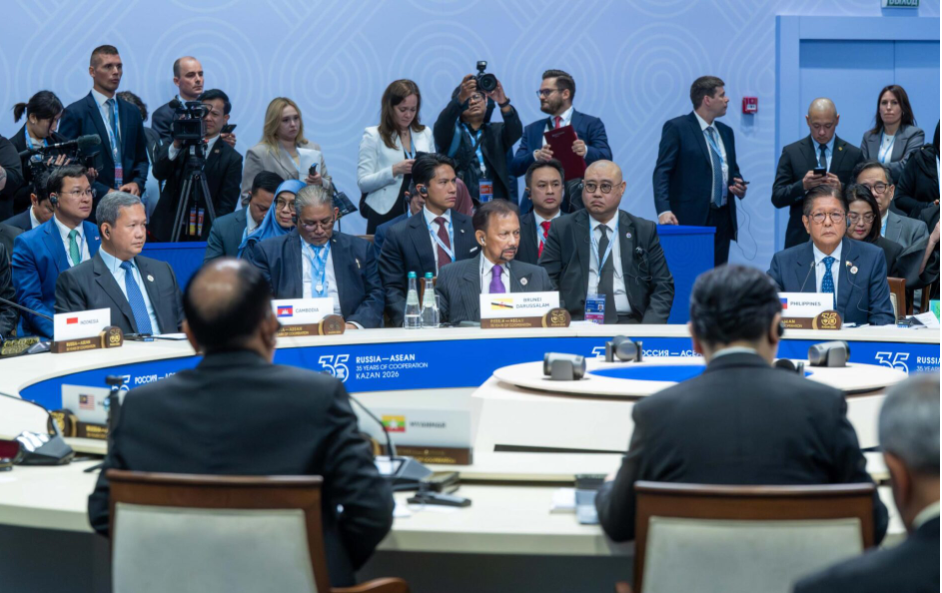
Sultan Hassanal Bolkiah of Brunei attended the Asean-Russia Commemorative Summit in Kazan, Russia on June 18, where he outlined a vision for deepened engagement between the 10-member bloc and Moscow. Speaking at the Kazan Expo International Exhibition Centre, the Brunei monarch expressed gratitude to Russian President Vladimir Putin for his hospitality and acknowledged the warmth extended by the government of the Republic of Tatarstan and the people of Kazan. He also offered condolences to Thai Prime Minister Anutin Charnvirakul following the death of Princess Bajrakitiyabha of Thailand. Accompanied by Brunei's Minister of Foreign Affairs Prince 'Abdul Mateen, the Sultan delivered remarks reflecting the broader regional perspective on Moscow's role in Southeast Asian affairs.
The commemorative gathering marked 35 years of formal dialogue between Asean and Russia, a relationship that the Sultan characterised as remarkably resilient despite the turbulent shifts in global geopolitics. Rather than viewing the partnership as stagnant, he underscored its demonstrated capacity to adapt and grow in significance as international circumstances evolve. This framing carries particular weight given the current strategic environment, where Russia faces isolation from Western institutions and Asean nations seek to maintain strategic autonomy by engaging with multiple powers. The Sultan's emphasis on resilience suggests Asean sees value in preserving this channel of communication and cooperation even as Moscow's international standing has shifted dramatically in recent years.
The scope of Asean-Russia cooperation has expanded substantially across all three pillars of the Asean Community framework—the political-security pillar, the economic pillar, and the socio-cultural pillar. This comprehensive engagement demonstrates that the relationship extends far beyond conventional diplomacy into practical areas affecting citizens' daily lives. The Sultan noted that these collaborative efforts have delivered tangible benefits to both sides and cultivated stronger connections between ordinary people, not merely government officials. For Malaysian readers, this expanded cooperation represents opportunities across multiple sectors, from trade partnerships to educational and cultural exchanges that can benefit the region's youth and workers.
As Asean pursues its Vision 2045 agenda, which outlines the bloc's development trajectory through the mid-21st century, the Sultan identified Russia as an important partner in tackling interconnected global challenges. Political tensions—whether between regional powers or great powers—threaten to destabilise the international order and disrupt Southeast Asian prosperity. Economic fragmentation, evidenced by the fragmentation of supply chains and competing trade blocs, creates uncertainty for exporters and investors throughout the region. The accelerating climate crisis demands cooperation on mitigation and adaptation, particularly for vulnerable nations like the Maldives and small island states within Asean. Rapid technological advancement presents opportunities but also risks, from artificial intelligence governance to cybersecurity threats. By engaging Russia on these fronts, Asean signals that addressing global challenges requires dialogue with all major powers rather than alignment with only one bloc.
Energy security emerged as a critical focus area in the Sultan's remarks, reflecting genuine concerns within Asean about stable, affordable energy supplies. Russia remains a significant global energy producer, and maintaining cooperative relationships on this front carries strategic importance for Southeast Asian economies heavily dependent on imported fuel and electricity. Food security likewise demands attention, particularly as climate change disrupts agricultural patterns and geopolitical tensions disrupt grain supplies. The Sultan's emphasis on these practical concerns grounds the partnership in concrete economic interests rather than abstract diplomatic principles. For Malaysia, which imports substantial quantities of food and energy, strengthening multilateral cooperation on these fronts directly affects price stability and supply chain resilience.
Climate action and disaster management were highlighted as domains where Asean and Russia can collaborate constructively. Southeast Asia faces particular vulnerability to climate impacts, from rising sea levels threatening coastal cities to changing rainfall patterns affecting agriculture. Russia possesses scientific expertise and technological capabilities in these areas that could benefit the region. Non-traditional security challenges—ranging from cybercrime to maritime piracy to transnational terrorism—require international cooperation that transcends Cold War-era divisions. By positioning Russia as a partner on these issues, Asean reinforces its doctrine of engaging all major powers in addressing shared threats rather than excluding any single nation.
The Sultan gave particular attention to human capital development as essential for sustaining the partnership into future decades. Education initiatives, professional exchanges, and training programmes create networks of individuals with personal relationships across borders, fostering understanding and trust that survive political shifts. When young Southeast Asians study in Russian universities or when Russian experts conduct training in Asean countries, they become unofficial ambassadors for cooperation. These grassroots connections often prove more durable than official diplomatic relationships, particularly during periods of international tension. The emphasis on equipping future generations with relevant skills acknowledges that this partnership must evolve beyond the current generation of leaders.
The adoption of the Kazan Declaration 2026 represents the formal expression of this strategic commitment. Alongside this declaration, Asean and Russia approved a Comprehensive Plan of Action covering the 2026–2030 period, providing a detailed roadmap for implementation. The two joint statements specifically addressing energy cooperation and cultural cooperation indicate that the partnership operates through both practical mechanisms and cultural exchange. These documents transform rhetorical commitment into actionable frameworks with timelines and deliverables. For regional observers, the adoption of these instruments suggests that despite occasional tensions and diverging interests, Asean remains committed to institutional engagement with Russia as a permanent feature of Southeast Asian diplomacy.
The second plenary session, structured as a working lunch and themed around integration processes in Eurasia, broadened the discussion beyond the bilateral Asean-Russia relationship. The inclusion of the Shanghai Cooperation Organisation secretary-general and the Eurasian Economic Commission chairman reflected a wider regional framework encompassing Russia, Central Asia, and parts of East Asia. This multilateral context matters for Asean because it positions Southeast Asian interests within the broader architecture of Eurasian affairs. Malaysia and other Asean nations increasingly recognise that their prosperity and security depend not only on their immediate region but also on broader patterns of cooperation and competition across the Eurasian continent.
The business forum held on June 17 as a side event provided a practical complement to the political discussions. By hosting formal commercial discussions between Asean and Russian enterprises, the summit reinforced that this partnership encompasses economic actors beyond government officials. Trade relationships, investment flows, and business partnerships create constituencies within both sides with incentives to maintain and deepen cooperation. For Malaysian businesses, such forums offer networking opportunities and potential market access. The acknowledgement of the business forum's outcomes suggests that expanding commercial ties represents a priority alongside political and security cooperation.
For Malaysia specifically, Brunei's prominent role in championing Asean-Russia cooperation carries significance. As Chair of Asean in 2023, Malaysia had oversight of the bloc's activities, and Brunei's active participation in major summits reinforces that cooperation with Russia remains a consistent theme across different national leadership positions. The Sultan's emphasis on balancing engagement with multiple powers aligns with Malaysia's own foreign policy doctrine of maintaining strategic autonomy and refusing alignment with any single bloc. By highlighting the partnership's resilience and mutual benefits, Brunei's position provides diplomatic cover for all Asean nations, including Malaysia, to maintain engagement with Russia despite Western pressure in some contexts.
The commemorative summit ultimately reflects Asean's mature approach to great power relations. Rather than allowing Cold War categories or contemporary bloc politics to determine policy, Asean has crafted a diplomatic strategy of selective engagement with all major powers based on identified mutual interests. Energy cooperation, climate action, disaster management, and non-traditional security challenges provide legitimate, substantive bases for engagement with Russia that serve Asean's interests independent of broader geopolitical alignments. The Sultan's address articulated this pragmatic vision clearly, positioning Asean-Russia cooperation as valuable not because of nostalgia or obligation, but because both sides have concrete reasons to work together on shared challenges. For the region's stability and prosperity, maintaining such cooperative channels remains valuable even amid international tensions.

