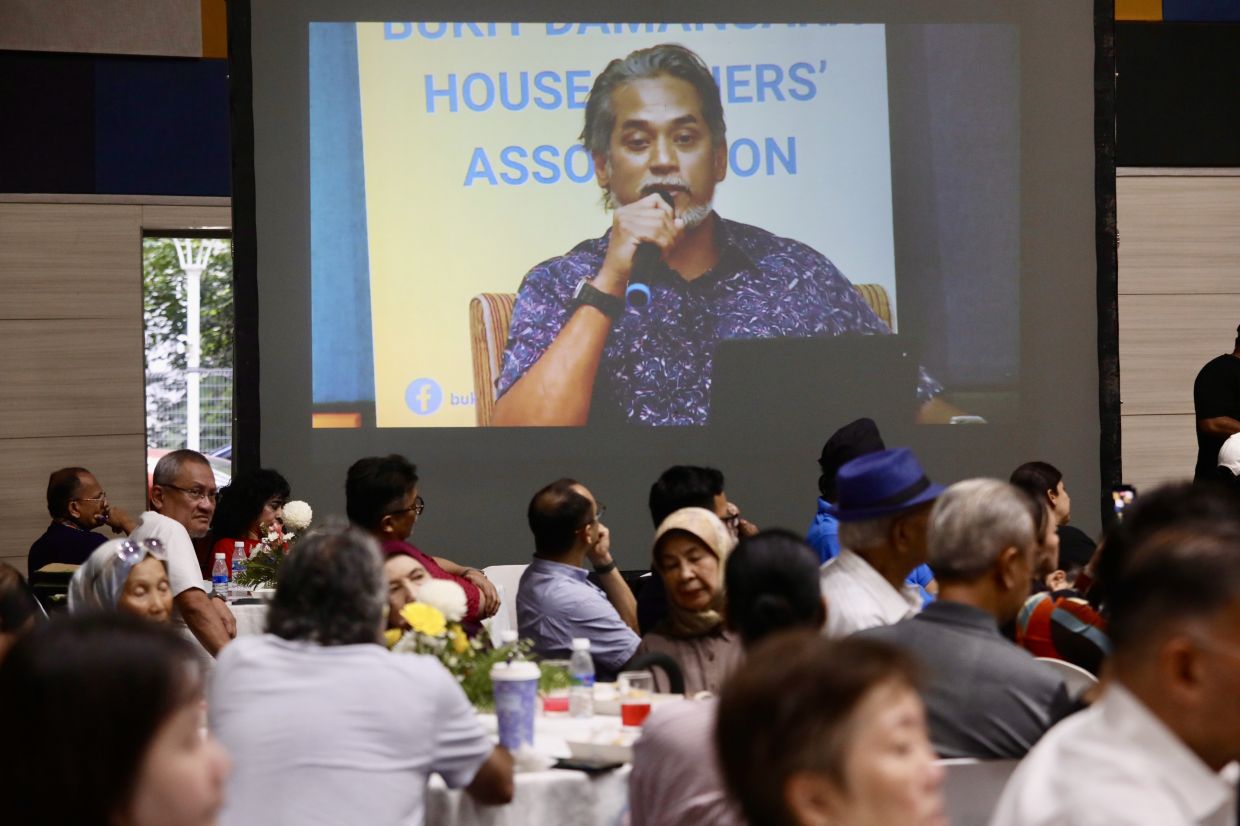
Approximately 400 residents of Bukit Damansara assembled at Pusat Komuniti Bukit Damansara for a three-hour community dialogue to formally request that Kuala Lumpur City Hall withdraw its construction permit for an adjacent semi-detached property's vertical expansion. The gathering, titled "Your Voice Matters", marked the first major town hall organised by the Bukit Damansara Home Owners' Association under its newly appointed president Khairy Jamaluddin, who was elected in early August. The event underscored growing friction between individual property rights and neighbourhood cohesion in established residential areas, a tension increasingly visible across Malaysia's property development landscape.
The renovation in question involves converting an original double-storey semi-detached dwelling into a three-storey structure, a modification that has generated sustained opposition within the community. Resident A. Zakki outlined the timeline of approvals and reversals that characterise the dispute. City Hall granted initial approval in December 2025, but community objections prompted a stop-work order the following January. However, the project received clearance again in June this year—approximately two months prior to the town hall—allowing construction to proceed and reach roughly 10 percent completion with structural pillars now visible on the property boundary.
The central grievance articulated by residents extends beyond mere aesthetic preferences. Zakki stressed that the renovation fundamentally compromises the architectural integrity of the semi-detached row, destroying the visual consistency that has defined the neighbourhood's character. More substantively, residents report that construction activity has already caused visible cracks in adjacent properties, raising legitimate structural safety concerns. A petition signed by 19 neighbouring households demonstrates organised and sustained opposition, though the precise mechanism by which these signatures should have triggered greater consultation remains a point of contention between residents and the municipal authority.
Khairy moderated the dialogue session with participation from Rosli Nordin, executive director of the City Hall Planning Department, and Supt Ahmad Firdaus Mustafia Kamal, the Brickfields deputy police chief. Rosli acknowledged that City Hall would document the concerns raised regarding the renovation's impact on residents' quality of life, though he stopped short of committing to permit withdrawal. This measured response disappointed many attendees who had anticipated a more definitive resolution. The presence of police leadership signalled that authorities recognised potential public order dimensions to the dispute, though no specific incidents were mentioned during the forum.
Beyond the renovation dispute itself, residents leveraged the town hall to address several interconnected municipal challenges. Morning and afternoon traffic congestion, concentrated between 7am and 7.30am and again from 2pm to 4pm, affects two nearby educational institutions: SK Bukit Damansara and Stella Maris International School Damansara. Supt Ahmad Firdaus assured residents that traffic matters were being managed appropriately, though he provided no specific data on enforcement intensity or planned interventions. Ameirul Azraie Mustadza, the SK Bukit Damansara Parent-Teacher Association chairman, acknowledged the school's ongoing efforts to dissuade double-parking through parental education, but indicated that budgetary constraints prevent the engagement of Rela (civilian volunteer community patrol) assistance.
The traffic situation reflects a broader pattern in Malaysian urban residential areas where increasing vehicle ownership, dual working parents, and proximity to quality schools create predictable congestion during school commute hours. The school community's request for daily rather than intermittent police traffic monitoring suggests inconsistent current enforcement. Ameirul's comment that the association had already written to traffic police indicates a responsive bureaucratic system, yet the need for direct requests at a town hall suggests that ordinary channels for problem escalation may lack sufficient urgency mechanisms. This gap between formal complaint procedures and visible action remains a persistent frustration for Malaysian residents in developed neighbourhoods.
Water infrastructure emerged as a third major concern during the dialogue. Air Selangor, the state water authority, faced questions regarding recurring pipe burst incidents affecting the neighbourhood. An Air Selangor representative acknowledged awareness of the problem and outlined plans to replace the ageing pipeline network serving Bukit Damansara. The water utility's commitment to systematic replacement rather than reactive repair suggests acknowledgment that piecemeal maintenance approaches have proven inadequate. For residents, such incidents disrupt supply and create safety concerns, particularly given that the neighbourhood comprises established properties likely containing ground-floor utilities and gardens dependent on reliable water access.
These water infrastructure challenges reflect the broader challenge facing Malaysian urban authorities as residential areas age. Properties constructed in earlier decades increasingly require comprehensive utility network replacement rather than targeted repairs. The cumulative cost and disruption of such work often falls heaviest on stable, middle-income neighbourhoods where residents possess both the knowledge to articulate concerns and the organisation to stage collective action. Poorer areas experiencing identical infrastructure decay frequently lack equivalent organisational capacity or political visibility.
Khairy characterised the town hall as a mechanism for bridging the gap between community members and decision-makers, positioning the event as a platform for direct problem articulation and collaborative solution-finding. He committed to follow-up engagement aimed at accelerating resolution processes. This framing reflects contemporary Malaysian political practice where elected representatives increasingly stage community consultations to demonstrate responsiveness while actual decision-making power regarding construction permits, traffic enforcement, and infrastructure investment remains concentrated within municipal bureaucracies and state-level utilities.
The Bukit Damansara situation illustrates tensions inherent in Malaysia's residential property development framework. Planning approval processes, while nominally consultative, often proceed with limited community input until work commences, at which point organised opposition becomes more difficult to ignore. The permit's reissuance following a stop-work order suggests that owners possess strong legal grounds for proceeding, even absent community consensus. For residents, this represents a governance failure—the system appears to privilege individual property rights over neighbourhood livability and established community standards.
Moving forward, the outcome regarding the semi-detached renovation remains uncertain. City Hall's acknowledgment of resident concerns does not necessarily translate to permit withdrawal, particularly if the original approval processes complied with statutory requirements. However, the convergence of multiple community grievances—construction oversight, traffic management, water infrastructure—during a single forum may prompt municipal authorities to demonstrate responsiveness across these interconnected issues to prevent further political friction in an affluent, organised constituency.
For other Malaysian residential communities facing similar development pressures, the Bukit Damansara case offers both encouragement and caution. Organised residents with sufficient education and resources can successfully elevate local concerns to senior government officials; however, the actual enforcement of their preferences against legal permit holders remains uncertain. The challenge of balancing property development rights, neighbourhood stability, and infrastructure adequacy will likely intensify as Malaysia's urban areas mature and resident expectations for consultation and oversight continue to rise.

