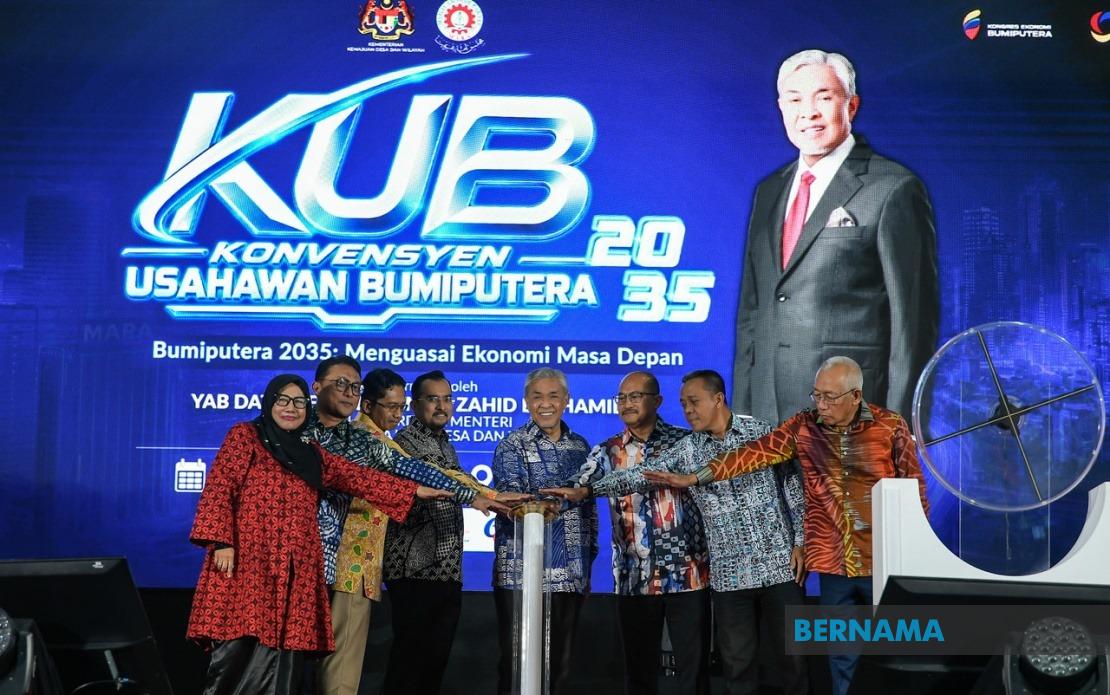
Deputy Prime Minister Datuk Seri Dr Ahmad Zahid Hamidi has delivered a stark assessment of the current state of Bumiputera entrepreneurship, arguing that decades of focus on participation have not translated into meaningful economic control for indigenous business owners. Speaking at the closing ceremony of the Bumiputera Entrepreneurs Convention (KUB) 2035 Declaration in Alor Setar, Ahmad Zahid contended that the time has come for a fundamental strategic shift that prioritizes building genuine ownership stakes and scaling operations rather than simply ensuring representation in economic activities.
The Deputy Prime Minister, who concurrently serves as Rural and Regional Development Minister, framed his remarks around a critical transition point in Malaysia's approach to Bumiputera economic development. He emphasized that while government support and ecosystem-building have created pathways for participation, entrepreneurs themselves must now demonstrate the ambition and determination to expand their ventures, engage in competitive markets, and generate substantive value creation. This distinction between participation and ownership reflects growing recognition among policymakers that token involvement in the economy fails to create lasting wealth and control for the Bumiputera community.
Ahmad Zahid's call for entrepreneurial courage signals an expectation that Bumiputera business owners should graduate beyond reliance on preferential policies and instead develop the competitive capabilities necessary to dominate their sectors. He underscored that the government's role would remain supportive—providing opportunities, developing the business ecosystem, and removing barriers to access—but that the onus ultimately rests with entrepreneurs to seize these advantages and scale their operations aggressively. This framing suggests a potential recalibration of policy emphasis from protective mechanisms toward capacity-building and competitive readiness.
Central to Ahmad Zahid's strategic vision are three major structural reforms intended to reshape the Bumiputera entrepreneurship landscape leading toward 2035. The first pillar involves integrating the currently fragmented support ecosystem, acknowledging a persistent systemic weakness that has long hampered effectiveness. Financing institutions, training providers, and market access facilitators operate largely through separate channels with limited coordination, creating inefficiencies and gaps that disproportionately affect smaller entrepreneurs with limited capacity to navigate multiple bureaucratic processes.
The second reform axis targets a fundamental reorientation in how the entrepreneurship development system functions. Rather than focusing narrowly on entrepreneur production—the creation of new business entrants—Ahmad Zahid advocates for prioritizing entrepreneur development and growth. This subtle but significant distinction implies that quantity of startups matters less than the quality, resilience, and expansion trajectory of existing ventures. The approach reflects lessons learned from previous initiatives that generated numerous small enterprises without achieving scale or systemic impact.
The third strategic pillar directly addresses a structural problem in Malaysia's development model: ensuring that national economic growth simultaneously strengthens locally-owned companies rather than primarily benefiting multinational corporations or large established conglomerates. Ahmad Zahid's emphasis on this dimension reveals concerns that despite decades of preferential policies, Bumiputera entrepreneurs remain marginalized within high-value sectors and that economic growth statistics mask persistent ownership concentration among non-Bumiputera entities. This requires deliberate policy intervention to funnel expanding economic opportunities toward Bumiputera business networks.
The fragmentation of the support ecosystem represents perhaps the most immediately actionable challenge Ahmad Zahid identified. When entrepreneurs must separately approach development agencies for training, banks for financing, and trade bodies for market connections, transaction costs and coordination problems multiply. An integrated approach would theoretically enable entrepreneurs to access comprehensive support packages tailored to their specific development stage and sectoral context. Implementing such integration would require significant bureaucratic restructuring and inter-agency cooperation, suggesting the seriousness with which policymakers view this reform.
For Malaysian and Southeast Asian business observers, Ahmad Zahid's remarks carry implications extending beyond rhetoric. The explicit rejection of participation-focused policies in favor of ownership-building suggests that upcoming government initiatives may introduce more stringent requirements for Bumiputera ventures seeking public procurement contracts, regulatory approvals, or development financing. Companies and investors operating in Malaysia's indigenous business ecosystem should anticipate growing expectations for genuine operational capacity and competitive positioning rather than mere structural compliance with preferential policies.
The timing of these pronouncements at the KUB 2035 Declaration ceremony indicates this represents a long-term strategic commitment rather than temporary messaging. The 2035 horizon aligns with Malaysia's broader Vision 2050 and mid-term development frameworks, suggesting that Bumiputera entrepreneurship reforms will remain central to policy discussions across multiple government administrations. This consistency provides potential investors and business partners with reasonable confidence in policy direction, even as specific implementation details remain to be clarified.
The practical challenge Ahmad Zahid's vision faces lies in execution. Integrating fragmented support systems requires overcoming institutional turf conflicts, competing budget priorities, and differing performance metrics across agencies. Shifting toward entrepreneur growth rather than production may conflict with political pressures to demonstrate high numbers of new business registrations and employment generation. Most critically, encouraging Bumiputera entrepreneurs to compete aggressively in open markets while maintaining some preferential support mechanisms creates inherent tensions that policy designers must carefully navigate.
From a regional perspective, Malaysia's evolution toward ownership-focused Bumiputera entrepreneurship policy may influence similar initiatives across Southeast Asia. Countries including Indonesia, Thailand, and Vietnam maintain indigenous business promotion programs, and Malaysia's strategic adjustments could offer valuable lessons—both positive examples and cautionary tales—regarding effective approaches to scaling native entrepreneurship in competitive regional economies. Should the Malaysian model succeed in producing substantial indigenous enterprises with regional competitiveness, it may reshape development policy discussions throughout ASEAN.
The Deputy Prime Minister's message ultimately reflects maturation in policy thinking around Bumiputera economic participation. Mere representation in economic activity, without corresponding control, wealth creation, and competitiveness, produces only superficial economic empowerment. Ahmad Zahid's call for a transition toward genuine ownership, supported through integrated systems and growth-focused development, represents a more demanding but potentially more effective approach to achieving meaningful and sustainable economic advancement for the Bumiputera community.

