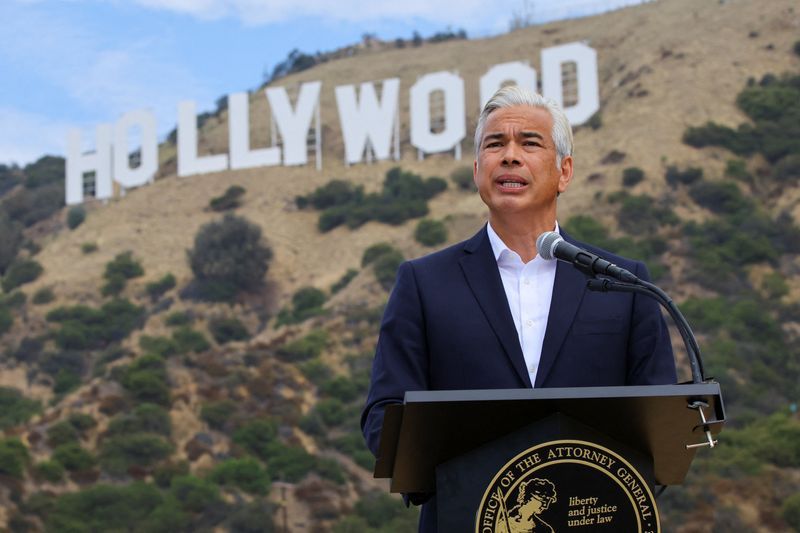
A coalition of twelve states led by California has launched a legal challenge to derail Paramount's proposed $110 billion acquisition of Warner Bros. Discovery, marking a significant threat to one of the entertainment industry's most ambitious consolidation efforts in recent years. The lawsuit, filed in federal court in Oakland, represents an unusual intervention by state authorities who believe the merger would grant the combined company excessive market power to control pricing and reduce consumer choice in film and television distribution across the United States.
The timing of this legal action reveals the contentious political dynamics surrounding modern antitrust enforcement. California Attorney General Rob Bonta and his Democratic counterparts from Arizona, Colorado, Connecticut, Massachusetts, Minnesota, Nevada, New Jersey, New Mexico, New York, Oregon, and Washington are challenging a deal that received approval from the U.S. Department of Justice just weeks earlier. Their lawsuit suggests that political calculations may have influenced the federal regulators' decision-making process, particularly given that Paramount's CEO David Ellison is the son of billionaire Oracle co-founder Larry Ellison, a prominent figure with close ties to Republican President Donald Trump. This political dimension has transformed what would typically be a straightforward regulatory matter into a proxy battle reflecting deeper partisan divisions over corporate consolidation and economic concentration.
According to the states' complaint, the merged entity would wield extraordinary control over America's entertainment markets. The combined company would command approximately 27 percent of the overall film distribution market, 30 percent of blockbuster film releases, and 27 percent of basic cable channels available to American households. This concentration would give Paramount-Warner Bros. control over major television networks including CNN, MTV, HGTV, Cartoon Network, and Nickelodeon, creating what the states characterize as a "media behemoth" capable of dictating terms to theaters, distributors, and consumers. The states calculate that for every dollar generated by wide-release theatrical films and basic cable channels nationwide, the combined company would capture more than a quarter of the revenue.
The practical implications for Malaysian and Southeast Asian media consumers merit closer examination. Paramount and Warner Bros. are major suppliers of content to regional broadcasters and streaming platforms throughout Asia-Pacific. A substantially larger and more powerful Paramount-Warner Bros. entity could negotiate from a position of overwhelming strength with local television networks and streaming services, potentially driving up content acquisition costs. These increased expenses would likely be passed along to consumers through higher subscription fees or reduced programming variety. Moreover, smaller independent content producers in the region might find it increasingly difficult to compete for shelf space and advertising revenue against content from this expanded global conglomerate.
The lawsuit emphasizes immediate harms to specific stakeholder groups whose concerns resonate across multiple countries. Theater operators fear the merger would eliminate competitive pressure between Paramount and Warner Bros. when negotiating release dates and screen allocations at thousands of cinemas. Without this rivalry, theatrical operators would lose leverage to negotiate favorable terms, potentially facing higher licensing fees that translate into increased ticket prices for moviegoers. Hollywood workers including writers, actors, and technical crews have expressed alarm that consolidation would reduce overall employment opportunities in an already precarious industry. The states argue these employment losses would cascade through dependent industries and local economies, though they acknowledge the merged company's commitment to produce thirty films annually following $6 billion in cost reductions.
Paramount has vigorously defended the transaction, characterizing the states' arguments as inconsistent with established antitrust jurisprudence and misrepresentative of competitive dynamics within the entertainment sector. The company contends that the promised $6 billion in operational efficiencies would enable more rather than less content production, allowing the combined studio to compete more effectively with streaming giants Netflix and Disney. However, the states dismiss these efficiency guarantees as unenforceable commitments incapable of constraining the company's pricing power after the merger closes. They argue that even if Paramount maintains its production volume commitments, the elimination of competition between these two previously independent studios would fundamentally alter the negotiating balance throughout the entertainment supply chain.
The politicization of antitrust enforcement has become increasingly pronounced in American governance, with Democratic state attorneys general weaponizing competition law to challenge corporate consolidation they associate with Trump administration permissiveness toward big business. California Attorney General Bonta explicitly framed the lawsuit as a response to what he characterized as Trump's "pro-rigged economy" policies, citing several other major antitrust cases in which the Department of Justice reached settlements Democrats criticized as insufficiently aggressive. Notably, some Republican state attorneys general have joined similar antitrust challenges against LiveNation and Nexstar's acquisition of broadcaster Tegna, suggesting that opposition to consolidation transcends pure partisan ideology, though the partisan divide remains substantial.
The financial stakes for Paramount are formidable and create intense pressure for rapid resolution. The company has committed to quarterly payments of approximately $650 million to Warner Bros. Discovery shareholders if the transaction fails to close before October, creating a ticking clock that could force expensive deal restructuring or outright termination. Preliminary analysis suggests federal courts typically require eight months on average to rule on contested merger challenges, meaning this lawsuit could generate hundreds of millions in additional costs even if Paramount ultimately prevails. Any prolonged uncertainty about the deal's viability would also destabilize Paramount's stock price and complicate efforts to secure necessary financing, potentially making the entire transaction unfeasible regardless of the legal outcome.
Media analysts view this state-led litigation as the most serious threat yet to the Paramount-Warner Bros. deal, despite the earlier federal regulatory approval. Paolo Pescatore of PP Foresight described the lawsuit as a "major setback" that could prove ruinous through delay costs alone, even assuming eventual victory for the company. The states have requested that Paramount voluntarily postpone closing the merger until litigation concludes, and they have indicated they will seek injunctive relief preventing the transaction if Paramount declines this request. This legal strategy maximizes leverage by creating unacceptable financial consequences for prolonged uncertainty.
For Southeast Asian stakeholders dependent on American entertainment content, this legal battle warrants close monitoring. The outcome will likely determine the structure of global media markets for years to come. If the states prevail and the merger is blocked, Paramount and Warner Bros. would remain independent competitors, potentially keeping content licensing costs lower for regional distributors and maintaining more space for non-dominant American producers. Conversely, if the merger ultimately proceeds despite state opposition, the resulting consolidated entity would dominate entertainment supply chains and could reshape content availability and pricing across Asia-Pacific markets. The states' unprecedented intervention suggests that regulatory anxiety about media consolidation extends beyond narrow antitrust theory into legitimate concerns about democratic access to diverse information sources and cultural content, considerations that resonate particularly strongly in developing media markets like those throughout Southeast Asia where media independence and diversity remain contested values.

