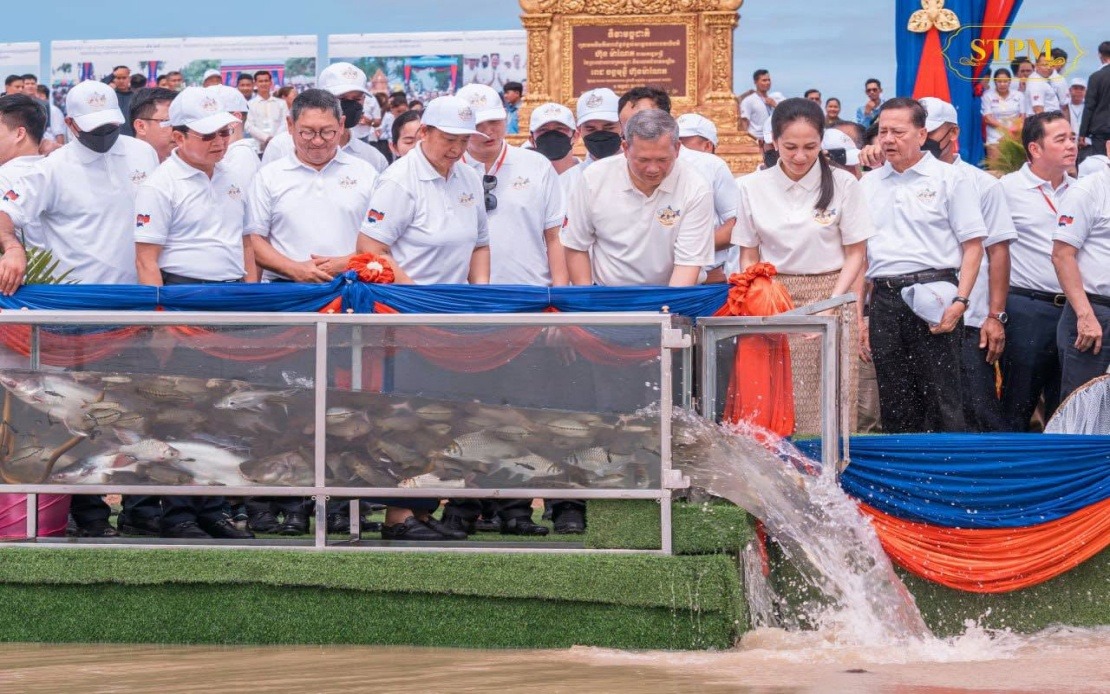
Cambodia's government has intensified its fight against illegal fishing activities, with Prime Minister Hun Manet directing local authorities to strengthen patrols in critical fish spawning zones across the kingdom. The directive came during National Fish Day celebrations in Svay Rieng Province, underscoring the government's commitment to preserving aquatic ecosystems that remain vital to millions of Cambodians dependent on the fishing industry for survival.
The challenge of protecting Cambodia's fisheries has proven complex, forcing the government to rely heavily on military deployment in the absence of adequate specialist law enforcement capacity. Hun Manet acknowledged this gap, explaining that army units stationed around Tonle Sap lake—Southeast Asia's largest freshwater body—have been mobilised over the past two years to tackle resource crimes both on land and water. Rather than expand military involvement further, the prime minister expressed a preference for developing civilian enforcement capabilities, recognising that long-term sustainability requires shifting away from military-dependent solutions toward professional regulatory frameworks.
The crackdown extends beyond simple fishing violations to target industrial-scale operations causing ecological damage. Large-scale clam dredging has emerged as a particularly destructive practice, systematically degrading fishing grounds and undermining the viability of small-scale operations that sustain rural communities. Hun Manet's order to cease such activities immediately signals a decisive shift toward protecting traditional fishing livelihoods against industrial encroachment—a pattern increasingly visible across Southeast Asia as governments balance economic development with resource preservation.
Cambodia's fisheries sector carries profound significance beyond economics. The government has articulated agriculture as the nation's foundational sector and fisheries as its primary protein source, positioning both as essential pillars of national food security. This characterisation reflects the reality that Cambodia's 17 million people remain heavily dependent on fish and aquatic products as their primary animal protein, with per capita fish consumption among the highest in the world. Disrupting this supply through unsustainable practices therefore threatens not merely incomes but broader nutritional security.
The timing of these enforcement measures during fish spawning seasons carries particular ecological importance. Many fish species migrate into shallow waters and spawning grounds during specific breeding periods, making them vulnerable to intensive harvesting. Protecting these seasons is scientifically recognised as essential for maintaining population levels and ensuring future productivity. Cambodia's approach mirrors international best practices, though implementation in a region with limited enforcement resources and porous maritime borders presents ongoing difficulties.
The release of 1.5 million fish and other aquatic species into the Vai Ko River at the Svay Rieng event demonstrates government efforts to actively rebuild fish stocks alongside enforcement activities. Such restocking programmes serve multiple purposes: they augment wild populations depleted by overfishing, provide tangible demonstration of state commitment to communities, and generate momentum for conservation initiatives. However, restocking alone cannot address systemic pressures from illegal fishing unless accompanied by genuine enforcement capacity.
Military involvement in resource protection reflects practical realities in many Southeast Asian nations where civilian agencies lack operational capacity or territorial reach. Yet this dependence creates complications, as armed forces typically lack environmental expertise and may prioritise border security over fisheries science. Hun Manet's acknowledgment of this limitation and stated desire to reduce military reliance suggests recognition that effective fisheries management requires professionalised environmental officers, scientific monitoring, and sustained funding rather than military-style command structures.
For regional observers, Cambodia's enforcement surge holds lessons about balancing food security with resource sustainability in densely populated Southeast Asia. As aquatic ecosystem degradation spreads across the region—driven by illegal fishing, pollution, and habitat loss—Cambodia's experience demonstrates both the necessity and difficulty of comprehensive protection measures. The kingdom's struggles mirror those in Thailand, Vietnam, and other neighbours managing competing pressures on shared water resources, including the Mekong River system upon which Cambodian fisheries fundamentally depend.
The effectiveness of these measures will ultimately depend on consistent implementation and adequate resource allocation. Enforcement orders without corresponding budget increases and personnel training often yield limited results, particularly in remote areas where illegal operators maintain strong local networks. Cambodia's shift toward civilian enforcement infrastructure, if adequately resourced, could establish a model for sustainable fisheries management in the region, though success remains contingent on political will extending beyond ceremonial announcements to sustained institutional commitment.
For Malaysian and broader Southeast Asian readers, Cambodia's fisheries protection initiative underscores the interconnected nature of regional aquatic resources and the shared vulnerabilities facing small-scale fishing communities across the peninsula and mainland zones. As industrial fishing operations intensify pressure on shared stocks, coordinated approaches to enforcement and resource management become increasingly necessary, raising questions about how effectively current regional mechanisms facilitate cooperation on transboundary fisheries issues.

