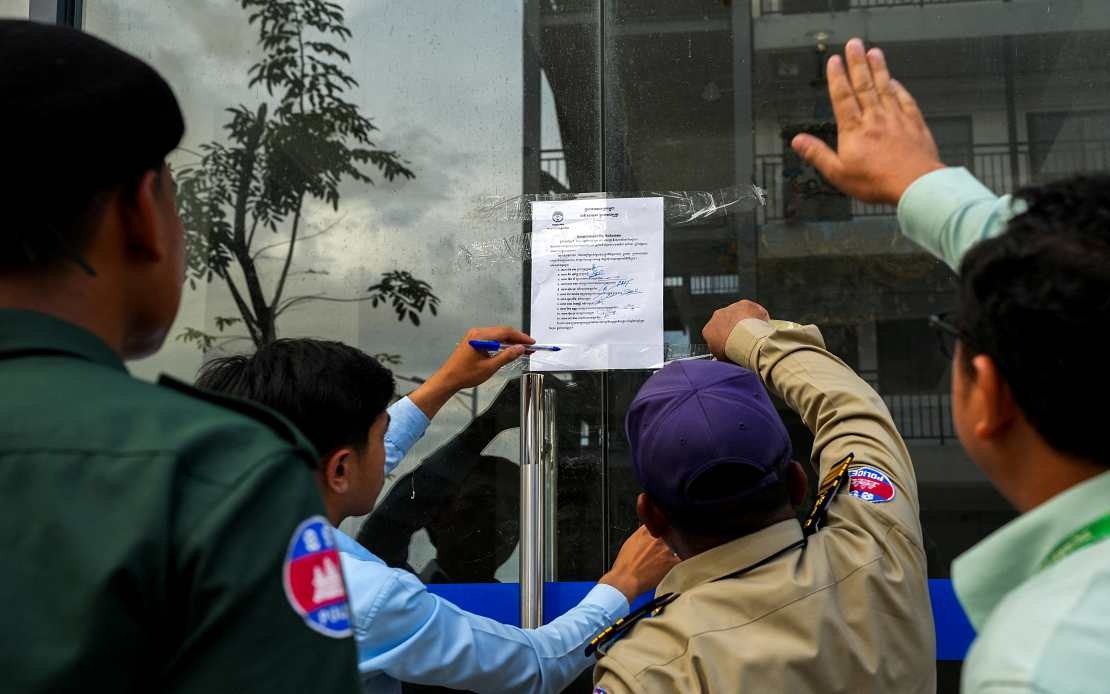
Cambodia has intensified its war against transnational cybercrime with the deportation of over 16,000 foreign nationals suspected of running online scam operations during the first half of 2026. The figure was disclosed by Police Lieutenant General Sok Veasna, who heads the General Department of Immigration, during a mid-year review meeting on Tuesday. The deportations represent a significant escalation in enforcement efforts that commenced in January this year, reflecting the government's determination to dismantle criminal networks exploiting Cambodia as a operational base.
The scale of Cambodia's immigration enforcement has expanded considerably beyond cybercrime cases alone. According to Sok Veasna, the country deported a total of over 45,000 foreign nationals during the six-month period, with cyber-scam suspects comprising roughly a third of that number. Importantly, all individuals removed from the kingdom face permanent exclusion from re-entering Cambodia, a provision designed to prevent repeat offences and signal that the government intends to maintain borders against organised crime elements.
Cambodia's crackdown reflects growing regional and international concern about sophisticated online fraud networks that have utilised Southeast Asian territories as operational hubs. These criminal enterprises target victims across the globe but have been particularly concentrated in certain jurisdictions within the region. The scale of Cambodia's problem became increasingly difficult to ignore as the country's international reputation suffered damage from association with these activities, prompting policymakers to take decisive action.
The government's legislative response demonstrates commitment beyond mere deportations. In April 2026, Cambodia enacted the Law on Combating Online Scams, which introduces substantially harsher penalties for senior operatives and kingpins involved in orchestrating fraud schemes. The legislation signals that authorities recognise the hierarchical nature of these criminal enterprises and are targeting not merely low-level participants but those directing operations from positions of authority.
Yet experts caution that while deportations and new legislation represent necessary steps, they address only the visible symptoms of deeper systemic problems. Thong Mengdavid, deputy director at the China-ASEAN Studies Centre of the Cambodia University of Technology and Science, acknowledged the importance of Cambodia's enforcement crackdown but characterised it as fundamentally temporary. According to Mengdavid, the country's deportation strategy, though welcome and overdue, cannot achieve lasting success without dismantling the underlying infrastructure enabling these operations to flourish.
The most critical vulnerability lies within Cambodia's own institutions. Mengdavid emphasises that high-level kingpins continue directing operations because they benefit from local protection networks—essentially corruption within government and law enforcement agencies that shields them from serious prosecution. Without addressing these protection networks, new suspects will simply replace deported individuals, perpetuating the cycle indefinitely. The expert assessment suggests that Cambodia faces a governance challenge as much as a law enforcement challenge.
Human trafficking components further complicate Cambodia's predicament. Many foreign nationals working in these scam operations have been coerced into participation through human trafficking schemes, meaning they occupy complex positions as both perpetrators and victims. Mengdavid argues that genuine progress requires Cambodia to address the trafficking dimension comprehensively, including rescue and rehabilitation of trafficked workers rather than simply removing them through deportation. This distinction matters significantly for long-term crime prevention and humanitarian considerations.
For Malaysian and regional observers, Cambodia's cyber-scam problem carries particular relevance. Criminal networks operating in Cambodia frequently target victims across Southeast Asia and beyond, meaning enforcement failures in one jurisdiction create security spillovers affecting neighbours. Malaysia has experienced incidents where citizens fell victim to scams operated from Cambodia, generating cross-border law enforcement coordination demands. Regional stability increasingly depends on countries like Cambodia successfully disrupting these networks rather than merely cycling operators through brief deportations.
The broader geopolitical context involves China's considerable concern about cyber-scam networks, as substantial victim populations within China have driven Beijing's diplomatic engagement with Cambodia on this issue. The China-ASEAN Studies Centre's involvement in analysing Cambodia's response reflects China's strategic interest in regional crime suppression. This international dimension influences Cambodia's commitment levels and resource allocation toward enforcement operations.
Looking forward, Cambodia faces the difficult task of sustaining enforcement momentum while implementing institutional reforms that address root causes. Deportations alone cannot succeed without simultaneous efforts to investigate and prosecute Cambodian officials and entrepreneurs facilitating these operations. International observers will monitor whether Cambodia moves beyond theatrical enforcement displays toward genuine structural reform. For Southeast Asia's collective security and the region's reputation in global financial systems, Cambodia's next steps matter considerably.

