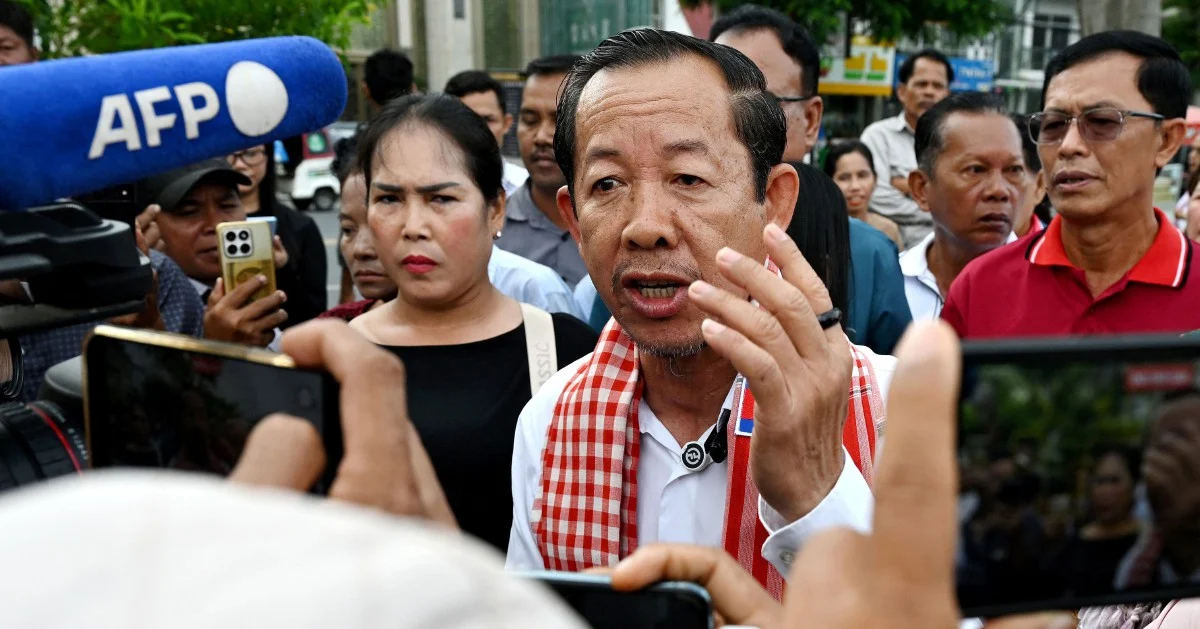
Cambodia's Supreme Court has suspended the prison sentence handed down to opposition figure Rong Chhun while maintaining a ban preventing him from standing for election, according to his legal representative. The decision, announced on Friday in Phnom Penh, represents a partial reprieve from the original conviction but leaves the core restriction intact, effectively barring the politician from formal electoral participation for a specified period.
The case against Rong Chhun reflects broader tensions within Cambodia's political landscape, where opposition voices face significant legal obstacles despite the country's formal democratic structures. The suspended sentence suggests judicial acknowledgment that aspects of the original conviction warranted reconsideration, yet the retained election prohibition underscores the persistence of institutional barriers to political competition. For a politician of Rong Chhun's stature and profile, the prohibition from candidacy represents a substantial constraint on his ability to influence the national political agenda through conventional electoral channels.
The suspended sentence mechanism in Cambodian law effectively places a conviction in abeyance without fully exonerating the individual. This approach allows authorities to maintain the legal judgement while offering a form of leniency by preventing immediate incarceration. For Rong Chhun, the suspension means he avoids prison but remains under the shadow of an active conviction that could be reinstated under specified circumstances, creating ongoing legal uncertainty that complicates his political trajectory.
The election ban carries profound implications for Cambodia's political opposition, which has faced escalating legal challenges over recent years. By maintaining restrictions on electoral candidacy while suspending custodial sentences, the court preserves a mechanism for sidelining prominent opposition voices without the international attention and criticism that would accompany incarceration. This approach has become increasingly common across several Southeast Asian jurisdictions, where legal systems are deployed to constrain opposition participation while maintaining superficial adherence to democratic procedures.
Rong Chhun's circumstances exemplify the precarious position of opposition politicians in Cambodia following the dramatic political upheavals of recent years. The judiciary's approach—partial leniency on imprisonment coupled with sustained electoral restrictions—suggests an attempt to balance domestic and international pressures. While suspending the sentence may reduce immediate criticism from rights groups and foreign governments concerned with mass incarceration of political figures, maintaining the election ban preserves state capacity to control electoral outcomes and prevent opposition consolidation.
The timing and nature of the court's decision warrant scrutiny regarding Cambodia's electoral preparation timeline. If elections are anticipated within the next several years, maintaining Rong Chhun's candidacy prohibition ensures he cannot mobilise supporters through formal campaigns or build institutional party strength through elected office. This temporal dimension transforms the election ban from a discrete legal penalty into an ongoing political management tool aligned with broader state interests in electoral dominance.
For Southeast Asian observers monitoring democratic trends, Cambodia's approach illustrates how legal systems can be instrumentalised to constrain opposition without resorting to the most visibly coercive methods. The strategy of suspending imprisonment while retaining electoral disqualification offers plausible deniability regarding political persecution—authorities can point to the sentence suspension as evidence of judicial restraint while the election ban quietly neutralises political threats. This differentiation between custodial and electoral penalties reflects sophisticated governance techniques that achieve restrictive outcomes through institutional mechanisms rather than crude force.
The broader context of this case includes Cambodia's historical trajectory under Prime Minister Hun Sen's administration, which has progressively consolidated state power while formally maintaining democratic institutions. Previous legal challenges to opposition figures have become sufficiently routine that the Supreme Court decision, despite its mixed nature, attracted less international outcry than earlier political prosecutions. This normalisation of constrained opposition participation within formal legal frameworks represents a concerning trend for democratic development across the region.
Rong Chhun's experience also highlights the vulnerability of opposition movements when individual leaders become the targets of sustained legal assault. By maintaining election bans on prominent figures, even while offering sentence suspensions, state authorities can degrade opposition capacity to organise, fundraise, and campaign without completely eliminating institutional opposition presence. The opposition thus exists in a constrained form that provides democratic legitimacy while limiting practical challenge to government authority.
The implications for regional democratic standards are notable, as Cambodia's approach provides a template that other Southeast Asian governments might adapt or refine. The specificity of combining suspended sentences with election disqualifications suggests deliberate judicial strategy rather than arbitrary application of law, indicating institutionalised mechanisms for opposition control within ostensibly rule-based systems. This distinction between formal legality and substantive democratic constraint merits careful attention from policymakers and civil society groups across the region.
International response to the court's decision will likely prove significant for assessing whether external pressure influences Cambodian judicial processes. Previously, international criticism has occasionally prompted government reconsideration of conviction severity, though electoral restrictions have proven more resistant to diplomatic pressure than imprisonment. The combination chosen by the Supreme Court—sentence suspension amid election ban maintenance—may represent a calculation that suspending imprisonment would satisfy international observers while the election prohibition would satisfy domestic political imperatives, thus positioning the decision as a strategic middle ground.

