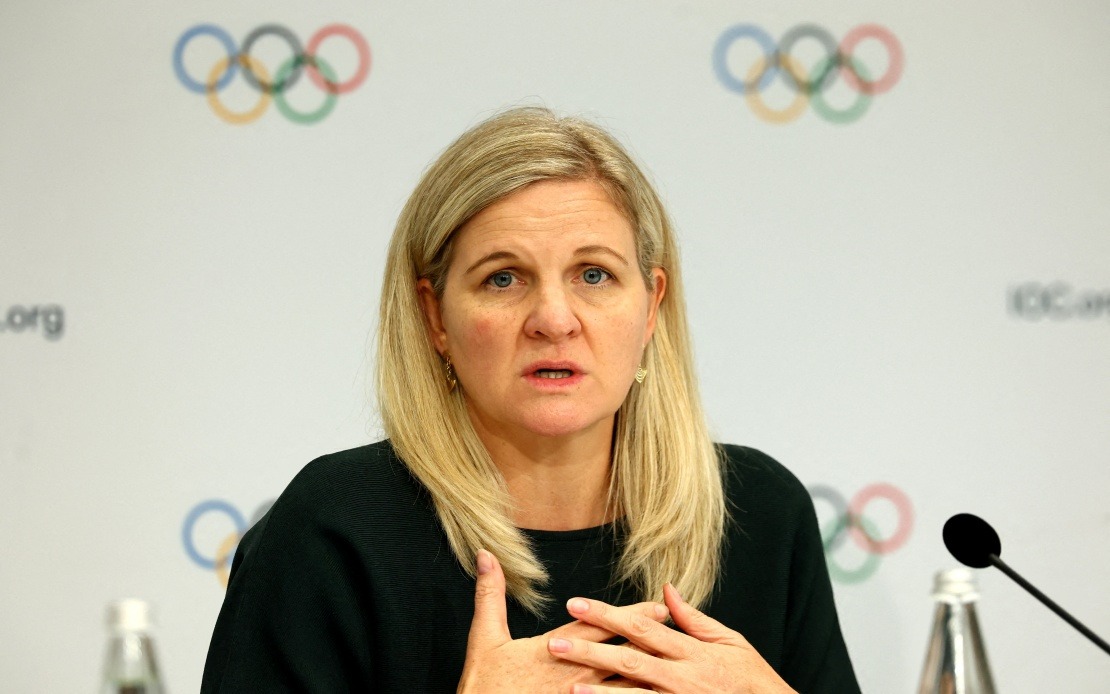
The International Olympic Committee has made clear it will not hesitate to invoke special legal machinery should United States President Donald Trump attempt to manipulate proceedings at the 2028 Los Angeles Olympic Games. IOC President Kirsty Coventry disclosed at a press conference in Moscow on Tuesday that the Court of Arbitration for Sport maintains dedicated divisions empowered to resolve disputes that may arise during the Olympic period, setting up a potential legal bulwark against political pressure.
Coverty's remarks come in the context of recent controversy surrounding Trump's alleged intervention in international sports governance. The reference point is Trump's public assertion that he had contacted FIFA following the sending-off of US national team player Folarin Balogun during World Cup qualifying matches. Trump subsequently praised FIFA for what he characterized as reversing an injustice, suggesting his communication had influenced the federation's decision-making process regarding the player's eligibility.
The incident involving Balogun illuminates broader concerns about executive interference in sporting matters. FIFA's disciplinary committee had initially suspended Balogun's red card, a decision that cleared the path for his participation in a Round of 16 encounter against Belgium. Even after Belgium formally protested the outcome, Balogun remained eligible to compete, though the Americans ultimately suffered a decisive 4-1 defeat in that match.
For Southeast Asian stakeholders and the broader international sports community, the IOC's preparedness to activate legal defences represents a significant safeguard. The establishment of these mechanisms reflects recognition that contemporary sports governance faces unprecedented pressures from political figures wielding soft power through informal channels. Malaysia and other nations with active Olympic participation should take note of how institutional safeguards are being constructed at the global level.
The Court of Arbitration for Sport operates through multiple structures designed to function during competitive periods. The ad hoc division, to which Coverty specifically referred, acts as a temporary tribunal staffed and equipped to hear cases in real time during Olympic competition. This arrangement ensures that disputes can be resolved swiftly without delaying games or competitions, a critical consideration given the compressed timeline of Olympic events.
The invocation of these legal frameworks would represent a significant departure from traditional Olympic governance, which has historically relied upon diplomatic protocols and informal negotiations to resolve conflicts between national governments and the IOC. Should Trump or any executive attempt to leverage his position to alter outcomes or eligibility determinations at Los Angeles 2028, the existence of this legal recourse signals that the Olympic movement possesses institutional countermeasures beyond the traditional realm of political negotiation.
Coverty's public articulation of this capability appears strategically designed to deter potential interference before it materializes. By making explicit the consequences and mechanisms for addressing violations of Olympic autonomy, the IOC leader has effectively drawn a line beyond which sporting governance will not bend to political pressure, regardless of the stature of the figure attempting to exert such influence.
The implications extend beyond a single nation's presidential influence. The framework Coverty described establishes precedent for how the Olympic movement will respond to governmental overreach in an era when the boundaries between sports and politics have become increasingly porous. For Malaysia, which regularly sends athletes to Olympic competitions and maintains diverse international sporting relationships, this institutional clarity serves the interests of fair competition and equal treatment.
Historically, the Olympic movement has sought to maintain formal distance from political interference, though in practice this separation has been more aspirational than absolute. The establishment of robust legal mechanisms to enforce this separation represents evolution in Olympic governance structures. The CAS ad hoc division becomes, in this context, not merely an administrative convenience but a guardian institution protecting the integrity of international competition from the intrusions of national power politics.
The Balogun incident, while seemingly isolated, exposes vulnerabilities in how international sports bodies respond to pressure from powerful governments. When FIFA's disciplinary decision appeared to shift following Trump's public statement, it raised questions about whether institutions possessed genuine independence or merely the appearance of autonomy. The IOC's proactive positioning suggests lessons have been absorbed regarding the necessity of transparent institutional defences against such pressures.
For athletes competing in 2028 Los Angeles, the existence of this legal framework theoretically ensures their eligibility determinations and competition outcomes rest upon sporting merit rather than geopolitical calculation. This matters profoundly for Southeast Asian competitors who travel to US-hosted events, as it provides assurance that decisions affecting their participation will be subject to objective sporting criteria and adjudication processes insulated from presidential preference.
Coverty's comments ultimately reflect the contemporary reality that Olympic autonomy requires active institutional defence. The IOC's willingness to articulate and deploy these mechanisms publicly signals resolve to maintain the sporting character of the Games regardless of political pressure. As the world anticipates Los Angeles 2028, this assertion of institutional authority provides a necessary counterweight to the gravitational pull of political influence in international sports governance.

