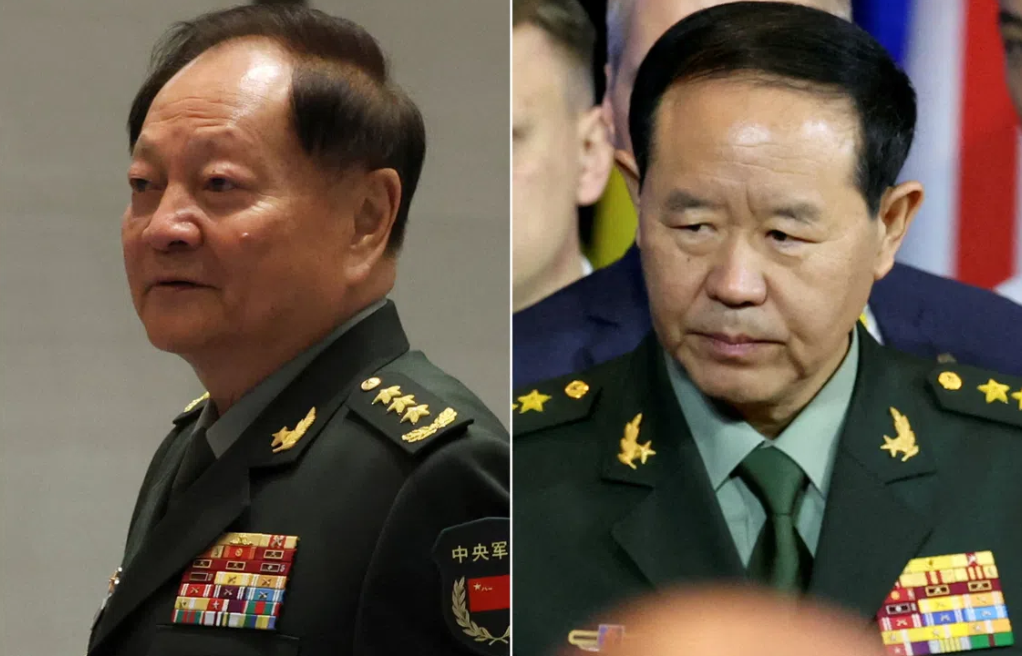
China has stripped two high-ranking military officers from the country's supreme defence institution, the Central Military Commission, following investigations into alleged serious disciplinary breaches and legal violations. The removals signal an intensification of the sweeping anti-corruption campaign that has reshaped the armed forces under President Xi Jinping over the past twelve years.
Zhang Youxia and Liu Zhenli, both prominent figures in China's military hierarchy, have been formally removed from the state-level Central Military Commission following an announcement by the Standing Committee of the National People's Congress on Friday. The departures leave the commission with just two active members in addition to Xi himself, marking a significant depletion of its operational cadre. This structural thinning underscores the scale and intensity of the ongoing personnel upheaval within China's defence establishment.
Zhang's removal represents particularly notable fallout, as he occupied the position of vice-chairman of the commission, effectively serving as second-in-command to Xi in military affairs. His standing extended beyond military ranks into the Communist Party's elite Politburo, where he held membership. Liu, meanwhile, served as a commission member and headed the Joint Staff Department, placing him at the operational centre of military command structures. Both men's removal from these positions signals that no rank or proximity to power provides immunity from the anti-corruption scrutiny that has become characteristic of Xi's tenure.
It bears noting that while the state Central Military Commission framework is where Friday's formal removals occurred, China's political system maintains a parallel structure through the Communist Party's own Central Military Commission. These institutions function as integrated entities despite their nominal separation. The timing and coordination of removals across both structures remain opaque, though observers note that Zhang and Liu have not yet been publicly or formally stripped of their Communist Party commission positions, suggesting the process may unfold in stages or face internal factional considerations.
The military has emerged as one of Xi's primary targets in his broader war on corruption since his assumption of supreme power in 2012. Xi's crusade has extended far beyond symbolic gestures, generating an extensive catalogue of investigations, dismissals, and prosecutions spanning more than a decade. Just last month, Xi convened senior Communist Party leaders specifically to emphasise the need for a more aggressive phase in the anti-corruption campaign focusing on defence sector vulnerabilities. This emphasis has coincided with fresh waves of military purges, suggesting the campaign is entering a new intensity rather than winding down.
The latest purge extends beyond the two principal figures, ensnaring additional officers and officials in the expanding dragnet. Lieutenant General Zhong Shaojun, who previously directed the General Office of the Central Military Commission, found himself stripped of his National People's Congress seat along with General Ju Qiansheng, a former commander of the Strategic Support Force. These removals indicate that investigations have branched across multiple military departments and command structures, suggesting either widespread problems or a systematic examination of institutional vulnerabilities.
Civilian officials connected to defence sectors have also fallen within the scope of investigations. Gao Shiwen, formerly serving as mayor of the southern city of Nanchang, has been caught up in the action. Shiwen's career trajectory included work at China Aerospace Science and Technology Corporation, a state-owned entity crucial to the country's space and defence capabilities. The inclusion of civilian defence sector officials alongside active military personnel suggests that the anti-corruption effort is casting a wide institutional net, targeting connections between military, aerospace, and civilian administrative structures.
Separately, China's Central Advisory Commission on Political and Legal Affairs recently moved to expel Zhao Zongqi from its membership ranks. Zhao's credentials include a significant operational background as commander of the Western Theatre Command, a military region overseeing China's border with India. His tenure encompassed the 2020 border clashes between Chinese and Indian forces in the Ladakh region, an episode that killed twenty Indian soldiers and left the incident's Chinese casualty figures shrouded in official opacity. Zhao's removal may reflect either personal accountability or broader changes in military leadership regarding border management strategies.
The ramifications of these removals extend beyond individual careers or internal military housekeeping. For Malaysia and the Southeast Asian region, the ongoing turbulence within China's military command structure carries strategic implications. The anti-corruption campaign has periodically affected defence procurement, military modernisation timelines, and command stability, potentially influencing Beijing's assertiveness in contested areas including the South China Sea. Military leadership uncertainty can trigger unpredictable behaviours as factions manoeuvre for advantage or institutional interests clash.
Moreover, the scale of the military purges raises questions about institutional effectiveness and morale within Chinese defence forces. When senior commanders face sudden removal and investigation, succession uncertainty can cascade through command hierarchies. This institutional stress may influence how China manages regional disputes, conducts military exercises, or responds to perceived provocations—factors that directly affect stability throughout Southeast Asia and the broader Indo-Pacific region.
The pattern established by these removals demonstrates Xi's willingness to sacrifice military stability in pursuit of centralised control and ideological conformity. The correlation between this campaign and Xi's consolidation of personal authority suggests that military loyalty has become prioritised over institutional expertise or seniority. This dynamic has potentially reshaped how China's military approaches strategic planning and regional engagement, elements that merit close regional monitoring.
As the anti-corruption campaign continues its trajectory through China's defence establishment, subsequent months may reveal whether these removals represent targeted strikes against specific officials or indicators of more systemic problems. The opacity surrounding investigation grounds and outcomes complicates external assessment, yet the visible removal of senior figures from command structures testifies to the depth of change underway within what remains one of Asia's most significant military forces.

