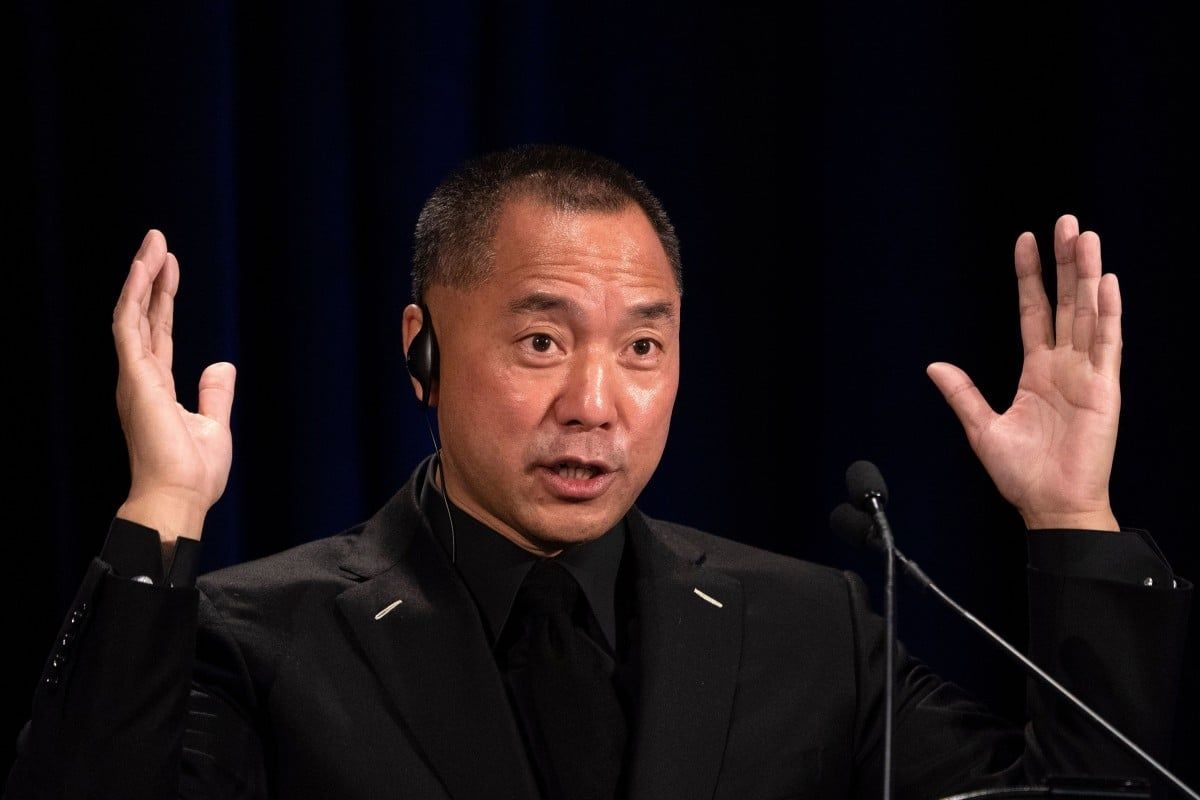
A self-exiled Chinese billionaire who repositioned himself as a pro-democracy activist and vocal critic of Beijing's Communist Party has been handed a 30-year prison sentence after a federal judge found him guilty of orchestrating a sprawling financial fraud that devastated over 1,000 investors globally. Judge Analisa Torres delivered the sentence in Manhattan on Monday, June 30, concluding that Guo Wengui systematically exploited vulnerable individuals seeking political change in China, siphoning their savings to fuel an extraordinarily extravagant lifestyle. The conviction marks a dramatic fall from prominence for a man who once counted among China's most wealthy entrepreneurs and who cultivated close ties to prominent American political figures during his decade-long exile in the United States.
Guo, who also operates under the aliases Miles Guo and Ho Wan Kwok, departed China in 2014 and subsequently established himself as a vocal dissident, eventually settling in New York in 2017 where he occupied a luxury apartment overlooking Central Park. Before his arrest and detention without bail three years ago, he had grown sufficiently close to conservative strategist Steve Bannon that the two announced plans in 2020 to mount an initiative aimed at overthrowing the Chinese government. His American connections expanded further when he gained membership at President Donald Trump's Mar-a-Lago golf club in Florida, cementing his position within certain circles of American political and business leadership. However, this ascendancy in the United States concealed an elaborate deception that prosecutors argued reflected extraordinary cynicism and calculated predation.
Torres emphasized in her ruling that Guo demonstrated complete disregard for his victims' devastation, reading aloud excerpts from letters submitted by those who had lost their life savings and experienced severe psychological distress, shame, and familial rupture resulting from their investment decisions. Wei Chen, one of the victims who testified during the trial, told the judge that Guo's fraudulent scheme had fundamentally destroyed her life and that of her entire family. The judge further noted that Guo had not merely avoided accepting responsibility but had actively encouraged his supporters to harass and intimidate those bold enough to speak publicly against him, revealing a pattern of behaviour extending well beyond financial deception into the realm of witness intimidation.
Prosecutors documented that between 2018 and 2023, Guo orchestrated what they characterised as an astonishing financial crime, convincing hundreds of thousands of individuals to invest over one billion dollars across multiple entities under his control. These vehicles included GTV Media Group Inc., his media company, as well as entities operating under the Himalaya Farm Alliance and Himalaya Exchange brands. The fraudulent proceeds underwrote a lifestyle of staggering excess featuring multiple mansions, yachts, luxury automobiles, designer apparel, and bespoke furnishings. Prosecutors argued that his conduct, which he himself failed to acknowledge as wrongdoing, had created a landscape of devastation affecting thousands of people across multiple continents.
Guo was convicted on nine of twelve criminal charges following a seven-week trial that unveiled the mechanics of his deceptive operation targeting thousands of investors in fabricated business opportunities. The conviction underscores how diaspora networks and ideological appeal can be weaponised for financial exploitation, particularly when victims are motivated by political conviction and seek to support causes they believe will advance democratic change. Judge Torres imposed a restitution order requiring Guo to forfeit eight hundred and eighty-nine million dollars, though the likelihood of victims recovering substantial portions of their losses remains uncertain given the complexity of asset recovery in international cases.
During the sentencing hearing, Guo presented himself as physically infirm, claiming he had been hospitalised earlier that Monday morning and disputing prosecutors' characterisation of him as malingering. He repeatedly wiped his mouth with tissues whilst asserting that his gastrointestinal distress was genuine rather than performative. When finally addressing the criminal charges directly, Guo offered minimal substantive response, instead defending his intentions by emphasising that he had moved to the United States specifically to oppose the Chinese Communist Party. This limited acknowledgment of the actual allegations against him typified what prosecutors and the judge alike identified as his complete unwillingness to reckon with the human consequences of his actions.
Guo's defence team had requested judicial leniency, arguing that he was fundamentally the victim of persecution by the Chinese Communist Party rather than a perpetrator of financial crime. They presented evidence that Guo bore physical scars and disfigurements from torture he allegedly endured in China between 1993 and 2022, requiring multiple surgical interventions to repair the damage. His lawyers contended that Chinese government officials had deliberately targeted him after he publicly exposed their corruption, forcing him to seek refuge first in Hong Kong, then London, and finally New York. They argued that a lengthy prison sentence would validate Beijing's campaign against him and potentially embolden further efforts to eliminate Chinese dissidents from American public life, whilst noting that comparable defendants in similar cases typically received sentences ranging from two to four years.
The defence further argued that Guo's substantial wealth initially derived from his family's position as the largest shareholder of China's foremost publicly traded securities company, before he became a target after revealing official corruption. Chinese authorities have consistently sought his extradition, accusing him of rape, kidnapping, bribery, and additional offences, though Guo has systematically denied these allegations as politically motivated persecution. When China's Ministry of Foreign Affairs responded to the American sentencing, officials noted that Guo remains wanted by Beijing and carries an Interpol Red Notice, which functions as a global request to law enforcement agencies to apprehend him pending potential extradition proceedings.
For Malaysian and Southeast Asian observers, this case illustrates broader vulnerabilities within liberal democracies regarding diaspora communities and the exploitation of ideological commitment for financial gain. The Guo Wengui case demonstrates how individuals fleeing authoritarian regimes can leverage political credentials and appeals to democratic values to build trust networks that become vehicles for sophisticated fraud. Furthermore, it raises important questions about the regulatory gaps and immigration frameworks that permitted him to operate with such minimal scrutiny for extended periods. The case also underscores the enduring influence of pro-democracy narratives and anti-China sentiment in attracting investment capital from sympathetic diaspora communities, particularly among Chinese nationals and ethnic Chinese populations throughout Asia who view contributions to anti-Communist initiatives as politically meaningful acts.
The sentencing carries significant implications for how Western nations balance concerns about political persecution and asylum principles against the necessity of prosecuting financial crimes. Guo's defence argument that a harsh sentence would validate Beijing's narrative resonates within broader debates about supporting Chinese dissidents, yet the extensive documentation of his fraudulent conduct presents compelling evidence that political opposition credentials cannot excuse systematic wealth extraction. The case may prompt greater scrutiny of how exiled activists and dissidents are vetted before gaining access to significant financial networks and political circles. For Malaysia and other Southeast Asian nations with substantial Chinese diaspora populations, the Guo Wengui conviction offers cautionary lessons regarding how appeals to ideological solidarity and democratic struggle can mask fundamentally exploitative financial schemes targeting vulnerable communities seeking meaningful engagement with political causes.

