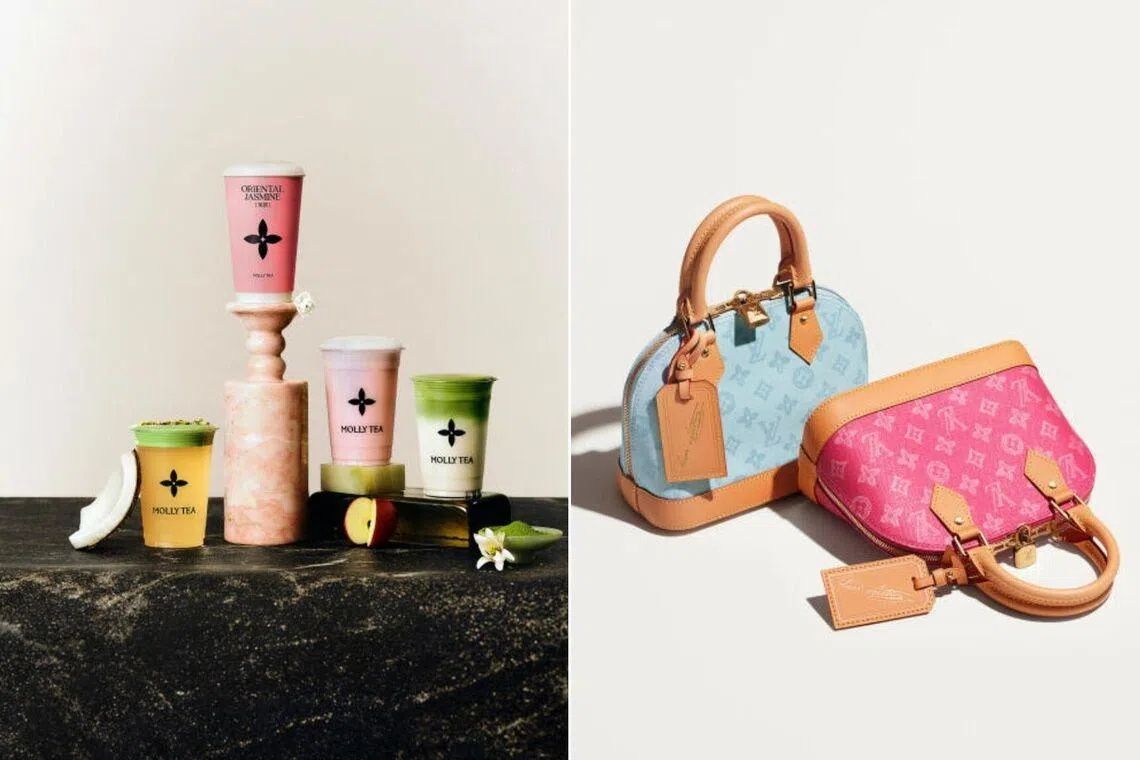
The Suzhou Intermediate People's Court in Jiangsu province has ruled that Molly Tea, a Shenzhen-based milk tea company, violated Louis Vuitton's intellectual property rights by using a four-petal flower design that closely resembles the French luxury giant's iconic monogram. The court's decision on June 29 requires the Chinese company to cease the infringement immediately, pay 10.3 million yuan (US$1.5 million) in compensation, and publish a public apology. The ruling has ignited considerable discussion on Chinese social media, with the dispute becoming a focal point for conversations about trademark protection, cultural appropriation, and the boundaries of intellectual property law in a rapidly commercialising consumer market.
Molly Tea's legal troubles began when Louis Vuitton initiated a lawsuit against the company in May 2025, challenging the similarity between its brand emblem and the French brand's trademarked designs. The case centred on seven of Louis Vuitton's registered four-petal flower graphic trademarks, which the company has used for decades as a core element of its global brand identity. Both Molly Tea itself and one of its franchise stores in Wuzhong district were named as defendants, highlighting how the company's trademark strategy extended across multiple operating entities. The swift decision by the court underscores the growing seriousness with which Chinese courts treat trademark infringement cases, particularly when established brands with significant market recognition are involved.
Since March 2024, Molly Tea had pursued an aggressive trademark registration strategy, filing multiple applications with the China National Intellectual Property Administration featuring floral designs. These filings covered a broad range of service categories including restaurant and accommodation services, advertising, and convenience foods. The company's intent appeared to be building a comprehensive brand portfolio around the flower motif. However, the overwhelming majority of these applications faced rejection from Chinese intellectual property authorities, with only the trademark specifically incorporating the Chinese characters for "Molly Tea" achieving successful registration. This pattern of rejections should have signalled to the company that its floral designs presented substantial similarity risks, yet the company proceeded with commercial use of the contested emblem.
The case has triggered widespread public engagement on Chinese digital platforms, with remarkable reach and visibility. A hashtag regarding Louis Vuitton's lawsuit against Molly Tea accumulated over 360 million views within days of the verdict becoming public knowledge. A related hashtag discussing the invalidation of Molly Tea's trademark garnered an additional 18.7 million reads. This level of online discussion reflects broader public interest in how intellectual property law operates in China and how local companies navigate the regulatory landscape. The engagement also suggests that Chinese consumers and internet users take trademark disputes seriously, viewing them as indicators of fair competition and market integrity.
Public opinion on the matter has fragmented into several competing narratives. Some observers acknowledge the visual similarity between Molly Tea's four-petal flower and Louis Vuitton's monogram, accepting that the similarity could indeed cause consumer confusion. Others contend that the designs possess sufficient visual differences and that the two companies operate in fundamentally different market segments—luxury fashion versus casual food and beverage—meaning confusion is unlikely. A third cohort of online commentators has questioned the originality of Louis Vuitton's signature pattern itself, advancing the argument that the French house may have drawn inspiration from traditional Chinese cultural motifs and floral symbolism. This line of reasoning raises the deeper question of whether any single commercial entity should hold monopolistic rights over centuries-old aesthetic traditions.
Kang Lixia, a partner at Beijing Standzer IP Firm, has offered expert perspective on the legal framework underpinning the court's decision. She explains that both parties maintain the right to appeal to a higher court, and the success of such an appeal would depend substantially on whether the appellant can present persuasive evidence of originality and distinctiveness in its own design. Kang emphasises a crucial distinction in Chinese trademark law: traditional floral patterns and motifs embedded in Chinese cultural heritage constitute part of the public domain and theoretically remain available for commercial use by any party. However, this principle collides with another fundamental doctrine in Chinese trademark law—the "first to file" principle, which grants trademark rights to the earliest applicant when multiple parties seek to register identical or similar marks for identical or similar goods.
The interplay between cultural heritage rights and commercial trademark protection creates the core tension in this dispute. When Louis Vuitton registered its four-petal flower design as a trademark decades ago, the company secured legal rights that extend beyond the specific product category in which it operates. Under cross-class protection provisions within Chinese trademark law, a highly recognised and earlier-registered mark like Louis Vuitton's can claim protection across unrelated product categories, effectively preventing later applicants from using similar designs even in entirely different industries. This creates a significant competitive disadvantage for later market entrants who might wish to incorporate traditional cultural elements into their branding. Kang notes that while Molly Tea and Louis Vuitton technically operate within different trademark classes, Louis Vuitton's status as an earlier-registered mark with substantial brand recognition entitles it to this expanded protection.
Liu Bin, an intellectual property lawyer from Beijing Zhongwen Law Firm, advocates for a more nuanced approach to resolving such disputes. He emphasises that trademark law does not require the disputed sign to be identical to a registered trademark for infringement to occur; rather, the determinative question centres on whether consumers are likely to experience confusion. This consumer confusion standard has become central to modern trademark jurisprudence globally, and Chinese courts increasingly apply this lens when evaluating similarity. Liu observes that public confusion on this matter stems from uncertainty about how traditional Chinese cultural patterns should be managed—whether they should remain perpetually available as shared cultural heritage or whether companies can claim proprietary rights once they deploy these elements in commercial contexts. Many members of the public instinctively believe that common cultural motifs should never be subject to exclusive control by any single entity.
Yet Liu articulates an important counterpoint that bridges both perspectives: intellectual property protection for figurative marks fundamentally protects the brand recognition that companies have painstakingly built through commercial investment and consumer engagement, not the cultural elements themselves. When Louis Vuitton uses its four-petal flower design, it does so as part of a holistic luxury brand experience that conveys specific messages about quality, exclusivity, and heritage to consumers worldwide. Similarly, when Molly Tea employs a floral design, it attempts to build its own brand recognition and market position. The law's concern emerges when the later use could dilute the earlier mark's distinctiveness or confuse consumers about the source of goods. Liu stresses that traditional Chinese cultural elements should indeed remain available for broader use and cultural continuity, but commercial trademarks incorporating these elements must not mirror or closely approximate earlier-registered brands.
The Molly Tea case illuminates a tension increasingly visible across Asian consumer markets as local companies grow in sophistication and seek to build distinctive brand identities. For Malaysian and Southeast Asian businesses, the verdict carries instructive implications. Companies operating across borders or seeking to expand regionally must conduct thorough trademark searches and freedom-to-operate analyses before commercialising new brand identities. The case demonstrates that cultural authenticity—the desire to incorporate heritage elements into branding—cannot serve as a legal justification for trademark infringement. Southeast Asian entrepreneurs would be wise to work with intellectual property counsel to develop original brand expressions that leverage cultural heritage without replicating earlier-registered marks, particularly those associated with globally recognised luxury brands that enjoy cross-class protection.
Molly Tea has confirmed its intention to appeal the court's decision to a higher court, signalling that the dispute will not conclude with this ruling. The appeal process will provide an opportunity for the company to present evidence regarding design distinctiveness and the public domain status of floral motifs. If successful, an appeal could reshape how Chinese courts balance cultural heritage protection against commercial trademark rights. Alternatively, if the higher court upholds the judgment, the decision will reinforce that global brands can effectively protect their intellectual property even against culturally-rooted designs in emerging market economies. The case will likely influence how other Chinese companies approach trademark strategy going forward, encouraging greater investment in original design development rather than adaptation of traditional motifs that risk collision with established marks.

